Tuesday, November 04, 2014

Sarah laughed with her relatives

Here is an interesting Torah Temimah on Vayera:


The pasuk is Bereishit 18:12:

וַתִּצְחַ֥ק שָׂרָ֖ה בְּקִרְבָּ֣הּ לֵאמֹ֑ר אַֽחֲרֵ֤י בְלֹתִי֙ הָֽיְתָה־לִּ֣י עֶדְנָ֔ה וַֽאדֹנִ֖י זָקֵֽן׃

"And Sarah laughed within herself, saying: 'After I am waxed old shall I have pleasure, my lord being old also?'"

Interestingly, the Targum Onkelos on this is

וְחַיֵּיכַת שָׂרָה, בִּמְעַהָא לְמֵימַר:  בָּתַר דְּסֵיבִית תְּהֵי לִי עוּלֵימוּ, וְרִבּוֹנִי סִיב. 

The word בִּמְעַהָא, in her innards, can be quite literal and anatomical. Maybe she is laughing about her innards, about the state of her womb. Compare to parashat Toledot, where it translates both the Hebrew bikirbah (as here), and means womb:
כה,כב וַיִּתְרֹצְצוּ הַבָּנִים, בְּקִרְבָּהּ, וַתֹּאמֶר אִם-כֵּן, לָמָּה זֶּה אָנֹכִי; וַתֵּלֶךְ, לִדְרֹשׁ אֶת-ה.וְדָחֲקִין בְּנַיָּא, בִּמְעַהָא, וַאֲמַרַת אִם כֵּין, לְמָא דְּנָן אֲנָא; וַאֲזַלַת, לְמִתְבַּע אֻלְפָן מִן קֳדָם יְיָ.
as well as a few pesukim later where it serves as a translation for bivitnah:

כה,כד וַיִּמְלְאוּ יָמֶיהָ, לָלֶדֶת; וְהִנֵּה תוֹמִם, בְּבִטְנָהּ.וּשְׁלִימוּ יוֹמַהָא, לְמֵילַד; וְהָא תְּיוֹמִין, בִּמְעַהָא.

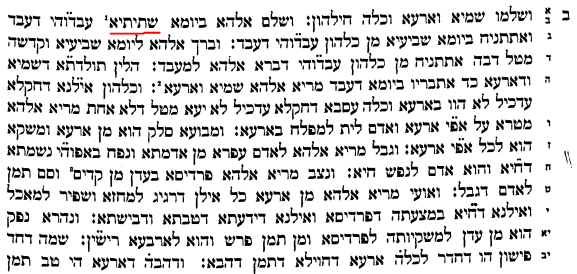
At any rate, Torah Temimah directs our attention to a gemara in Megillah 9a, where Ptolemy compelled 70 Jewish Sages to translate the Torah to Greek:
מעשה בתלמי המלך שכינס שבעים ושנים זקנים והכניסן בשבעים ושנים בתים ולא גילה להם על מה כינסן ונכנס אצל כל אחד ואחד ואמר להם כתבו לי תורת משה רבכם נתן הקב"ה בלב כל אחד ואחד עצה והסכימו כולן לדעת אחת וכתבו לו (בראשית א, כז) אלהים ברא בראשית (בראשית א, א) אעשה אדם בצלם ובדמות (בראשית א, כו) ויכל ביום הששי וישבות ביום השביעי (בראשית ה, ב) זכר ונקבה בראו ולא כתבו בראם (בראשית יא, ז) הבה ארדה ואבלה שם שפתם (בראשית יח, יב) ותצחק שרה בקרוביה (בראשית מט, ו) כי באפם הרגו שור וברצונם עקרו אבוס (שמות ד, כ) ויקח משה את אשתו ואת בניו וירכיבם על נושא בני אדם (שמות יב, מ) ומושב בני ישראל אשר ישבו במצרים ובשאר ארצות ארבע מאות שנה (שמות כד, ה) וישלח את זאטוטי בני ישראל (שמות כד, יא) ואל זאטוטי בני ישראל לא שלח ידו (במדבר טז, טו) לא חמוד אחד מהם נשאתי (דברים ד, יט) אשר חלק ה' אלהיך אתם להאיר לכל העמים (דברים יז, ג) וילך ויעבוד אלהים אחרים אשר לא צויתי לעובדם וכתבו לו את צעירת הרגלים ולא כתבו לו (ויקרא יא, ו) את הארנבת מפני שאשתו של תלמי ארנבת שמה שלא יאמר שחקו בי היהודים והטילו שם אשתי בתורה:
Within this list is ותצחק שרה בקרוביה, that she laughed with her relatives. This looks like a slight misspelling of בקרבה, just as לא חמוד אחד מהם נשאתי (a desirous thing, rather than donkey) looks like a slight misspelling of לא חמור אחד מהם נשאתי, yet is, according to this midrash, a deliberate change, even as the target translation was Greek, where such close spellings seem irrelevant. I would point out that ואמר להם כתבו לי תורת משה רבכם does not imply any translation. Perhaps Ptolemy was demanding a mere transcription of the Hebrew text, rather than a translation?

Rashi on Megillah 9a explains the reasoning for this change, regarding Sarah laughing, as follows:

בקרוביה - שלא יאמר על אברהם לא הקפיד דכתיב ויצחק ועל שרה הקפיד לפיכך כתבו בקרוביה לומר אברהם בלבו והיא אמרה בקרוביה:
"That he should not say that about Avraham He was not strict, as is written [Bereishit 17:17 when Avraham fell on his face and laughed on hearing the news, in Lech Lecha] 'he laughed', while upon Sarah he was strict. Therefore they wrote בקרוביה, to say that Avraham was [laughing] in his heart while she said it among her relatives. [And therefore He was strict..]"

After citing Rashi, Torah Temimah continues:
"And if not for his words, once could suggest that they [the elders] changed this language because, in truth, it is difficult. For since she laughed internally, why should the verse state at all that she laughed? And in truth, in Midrash Rabba [?? I don't see it there], they sensed this, and said that with ruach hakodesh he [the malach?] knew that she laughed. And therefore they worried that Ptolmey would ask how they knew that, and the derasha of the Midrash Rabba that it was known via ruach hakodesh he would not have accepted. Therefore they wrote for him בקרוביה, such that she laughed in public..."
Interestingly enough, in what we call the Septuagint today, many of these emendations are missing. The change of חמוד for חמור is there, as I discuss in a different parshablog post. But here is what we have on this pasuk in Vayera:

12 And Sarrha laughed in herself, saying, The thing has not as yet happened to me, even until now, and my lord is old.

12 ἐγέλασεν δὲ Σαρρα ἐν ἑαυτῇ λέγουσα Οὔπω μέν μοι γέγονεν ἕως τοῦ νῦν, ὁ δὲ κύριός μου πρεσβύτερος.

So the change is missing.

Wednesday, October 22, 2014

Did Hashem finish Creation on the sixth or the seventh?

Chazal noted the anomaly in Hashem finishing Creation on the seventh day, when there was no described work performed on that day. As Rashi writes, channeling Bereishit Rabba:

And God completed on the seventh day His work that He did, and He abstained on the seventh day from all His work that He did.ב. וַיְכַל אֱלֹהִים בַּיּוֹם הַשְּׁבִיעִי מְלַאכְתּוֹ אֲשֶׁר עָשָׂה וַיִּשְׁבֹּת בַּיּוֹם הַשְּׁבִיעִי מִכָּל מְלַאכְתּוֹ אֲשֶׁר עָשָׂה:
And God completed on the seventh day: Rabbi Shimon said: [A human being of] flesh and blood, who cannot [exactly] know his times and his moments, must add from the profane to the holy [i.e., he must add some time to the Sabbath.] The Holy One, blessed be He, Who knows His times and His moments [exactly], entered it [the Sabbath] within a hairbreadth, and it therefore appeared as if He completed it [His work] on that day. Another explanation: What was the world lacking? Rest. The Sabbath came, and so came rest. The work was completed and finished. — [from Gen. Rabbah 10:9]ויכל אלהים ביום השביעי: רבי שמעון אומר בשר ודם שאינו יודע עתיו ורגעיו צריך להוסיף מחול על הקודש, הקב"ה שיודע עתיו ורגעיו נכנס בו כחוט השערה ונראה כאלו כלה בו ביום. דבר אחר מה היה העולם חסר, מנוחה, באת שבת באת מנוחה, כלתה ונגמרה המלאכה:

That is a midrashic take on the textual anomaly. A peshat explanation might be something along the lines of that the work, and the world, was declared finished on that day, since there was no more to be created on that day. (This is something like Rashi's second explanation.) Or it is a pluperfect, or past perfect, that it had been completed. (Simple perfect: he walked. Pluperfect: he had walked.) Or else וַיְכַל has some alternate sense of stoppage.

In Vetus Testamentum, we find that the Samaritans have an interesting variant text for Bereishit 2:2. The Masoretic text is on the right, and differences in the Samaritan text are on the left:


Thus, the Samaritans state that Elokim finished on the sixth day the work that he did, and rested on the seventh day.

The same appears in the Septuagint:
2 καὶ συνετέλεσεν ὁ θεὸς ἐν τῇ ἡμέρᾳ τῇ ἕκτῃ τὰ ἔργα αὐτοῦ, ἃ ἐποίησεν, καὶ κατέπαυσεν τῇ ἡμέρᾳ τῇ ἑβδόμῃ ἀπὸ πάντων τῶν ἔργων αὐτοῦ, ὧν ἐποίησεν.
2 And God finished on the sixth day his works which he made, and he ceased on the seventh day from all his works which he made. 
In the sectarian work, the pseudepigraphic Book of Jubilees, 2:16, we see a similar idea expressed:
  1. And He finished all his work on the sixth day - all that is in the heavens and on the earth, and in the seas and in the abysses, and in the light and in the darkness, and in everything.
[Update: HT AryehS.

Also, the Peshitta, a Syriac translation, has the sixth day:


]

However, we should treat this variant with caution, because it is just too perfect. Rabbi Shmuel David Luzzatto (Shadal), in his commentary on this verse, schools us in the idea of lectio difficilior, the rule of the more difficult word being the more likely original, particularly as it pertains to the Samaritan text. (The idea, as I would explain it, is that if a word choice is in truth justifiable, but it seems difficult to the average reader, then that is the more likely original reading, because a scribe will illegitimately emend the text towards the easier reading. When and where to apply this rule requires a careful, judicious approach.)

Shadal writes:


"וַיְכַל אֱלֹהִים -- This is connected with the end of the pasuk -- since on the seventh day all His work had already finished (kila), therefore He rested on the seventh day.

And behold, וַיְכַל is a past tense verb that was already completed [=pluperfect, see above], and there are many like it.

And in the Targum attributed to the 70 [Jewish] elders [the Septuagint], and so too in the sefer Torah of the Cutheans [Samaritans] it is written 'on the sixth day'.  And Clericus already saw that this is nothing but an emendation and a scribal 'fixing', and this is as they said in the Talmud (Megillah 9a) [regarding the idea that the 70 elders made 'fixes' to the text so that the non-Jewish reader would not get confused]. For behold, if it was such that it was written initially 'and God [had] completed on the sixth day', there is no reason it would enter a person's mind to emend [the text to read] ויכל בשביעי. And conversely, if it was initially written בשביעי, it it quite understandable that this language would be difficult to the masses, and they [the authors of Septuagint, and perhaps he intends Samaritans as well] arose and emended it to בששי. And this is an important principle about the matter of variants which are found in the book of the Cutheans [Samaritans], that all the emendations which their scholars emended was due to the smallness and lightness of their understanding and thoughts. And this is as the scholar [Wilhelm] Gesenius explained, with good discernment and knowledge, in his book De Pentateuchi Samaritani origine et indole et auctoritate, Halae 1815. Also the scholar [Johannes Bernardus / Giovanni Battista de Rossi] De-Rossi, though at times is seduced towards the Samaritan nusach, and he doesn't understand all that Gesenius understood, still already wrote, as a general matter, like these words, saying:
Quaelibet lingua et aetas suas habet anomalias et enallages; nec omnes nec semper grammatice scripserunt sacri auctores. Unde non temere rejicienda lectio anomala. Immo anomala lectio plerumque verior. Facillimum namque est anomalis analoga a scribis substitui, analogis anamola difficillimum (Variae lectiones, Vol I. Proleg. par II, §§ 38, 39).
[Josh: My rough translation:] Every age has its own language and anomalies and alteration; nor are all nor is it always the scholar who wrote, of the sacred authors. Hence one should not rashly reject an anomalous reading. Indeed, the anomalous choice is generally truer. It is very easy for scribes to replace an anomalous reading [with an easier one], but substituting an anomalous reading is more difficult."
End quote from Shadal.

(The page from De Rossi's work, Variae Lectiones Veteris Testamenti: Ex Immensa Mss. Editorumque, here:

)

I will, however, present a counterargument. It is true that, as a matter of deliberate scribal emendation, because the scribe (falsely) believed there was an error in the text in need of correction, or because the scribe saw his role as "improving" the clarity of the text, this application of lectio difficilior makes sense.

However, we might also consider the possibility of accidental scribal emendation. Recall that השישי and השביעי begin with the same two letters, הש. So if we were to posit that הששי were original, a scribe might have been copying ביום הששי and lost track after writing ביום הש. Then, "dittography" comes into play. This is the accidental repetition of a letter, syllable, word, or phrase. Realize that ביום השביעי occurs legitimately two times following, first at the end of this pasuk, וַיִּשְׁבֹּת בַּיּוֹם הַשְּׁבִיעִי, and next, without the leading ב in the next pasuk, וַיְבָרֶךְ אֱלֹהִים אֶת יוֹם הַשְּׁבִיעִי. If so, perhaps the scribe accidentally duplicated ביום השביעי here, and that error served as the basis for our masoretic text. (Though note one could argue in the opposite direction, that this is dittography due to יום הששי of the two pesukim earlier.)

Despite this vector of accidental scribal emendation, the fact that the Samaritan text has it makes me strongly suspect that this is a deliberate scribal emendation to make the text read more cleanly. This is indeed characteristic of the Samaritan text. And then, just as we see some midrashim relying on the "easier" Samaritan text of certain pesukim, presumably spread in vulgar (non-checked) texts, this Hebrew version of the pasuk stood as the basis for the Greek translation in the Septuagint.

[Update: Regarding the Peshitta, here is what Rabbi Chaim Heller has to say:
"Footnote 1) See what I wrote in this in my essay on the Targum Yerushlami on the Torah (page 13). Yet it is quite possible that the basis of this variant came about via error, that the copying scribe erred and switched the word השביעי with the word הששי which was written above, close by, and he copied it here. See the introduction, note 3. " 
In that introduction, note 3, where he discusses transcription error and transferring text from related matters close by.

In his sefer, Al HaTargum Hayerushalmi LaTorah, Rabbi Heller writes as follows:


]

Wednesday, October 15, 2014

Posts so far for parshat Bereishit


2014

1. Minchas Shai introduces us to Ben Asher and Ben Naftali, who have their very first difference on Bereishit 1:3. Plus, why he calls the munach a galgal.

2. At Girsology, an attempt at a Mikraot Gedolot Chadashot. Link goes to Bereishit 1:1, but just change the last number. At the time of this writing, it goes to Bereishit 1:6, but hope to have the first perek up in its entirety soon.

2013

1. Did Saadia Gaon have a masorah on shafan as al-wabr? According to Ibn Ezra, Saadia Gaon sometimes made things up, for the honor of Torah. Even so...

2. Ish and Isha, and dikduk. The derivation given in the Torah for Isha seems to contradict the grammatical analysis...


2012

1. Bereishit sources, 2012 edition. I've added biographical information to many of the meforshim, as well as images and discussions of their general approach. Also, sorted now in chronological order, so you can look at Geonim, Rishonim, 19th century Acharonim, and so on.

2. Running commentary on parashat Bereishit, part one.

3. YUTorah on parshat Bereishit

4. Is evolution and an old earth mentioned in Chagiga? I don't think so.


2011
  1. All the king's horse -- on a post on Beshalach, I write:
    Even though Rashi to Bereishit 3:8 says "ואני לא באתי אלא לפשוטו של מקרא ולאגדה המיישבת דברי המקרא דבר דבור על אופניו", people overapply it. I am not at all convinced he meant it as people take it. How precisely to take it is another story, but it does NOT mean that Rashi always imagines that he is saying peshat. I've heard some Rashi scholars say that he only meant it in that instance. I would say that he is rejecting a specific type of midrash. 
    .
    See there for my analysis of that Rashi.
    .
  2. The Or Hachaim, that we no longer have ruach hakodesh -- While the Divrei Chaim said someone was an apikores for saying that the Or HaChayim did not write with ruach kakodesh, and dismisses reports of Gedolim who say there is no ruach hakodesh nowadays, this is what Or Hachaim himself says. (Credit to David Guttman at Believing is Knowing, who credits in turn Professor David Assaf.)
    .
  3. The talking snake vs. the talking donkey -- I discuss a short shiur which discusses Abrabanel's distinction.
    .
  4. Bereishit sources -- In 2008, links to the appropriate page in an online Mikraot Gedolot, by aliyah and by perek.  In 2009, expanded to more than 100 meforshim. In 2010, further improved. In 2011, added many more more meforshim to several categories. For a small set of examples, Rav Chaim Kanievsky to general meforshim, meforshei Rashi and kitvei yad to the Rashi section, and Targumna to the Targum section.
    .
  5. Did Rav Saadia Gaon dream that Pishon was the Nile? This is what Ibn Ezra alleges. It is possible, though far-reaching. I try to give a sevarah, at the end.
    .
  6. Adnei HaSadeh and Earth Mouse in parashat Bereishit -- According to Rav Chaim Kanievsky, one can make adiyuk in two pesukim in parashat Bereishit to refer to the creation of the adnei hasadeh and the earth-mouse. The adnei hasadeh is a humanoid creature connected by an umbilical cord to the ground, and the earth mouth is one that is in the process of spontaneously generating, and so is still half made of earth.
    .
  7. Of Tree-Geese and Mandrakes -- According to Rav Chaim Kanievsky, an additional reason for the repetition of the creation of bird and wild animals is that certain birds and wild animals indeed needed to be recreated for the purpose, since they could not be transported. For instance, the tree-goose, which is grows from a tree and is attached by its nose (beak?) to the tree, and the adnei hasadeh, which (as it seems is a humanoid creature attached to the ground by an umbilical cord.
    .
  8. The Ohr HaChaim's kamatz in רָקִיעַ הַשָּׁמָיִם -- He makes a grammatical distinction based on a kametz under the resh, which places it in absolute rather than construct form. Alas, that kametz does not exist.
    .
  9. Of the Sambatyon River, and the Fish who keeps Shabbos -- Radak explains the sanctification of Shabbos in part that there are elements of creation which testify to the chiddush haOlam. Namely, the River Sambatyon and the Shabtai fish, both which rest on Shabbos. I consider each. And Birkas Avraham expands upon the features of the Shabtai fish, and relates it to the mitzvah of eating fish on Shabbos.
    .
  10. Does Sifsei Chachamim know about time zones? And that it can be night in one country while it is day in another? I think he can. Rav Chaim Kanievsky points out a difficulty in Sifsei Chachamim, in that it does not seem to work with a round earth. He answers that the division away from ערבוביא was only during the days of Creation. I suggest another resolution.
    .
  11. What parsing of זאת הפעם does Ibn Caspi reject, based on trup?  I don't think it is the one mentioned in the footnote, namely the traditional parse of 'this time a bone of a bone', rejected in favor of 'Adam said this time'. This does not work with Ibn Caspi's wording. Rather, I think that he is rejecting Shadal's parse of זאת referring to the אשה, in favor of the traditional parse.
    .
  12. YU Torah on parashat Bereishit
    .
  13. Peshita on Bereshit perek one and two, three, four, five, six.
    .
  14. The revii on דשא -- Minchas Shai and Shadal weigh the merits of a zakef or a revia on the word דֶשֶׁא, in parashat Bereishit. Shadal gives some good evidence
    .
  15. Is it וַחֲשׁוֹכָא פְרִישׂ עַל אַפֵּי תְּהוֹמָא in the very second verse of the Torah? Already in the second pasuk of Bereshit, Shadal notes and endorses a girsological variant in Onkelos.
    .
  16. Is יְעוֹפֵף a command, or an adjective? Two girsaot in Onkelos, reflecting a machlokes Chazal. Plus, the trup appears to indicate one way over another.
    .
  17. Ramban, the perfect encoding of Torah, and hidden messages such as Torah codes -- Torah Codes are based, in part, on this kabbalistic concept. The text of the Torah in its present form is perfect and can be used to discover hidden meanings. But if one disagrees with this assertion -- and there is strong reason to do so -- then all Torah codes are thrown off.
2009
  1. Introducing Absolut Genesis, 2009 edition. From the same folks who brought you the Absolut Haggadah. See my review of Absolut Genesis here, and download Absolut Genesis here.

    Also, as part of my review, I give several of my own suggestions as to the meaning of the two clothes-giving incidents.

  2. In the beginning, Hashem separated?! Why I don't find this novel interpretation persuasive, or even that novel.
    .
  3. The Torah begins with the letter Bet. Ibn Ezra criticizes a midrash which explains why, and is criticized in turn by his supercommentator, Avi Ezer, who concludes that Ibn Ezra never wrote it, but that it was written by a talmid toeh. This is somewhat reminiscent of goings-on nowadays. I look into Ibn Ezra in Sefer Tzachot and see that the purported contradiction between Ibn Ezra and himself is readily answerable.
    .
  4. Is the second Pru Urvu a blessing or a mitzvah? Ibn Ezra "argues" with the traditional explanation of Chazal that is it a mitzvah, and explains why. Or rather, says that this was a din deRabbanan which Chazal attached to this pasuk as a sort of asmachta. And I defend him from an attack by Avi Ezer, his supercommentary.
    .
  5. From Junior, did Adam HaRishon name the T-Rex? And proof that no one created Hashem. And all about bechira chofshis.
    .
  6. Did Chava speak parseltongue? If not, how was she able to communicate with the snake in Gan Eden?
    .
  7. The unfinished north, like the letter Beis. Which means that in medieval times, some people considered east to be up. Does this mean that the world was flat?
    .
  8. Was Rashi's father an Am HaAretz? Why does Rashi ask such a "silly" question in the beginning of his perush, if not out of respect to his father?
    .
  9. How are the days of man 120 years? We can say that these Benei Elohim are angels, the nefilim of the context which follows. And since the descendants are also flesh, and not just spiritual beings, they shall have a similar lifespan as that of man, namely 120. Someone who is adam cannot have Hashem's spirit abide in them forever, and therefore they are mortal.

    Or alternatively, because of their sinning, their lifespan has been reduced. I still think it is plausible, and don't consider the explicit contradiction we find immediately after, in that Shem and company lived much longer, to be an unassailable contradiction.
    .
  10. The Torah is not a science book! When arguing this out with one another, the Rishonim do not seem to assume that such a question -- we don't see snakes speak -- is by its very nature heretical. Rather, such questions, and grappling with various features of the text, is talmud torah, and is what they are obligated to engage in. Compare with the attitude that some take nowadays.
    .
  11. The gimel / kaf switch, and the talmid toeh -- Or is Ibn Ezra simply reversing himself?
    .
  12. His journey(s) -- when the masorah opposes the Zohar -- Zohar on Bereishit, on a pasuk in Lech Lecha. In Lecha Lecha, we have a few instances in which rather old Rabbinic texts indicate something about a pasuk that goes against the masoretic notes as well as all our sefarim. In one instance, it is Zohar against the masorah; in another, the gemara; and in a third, Rashi.

    This is interesting in and of itself, but what is also interesting is the way that the mosereticcommentators handle this. In this first post, a contradiction between Zohar's version of a pasuk and our own.
2008
  1. The World Was Created in 10 Statements, part i and part ii -- An attempted analysis of this curious declaration, and identification of which statements in Bereishit these may be.

2007
  1. The Snake's punishment: Taking the narrative of the sin in the garden of Eden as metaphor, how are we to understand the snake being punished. What I believe is a plausible explanation, in which the Snake is the evil inclination, and it is not punishment but rather a delineating of the role of the "snake" in terms of its relation to mankind.
    .
  2. Gilgamesh, Utanpishtim, and Gan Eden: cross-listed to Noach. Comparisons and contrasts to the Noach story, and to the Adam story. Such as sleep overtaking Adam, the tree of knowledge perhaps being intercourse, the mouth of the rivers as a place in which eternal life is possessed by those dwelling there. And so on.
    .
  3. Was Chava named for a snake? A response to a DovBear post. I doubt it, and explain why.
    .
  4. The appropriately named Er and Onan: Cross-listed from Vayeshev. But along the lines of the idea that Hevel was not Hevel's true name, but rather was a name chosen as appropriate to his fate.
2006
2005
  • Adam and Eve as Metaphor
    • This post is divided into three parts.
      [A. Motivations] claims that assigning Scripture a metaphorical role where it contradicts modern scientific beliefs is a sign of lack of faith - in which case the claim of metaphor is a means of rendering the text impotent without seeming a heretic; or abundance of faith - in which case one is sure both science and Torah are absolutely true, but this forces one to claim the Torah speaks metaphorically. Either approach is unfair to the text. An example of genesis on the basis of the four elements is given, as is an example of a midrash switching around the order of a verse about rotting manna to accomodate a scientific belief in spontaneous generation. (Before turning for this last, I offer a defense of this midrash.) It is fair to label a text metaphorical if there are features internal to the text that suggest it is metaphor.
      [B. Three Distinct Issues] puts forth that there are three issues that should not be conflated - age of the universe, age of the earth, and age of civilization. It is the last that is really under discussion. Age of the universe is no issue since a proper reading of the first three verses in Genesis, as well as comparison to other creation stories, implies a creation from primordial matter, rather than ex nihilo. The creation ex nihilo may still exist for the primordial matter. Creation and placement of celestial bodies on the fourth day should be understood in the context of the entire described creation, which is a different matter. The solution might lie in the pluperfect, or better, since the creation in 6-days is Earth-centered and the celestial bodies are explicitly placed there to mark time - day, night, years, and seasons - perhaps we might interpret this as the placing of the earth in relation to these celestial bodies - at a certain distance from the Sun, at a certain revolution about it, and at a specific axis and speed of rotation. Age of the Earth is also not necessarily truly an issue. The purpose of retelling the cosmogony, even if absolutely literal, is to show God's relationship with His creation. Thus, for example, He creates and keeps as pets the sea monsters, which in other cultures were the enemies of the pantheon of the gods. Also, actions of the unfathomable God are described, so they must be metaphor on at least some level - God has no arm, but has a zeroa netuya. Similarly, "days" are a tool to allow the human mind to wrap around whatever epoch or grouping (perhaps not even chronological) of God's creative acts. This may be separated by some time from Adam, especially if Adam is metaphor. Age of Civilization is no problem if the tale of the garden is metaphor, and if the genealogical lists with thousand-year old people, like that of the Sumerian king lists, is not meant to record historical fact but serves another purpose. Also, a curiosity about carbon dating and question if a 6000 year dating for civilization is truly problematic.
      [C. Adam and Eve as Metaphor] gets to the meat of the issue. What features of the story suggest it is metaphor. I propose how each story details the relationship of man to God or the world. Thus, Man as created in God's image, Man as dominating nature, man's relation to woman, and man's place in the world, as distinct from that of angels.
      I give reasons why the story seems metaphor. The Man and the Woman are given type names, and referred to with the definite article. Talking snakes and magic trees are not in the normal range of human experience. Disagreement between details of creation in this story vs. that of chapter 1 (accounted for since details of a metaphor may clash with reality or that of another metaphor). Consumption of the fruit changes mankinds nature. The punishment is not personal but establishes the very nature of Man and the natural order.
      I discuss the meaning of the metaphor. Man's eating from the tree was inevitable, and reflects his ability to choose between Good and Evil, a capacity angels lack. The serpent represented Man's yetzer, and the act of diverting from God's will, rather than something intristic in the fruit, actualized Man's ability to choose. This ability is a Good Thing (TM), for it makes choosing Good more valuable, and so there is no fall from Grace but rather a description of how Man is on a higher level than angels. The punishment is no punishment but rather a description of how the world must be to accomodate Man's special nature - life must be finite, rewards must be earned through hard work and pain, and there must be a struggle to overcome and crush the head of temptation. Other metaphors are surely present but this represents a major one.
  • Moshe's Name (cross-posted from Vayikra)
    • This post argues in favor of the Biblically given derivation of Moshe's name, which has many points in its favor over the proposed Egyptian one MSS. It begins with a discussion of how many Biblical derivations do not work out entirely etymologically, but are based on sound similarity. Several examples from parashat Bereishit are discussed: Noach, Kayin, Shet, Isha.
  • Hevel's Hark and the Skipper Too
    • We consider the meaning of kol in the phrase ק֚וֹל דְּמֵ֣י אָחִ֔יךָ צֹֽעֲקִ֥ים אֵלַ֖י מִן־הָֽאֲדָמָֽה, from the perspective of trup. Does it mean hark, or the voice of?
2004
  • Adam and Chava pull a Yeshaya
    • by hiding themselves in a tree, in a neo-drash I just made up. This leads to a discussion of Yeshaya hiding in a tree and being killed by the evil king Menashe, in the gemara and in pseudopigraphic work called The Ascension of Isaiah.
  • Moshe/Kayin parallels, and midrashic vs. peshat narrative (cross-posted from Shemot)
    • Parallels between two murders - of Hevel and of the Egyptian. Both killings take place in solitude, both killers try to pretend the murder did not happen, both go into exile as a result of the murder. In both instances the ground plays a role in covering up the murder. Brothers play a role in both. In both instances focus is made on potential descendants of the deceased.
      Then I highlight and discuss the difference between the two accounts of Moshe's actions, one midrashic, and one literal.
2003
  • Three paths to sin
    • Some homiletics I wrote, for a class in homiletics. From the three possible ways Adam came to sin, the subject of a Rabbinic dispute. 1) Carelessness caused by lack of chavivut for mitzvot; 2) Rationalization; 3) Sympathy and empathy.
  • HaGān, Mashiv HaRuach, And The Pseudo-pausal
    • HaGān, with a kametz appearing even where there is no etnachta or silluq, is good evidence of the pseudo-pausal, such that hatāl should be said even if you say hageshem.

to be continued...

Monday, October 13, 2014

Minchas Shai introduces us to Ben Asher and Ben Naftali

Minchas Shai (Rabbi Yedidya Nortzi, 1560 – 1626), in a comment on the third pasuk of Bereishit, tells us about Ben Asher and Ben Naftali.

The pasuk in question is:
וַיֹּ֥אמֶר אֱלֹהִ֖ים יְהִ֣י א֑וֹר וַֽיְהִי־אֽוֹר׃
He writes:

"יְהִ֣י א֑וֹר -- with a galgal [Minchas Shai's term here for munach], rather than with a makef [connecting yehi to or, which would retain the etnachta]. So is it in an early printing and in the Sefardic sefarim. And so it is to Ben Asher. However, Ben Naftali has it without a galgal but with a makef. And this is the first distinction between them.

And these people [Ben Asher and Ben Naftali] were two heads of yeshivot in Masorah. The name of one of them was Yaakov ben Naftali and the name of the second was Aharon ben Asher. And Rabbi Avraham of Balmes  (d. Venice 1523) called him Moshe ben Ashem. And in the Shalshelet Hakabbalah [from Rabbi Gedalya ben Yosef Ibn Yachya, pg 32] it is written that
after the generation of Rabbenu Saadia Gaon, there were two great Sages who disagreed regarding many words in the Torah and their trup, and they were called Rabbi Aharon ben Moshe of the tribe of Asher, and Rabbi Moshe ben David from the tribe of Naftali.
[Josh: note that the quote actually begins, בדור הזה היה לפי דעתי...]

And we rely on the reading of Ben Asher. And so did the Rambam za'l [Mishneh Torah, Hilchot Sefer Torah, 8:5] rely upon him, and this is like the custom of the Westerners. And the Easterners rely on the reading of Ben Naftali. And this is an important rule in the Scriptures. Therefore, know this, and I will not need to repeat it in every place."

End quote of Minchas Shai. As to why Minchas Shai refers to this as a galgal, William Wickes addresses this in his Ṭaʻame 21 sefarim: a treatise on the accentuation of the twenty-one so-called Prose Books of the Old Testament, in a footnote beginning on the bottom of page 23. Wickes writes:


I suppose we can see some of that angle rounded off in the Munach when we look at the Leningrad Codex:


Here is a larger context for Wickes' statement, where he describes the various names associated with the Munach.


Update: Interestingly, in the Minchas Shai edition by Tzvi Betzer, he notes that this is not mentioned in the standard list of differences between Ben Naftali and Ben Asher manuscripts, and so he must have found this in some manuscript list of differences:

חילוף ראשון שביניהם: החילוף הזה אינו נזכר בחילופים - ד, וכנראה מצא אותו נורצי ברשימת חילופים בכתב־יד.

Sunday, September 14, 2014

A dead man's shoes

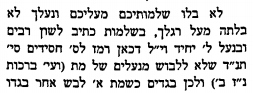
In Taama De'kra on parashat Ki Tavo, Rav Chaim Kanievsky writes:


That is, towards the end of Ki Tavo, Devarim 29, the pasuk states:

ד  וָאוֹלֵךְ אֶתְכֶם אַרְבָּעִים שָׁנָה, בַּמִּדְבָּר; לֹא-בָלוּ שַׂלְמֹתֵיכֶם מֵעֲלֵיכֶם, וְנַעַלְךָ לֹא-בָלְתָה מֵעַל רַגְלֶךָ.4 And I have led you forty years in the wilderness; your clothes are not waxen old upon you, and thy shoe is not waxen old upon thy foot.

"לֹא-בָלוּ שַׂלְמֹתֵיכֶם מֵעֲלֵיכֶם, וְנַעַלְךָ לֹא-בָלְתָה מֵעַל רַגְלֶךָ -- Regarding clothing it is written in plural and by shoe it written in singular. And there is to say that here it hints to the Sefer Chassidim, siman 454, that one should not wear the shoes of a dead person (and see Berachot 57b). And therefore, the clothing, when one person dies, another could wear his clothing, so it is written in plural, but shoes, only one person can where them. And there is nothing which is not alluded to in the Torah."
We can see the referred to item in Sefer Chassidim here:


"One who owes others should not give a lot of charity, until he has repaid his debt. And a person should not give something dangerous as charity. If someone was given shoes of a deceased [מנעלים של מת] and wishes to give them to a pauper, they tell him "And you shall love your fellow as yourself!" Rather, sell them to a gentile so that no Jewish person comes to danger, and then give the money to the pauper."
There are many explanations and rationalizations given to this statement in Sefer Chassidim. It can be connected to Berachot 57b, as Rav Kanievsky did above:
Our Rabbis taught: [If one dreams of] a corpse in the house, it is a sign of peace in the house; if that he was eating and drinking in the house, it is a good sign for the house; if that he took articles from the house, it is a bad sign for the house. R. Papa explained it to refer to a shoe or sandal. Anything that the dead person [is seen in the dream] to take away is a good sign except a shoe and a sandal; anything that it puts down is a good sign except dust and mustard.
Perhaps we can say that the fact that Rav Papa, or the brayta, see a negative omen in a dreaming that dead man took shoes from a house indicates that this was regarded (legitimately, superstitiously, culturally) as a danger. If so, then perhaps this could in turn serve as a basis for idea presented by Rabbi Yehuda HaChassid.

Though I don't think we need to try too hard to legitimize it. There are many strange things in Sefer Chassidim, which don't have a basis in the halacha or hashkafa of Chazal, nor were accepted as binding by the general Jewish community. Nor do we need to find an allusion to it in a pasuk.

There are various explanations floating around as to the meaning, and basis, of this position. (See Nit'ei Gavriel for a discussion.). For instance, some say this refers to shoes made from leather from a deceased (and therefore sick) animal. Some say it does refer to the shoes of a deceased person, but the problem is sweat from the deceased. Some say (Koret HaBrit) that the concern is that wearing such shoes will cause one to think about this during the day, and that those thoughts will cause one to dream about it at night, and we saw that this is a negative omen, and from this the sakana.

My problem with the last explanation is this. The idea that daytime thoughts cause the contents of nighttime dreams comes from the same approximate sugya in Berachot, about dreams, on 55b-56a:
R. Samuel b. Nahmani said in the name of R. Jonathan: A man is shown in a dream only what is suggested by his own thoughts, as it says, As for thee, Oh King, thy thoughts came into thy mind upon thy bed.37  Or if you like, I can derive it from here: That thou mayest know the thoughts of the heart.38  Raba said: This is proved by the fact that a man is never shown in a dream a date palm of gold, or an elephant going through the eye of a needle.39
The Emperor [of Rome]1  said to R. Joshua b. R. Hananyah: You [Jews] profess to be very clever. Tell me what I shall see in my dream. He said to him: You will see the Persians2  making you do forced labour, and despoiling you and making you feed unclean animals with a golden crook. He thought about it all day, and in the night he saw it in his dream.3  King Shapor [I] once said to Samuel: You [Jews] profess to be very clever. Tell me what I shall see in my dream. He said to him: You will see the Romans coming and taking you captive and making you grind date-stones in a golden mill. He thought about it the whole day and in the night saw it in a dream. 
I would suggest that Chazal were not monolithic in their attitude towards dreams. Instead, there are at least two strains. A gross simplification would be to call one Rationalist and the other Mystical (or non-Rationalist), but it is a convenient gross simplification. The Rationalist position understood dreams as the synapses in the brain continuing to fire at night, such that we keep thinking about what we were thinking about during the day. The Mystical position took dreams as a form of prophecy, as messages from on high.

(Complicating this is that dream interpretation was regarded as a science, And these is the well-developed idea of reality following whatever interpretation is offered, which seems to contrast with definitive explanations given for specific symbolism. And that certain types of dreams, over others, were understood to be prophetic, for instance, those which are repeated and occur towards the end of night, I think there are more than two positions to be had, and one member of Chazal might hold a nuanced position that cannot be neatly placed into Rationalist and non-Rationalist,)

Once we say that a particular dream is caused by daytime thoughts, I would argue that this strips it of its meaning, and its danger. Neither the Emperor of Rome nor King Shapur were put in danger by their dreams. If one wears the shoes of a deceased person and therefore dreams that dream mentioned by the gemara, there is no negative omen, and no danger in it. We should not conflate these two incompatible conceptions of dreams in order to create a prohibition, or an explanation for a prohibition.

Thursday, September 11, 2014

Minchas Shai on parshat Ki Tavo, pt i

Minchas Shai on parashat Ki Tavo begins as follows:


1) He writes that the sidra of Ki Tavo begins with a petucha gap.

2) He writes that אשר has a pashta. As opposed to what? Since this is often a response to Bomberg's Mikraos Gedolos, correcting the multiple errors, we should examine it, just to be sure that there is not something else there. Looking at Bomberg's first Mikraos Gedolos (pg 252), it has a pashta:


So too in Bomberg's second Mikraos Gedolos (pg 441), the word אשר has a pashta:


Presumably, then, the reason to note that אשר in the first pasuk has a pashta is that one might have made a mistake. That mistake would be to confuse it with a kadma. In the second pasuk of Ki Tavo, there are two instances of אשר, and each is marked with a kadma. The pashta and kadma look alike, but the pashta always appears on the very last letter of the word, while the kadma appears over the letter starting the stressed syllable. So, for a kadma, the symbol appears on the ש while for a pashta the symbol appears on the ר.

3) He also notes that in the phrase וְיָשַׁ֥בְתָּ בָּֽהּ, there is a dagesh in the bet. This too appears in Bomberg's Mikraos Gedolos correctly.

The purpose of pointing the dagesh out is that we might have erroneously thought that the dagesh should not appear there. After all, the previous word ended in a vowel (thus, an open syllable) and the trup symbol on that previous word, a mercha, was a joining, conjunctive, trup. While in the general case, the letters בגת כפת receive a dagesh kal  at the beginning of a word or after a sheva nach, the exception is where the previous word ended in an open syllable (usually the letters אהוי, but a kamatz under a ת also works) and there in a conjunctive trup. So we would expect no dagesh here.

An example of this from Ki Tavo is in this perek, pasuk 11:

וְשָֽׂמַחְתָּ֣ בְכָל־הַטּ֗וֹב

There is no dagesh in the ב because of the kametz under the ת, and because the trup symbol on that previous word is a munach, a conjunctive trup.

So why is there a dagesh placed in the ב in the first pasuk? The critical difference is that in וְשָֽׂמַחְתָּ֣ בְכָל־הַטּ֗וֹב, the trup symbol and thus the stress is on the very last syllable. However, in the וְיָשַׁ֥בְתָּ בָּֽהּ the trup symbol and thus the stress is on the penultimate (second to last) syllable.

That is, in וְיָשַׁ֥בְתָּ בָּֽהּ, the trup symbol and stress was moved from its normal place on the last syllable so as to prevent two stressed syllables in a row (veyashavTA BAH). That is called nasog achor. In such a case, the rule of dechik is that the first letter of that following word gets a dagesh chazak, which geminates (doubles) it.

So that means that the dagesh in the ב is a dagesh chazak, which both geminates it and renders it a plosive (bet) rather than fricative (vet), rather than being merely a dagesh kal, which would have also rendered it a plosive.

Tuesday, September 02, 2014

The Semag's strange girsa of וְכִי תָבֹא בְּקָמַת רֵעֶךָ

(Cross-posted to Girsology.)

In the middle of parshat Ki Teitzei [Devarim 23:25-26], we read:

כה  כִּי תָבֹא בְּכֶרֶם רֵעֶךָ, וְאָכַלְתָּ עֲנָבִים כְּנַפְשְׁךָ שָׂבְעֶךָ; וְאֶל-כֶּלְיְךָ, לֹא תִתֵּן.  {ס}25 When thou comest into thy neighbour's vineyard, then thou mayest eat grapes until thou have enough at thine own pleasure; but thou shalt not put any in thy vessel. {S}
כו  כִּי תָבֹא בְּקָמַת רֵעֶךָ, וְקָטַפְתָּ מְלִילֹת בְּיָדֶךָ; וְחֶרְמֵשׁ לֹא תָנִיף, עַל קָמַת רֵעֶךָ.  {ס}26 When thou comest into thy neighbour's standing corn, then thou mayest pluck ears with thy hand; but thou shalt not move a sickle unto thy neighbour's standing corn. {S}


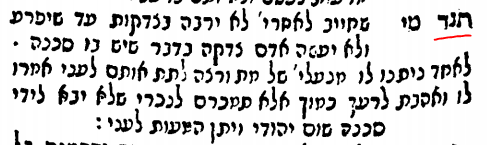
Minchas Shai writes regarding this: 
כִּי תָבֹא בְּקָמַת רֵעֶךָ -- in Sema'g [Sefer Mitzvot Gedolot] the volume on Lavin, siman 183, the following language is written:
It is written in parashat Ki Teitzei, כִּי תָבֹא בְּקָמַת רֵעֶךָ etc., and [תניא] we learn in a brayta, בְּיָדֶךָ and not with a sickle or a scythe. And just as it warned the worker not to grab the standing grain and eat eat, except by hand, so did it warn by a vineyard not to harvest for his [own] eating with something with which one usually harvests, for behold, they are juxtaposed one to the other, and this is even according to Rabbi Yehuda that we don't darshen semuchin [juxtapositions], in Mishneh Torah [meaning sefer Devarim], he does darshen semuchin. And furthermore, since it is written [in pasuk 25] כִּי תָבֹא בְּכֶרֶם רֵעֶךָ, and it is written וְכִי תָבֹא בְּקָמַת רֵעֶךָ, the vav [of וְכִי] adds on the first matter, and we learn one from the other." However, in Sefardic sefarim, there is no vav present.
End quote [of Semag].

And I am wondrously astonished at this, for I have not seen nor heard in my days that there is a dispute in this matter, neither in the Bavli nor Yerushalmi. And if someone should whisper to you that we don't know the facts of the matter clearly [such that this introduces uncertainty], tell him that from the Masoret we know that it is written without a vav, and the Gadol HaDor has said it -- and who is this? Rama  [Rabbi Meir Abulafia] who wrote this in his Masorot, that within the entire sefer Devarim, the beginning of each pasuk is כִּי except for eight instances in which the beginning of the pasuk is וְכִי. And the sign is ... [then he lists the eight pesukim. Those eight pesukim are, in the same order:

דברים פרק יד
  • פסוק כ"ד: וְכִי-יִרְבֶּה מִמְּךָ הַדֶּרֶךְ, כִּי לֹא תוּכַל שְׂאֵתוֹ--כִּי-יִרְחַק מִמְּךָ הַמָּקוֹם, אֲשֶׁר יִבְחַר יְהוָה אֱלֹהֶיךָ לָשׂוּם שְׁמוֹ שָׁם:  כִּי יְבָרֶכְךָ, יְהוָה אֱלֹהֶיךָ. 
דברים פרק טו
  • פסוק י"ג: וְכִי-תְשַׁלְּחֶנּוּ חָפְשִׁי, מֵעִמָּךְ--לֹא תְשַׁלְּחֶנּוּ, רֵיקָם. 
  • פסוק כ"א: וְכִי-יִהְיֶה בוֹ מוּם, פִּסֵּחַ אוֹ עִוֵּר, כֹּל, מוּם רָע--לֹא תִזְבָּחֶנּוּ, לַיהוָה אֱלֹהֶיךָ. 
דברים פרק יח
  • פסוק ו: וְכִי-יָבֹא הַלֵּוִי מֵאַחַד שְׁעָרֶיךָ, מִכָּל-יִשְׂרָאֵל, אֲשֶׁר-הוּא, גָּר שָׁם; וּבָא בְּכָל-אַוַּת נַפְשׁוֹ, אֶל-הַמָּקוֹם אֲשֶׁר-יִבְחַר יְהוָה. 
  • פסוק כ"א: וְכִי תֹאמַר, בִּלְבָבֶךָ:  אֵיכָה נֵדַע אֶת-הַדָּבָר, אֲשֶׁר לֹא-דִבְּרוֹ יְהוָה. 
דברים פרק יט
  • פסוק י"א: וְכִי-יִהְיֶה אִישׁ, שֹׂנֵא לְרֵעֵהוּ, וְאָרַב לוֹ וְקָם עָלָיו, וְהִכָּהוּ נֶפֶשׁ וָמֵת; וְנָס, אֶל-אַחַת הֶעָרִים הָאֵל. 
דברים פרק כא
  • פסוק כ"ב: וְכִי-יִהְיֶה בְאִישׁ, חֵטְא מִשְׁפַּט-מָוֶת--וְהוּמָת:  וְתָלִיתָ אֹתוֹ, עַל-עֵץ. 
דברים פרק כג
  • פסוק כ"ג: וְכִי תֶחְדַּל, לִנְדֹּר--לֹא-יִהְיֶה בְךָ, חֵטְא. 
]

End quote of Minchas Shai.

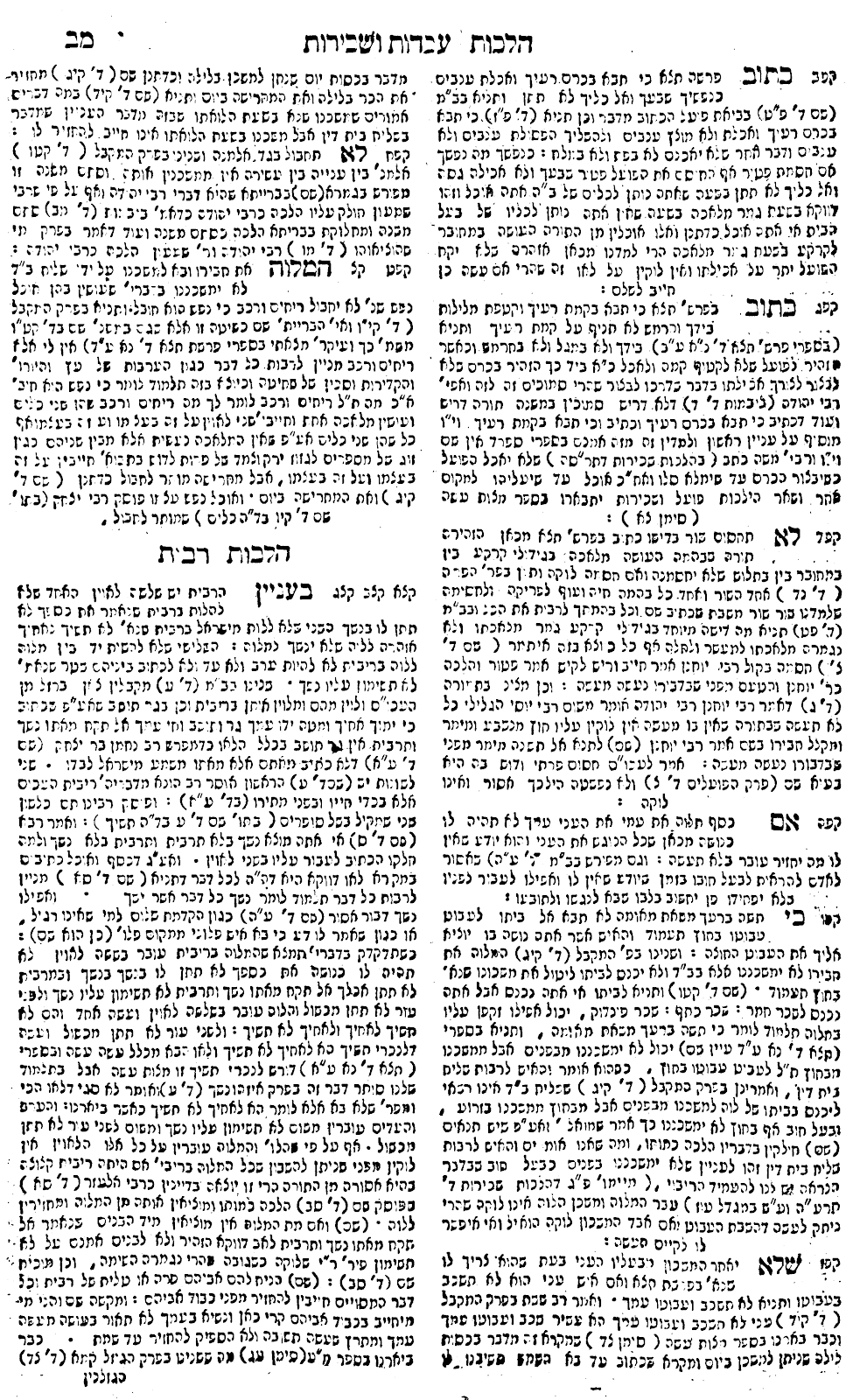
We can see the Semag in full here, in the second paragraph (183) on the right hand side:


The author of Sefer Mitzvos Gedolos, namely Rabbi Moshe ben Yaakov of Coucy, was a French Tosafist in the first half of the 13th century.

Here is the Likutei HaMasoret from the Rama, Rabbi Meir Abulafia, just as Minchas Shai recorded it. However, since the Rama lived and operated in Spain and so would naturally describe the state of Sefardic precise texts, and the Semag explicitly says that the Sefardic texts don't have this, this might be of limited utility. Obviously Minchas Shai maintains that it is an effective Masoret. At any rate, at the end of Masoret Seyag Lechachma, here is what we find:


Looking to Vetus Testamentum to see if there is any text with וכי in this pasuk, there is nothing. Namely, he lists Cod 300, but that is Minchas Shai!


When we look up at the end of Vetus Testamentum to see what this text is, we see that #300 is a printed text, and more specifically, is Minchas Shai's commentary. As the author explains here:


:
Cod. 300, Biblia impressa, merito celibratissima, Minchath Shai; de quo jam fusius egi, $62. Addam tantum, Notas hic effe signitas 300; Textum vero, 300 T.
I don't speak Latin, so here is my best guess (with a little help from Google Translate.)
Bible, printed, deservedly celebrated, Minchath Shai; of which I have done already in more detail, $ 62. I will show his comments as 300; The text, itself, as 300 T.
Here is the printed TaNaCh with Minchas Shai, with text כי and comment from Minchas Shai about the Semag and וכי:


LinkWithin

Blog Widget by LinkWithin