
Sometimes I wish...
Here.
(hat tip: the chocolate lady)
Tuesday, March 28, 2006

Transliteration - request for comment
As you can see from other posts on this blog, I'm working on transliteration. Comments are welcome on the examples (of "Academic" and "Ashkenazic").
Part of this work is transliterating to multiple transliteration schemes in use. (e.g. "oy" or "oi" for cholam, "th" for saf, etc.)
What is your transliteration scheme? Where did you learn it?
Part of this work is transliterating to multiple transliteration schemes in use. (e.g. "oy" or "oi" for cholam, "th" for saf, etc.)
What is your transliteration scheme? Where did you learn it?
Vayikra: More Transliteration Work
I have been working a bit more on the transliteration, and added a piece of the kametz katan component. For this, see the transliteration of korbanchem. I've also added a bit of handling for the Shem haShem. See the Shem alone, and when with a leading lamed. Note also how I handle patach ganuv. Here is a transliteration of the beginning of parshat Vayikra (1:1-9), in Academic and in Ashekenazic.
1)
wayyiqrāʾ, ʾel-mōšeh; wayḏabbēr ʾăḏōnāy ʾēlā(y)w, mēʾōhel môʿēḏ lēʾmōr
vayikra, el-moshe; vaydabeir adonay eila(y)v, meiohel moeid leimor
2)
3)
6)
7)
1)
wayyiqrāʾ, ʾel-mōšeh; wayḏabbēr ʾăḏōnāy ʾēlā(y)w, mēʾōhel môʿēḏ lēʾmōr
vayikra, el-moshe; vaydabeir adonay eila(y)v, meiohel moeid leimor
2)
dabbēr ʾel-bənê yiśrāʾēl, wəʾāmartā ʾălēhem, ʾāḏām kî-yaqrîḇ mikkem qorbān, laʾdōnāy--min-habbəhēmāh, min-habbāqār ûmin-haṣṣōʾn, taqrîḇû, ʾeṯ-qorbanḵem .
dabeir el-b'nei yisraeil, v'amarta aleihem, adam ki-yakriv mikem korban, ladonay--min-hab'heima, min-habakar umin-hatzon, takrivu, es-korbanchem3)
ʾim-ʿōlāh qorbānô min-habbāqār, zāḵār tāmîm yaqrîḇennû; ʾel-peṯaḥ ʾōhel môʿēḏ, yaqrîḇ ʾōṯô, lirṣōnô, lip̄nê ʾăḏōnāy
im-ola korbano min-habakar, zachar tamim yakrivenu; el-pesach ohel moeid, yakriv oso, lirtzono, lifnei adonay
4)
wəsāmaḵ yāḏô, ʿal rōʾš hāʿōlāh; wənirṣāh lô, ləḵappēr ʿālā(y)w
v'samach yado, al rosh haola; v'nirtza lo, l'chapeir ala(y)v
5)
wəšāḥaṭ ʾeṯ-ben habbāqār, lip̄nê ʾăḏōnāy; wəhiqrîḇû bənê ʾahărōn hakkōhănîm, ʾeṯ-haddām, wəzārəqû ʾeṯ-haddām ʿal-hammizbēaḥ sāḇîḇ, ʾăšer-peṯaḥ ʾōhel môʿēḏ
v'shachat es-ben habakar, lifnei adonay; v'hikrivu b'nei aharon hakohanim, es-hadam, v'zar'ku es-hadam al-hamizbeiach saviv, asher-pesach ohel moeid
6)
wəhip̄šîṭ, ʾeṯ-hāʿōlāh; wənittaḥ ʾōṯāh, linṯāḥe(y)hā
v'hifshit, es-haola; v'nitach osah, linsacheha
7)
wənāṯənû bənê ʾahărōn hakkōhēn, ʾēš--ʿal-hammizbēaḥ; wəʿārəḵû ʿēṣîm, ʿal-hāʾēš
v'nas'nu b'nei aharon hakohein, eish--al-hamizbeiach; v'ar'chu eitzim, al-haeish
8)wəʿārəḵû, bənê ʾahărōn hakkōhănîm, ʾēṯ hannəṯāḥîm, ʾeṯ-hārōʾš wəʾeṯ-happāḏer--ʿal-hāʿēṣîm ʾăšer ʿal-hāʾēš, ʾăšer ʿal-hammizbēaḥ
v'ar'chu, b'nei aharon hakohanim, eis han'sachim, es-harosh v'es-hapader--al-haeitzim asher al-haeish, asher al-hamizbeiach
9)
wəqirbô ûḵrāʿā(y)w, yirḥaṣ bammāyim; wəhiqṭîr hakkōhēn ʾeṯ-hakkōl hammizbēḥāh, ʿōlāh ʾiššēh rêaḥ-nîḥôaḥ laʾdōnāy
v'kirbo uchraa(y)v, yirchatz bamayim; v'hiktir hakohein es-hakol hamizbeicha, ola ishei reiach-nichoach ladonay
Tuesday, March 21, 2006
Transliteration - Vayakhel
I'm currently working on Hebrew transliteration. Here are the first three pesukim of Vayakhel:
Shemot 35:
1) wayyaqhēl mošeh, ʾeṯ-kāl-ʿaḏaṯ bənê yiśrāʾēl--wayyoʾmer ʾalēhem: ʾēlleh, haddəḇārîm, ʾašer-ṣiwwāh Hashem laʿaśoṯ ʾoṯām
2) šēšeṯ yāmîm, tēʿāśeh məlāʾḵāh, ûḇayyom haššəḇîʿî yihyeh lāḵem qoḏeš šabbaṯ šabbāṯon, laHashem; kāl-hāʿośeh ḇo məlāʾḵāh, yûmāṯ
3) loʾ-ṯəḇaʿarû ʾēš, bəḵol mošəḇoṯêḵem, bəyom, haššabbāṯ
Comments?
Shemot 35:
1) wayyaqhēl mošeh, ʾeṯ-kāl-ʿaḏaṯ bənê yiśrāʾēl--wayyoʾmer ʾalēhem: ʾēlleh, haddəḇārîm, ʾašer-ṣiwwāh Hashem laʿaśoṯ ʾoṯām
2) šēšeṯ yāmîm, tēʿāśeh məlāʾḵāh, ûḇayyom haššəḇîʿî yihyeh lāḵem qoḏeš šabbaṯ šabbāṯon, laHashem; kāl-hāʿośeh ḇo məlāʾḵāh, yûmāṯ
3) loʾ-ṯəḇaʿarû ʾēš, bəḵol mošəḇoṯêḵem, bəyom, haššabbāṯ
Comments?
parshat Vayyaqhēl: Behold, Hashem is Called/Credited
Midrash Rabba (48:5) has an interesting spin on the singling out of Betzalel. While it is homiletic, it fits into an existing theme in the peshat of the pesukim, and also relies on a very clever play on a linguistic ambiguity in the text, one which most casual and many serious readers of midrash will miss.
It begins with a citation from Yeshaya 54:16. The context on a peshat level is beautiful in its own right:
The Midrash takes pasuk 16 and reads it as referring to Betzalel: הִנֵּה אָנֹכִי, בָּרָאתִי חָרָשׁ - "Behold, I have created the smith..."
After all, the complex work of the Mishkan requires great craftsmanship. Perhaps this can all be attributed to Betzalel's greatness. However, Hashem created the smith, and gave him this wisdom and skill.
The midrash interprets the continuation of the pasuk as referring to how the Mishkan atoned for the sin of the golden calf. נֹפֵחַ בְּאֵשׁ פֶּחָם because the sin golden calf involved fire (as Aharon said, "and I cast it into the fire and this calf came out.") Perhaps this same phrase refers to Betzalel's fixing of the sin (see commentaries). Presumably, וּמוֹצִיא כְלִי לְמַעֲשֵׂהוּ is understood as a reference to the Mishkan and its vessels. The midrash draws a parallel to the student of a doctor who places a plaster on a wound, and the wound heals. People praise the student of the doctor, but the doctor says to them, "Praise me who taught him." Similarly, people would praise Betzalel, saying that he created the Mishkan with his own wisdom and understanding -- chochma and tevuna, and Hashem says, "It is I who created him and taught him, as it states הִנֵּה אָנֹכִי, בָּרָאתִי חָרָשׁ. Therefore, Moshe said (in Vayekhel, in Shemot 35:30) רְאוּ קָרָא ה בְּשֵׁם.
How is this pasuk in Vayakhel a prooftext? Perhaps it is not. Perhaps this is a way of concluding the homily, now that we have drawn the idea of Betzalel, mentioned in this pasuk. However, then לפיכך, "therefore," which introduced the pasuk, is a bit awkward. Perhaps what was meant was the continuation of the pasuk - sometimes a derasha is made from the continuation, and only the beginning is cited. Indeed, the next pasuk, as we shall see, continues the current pasuk and bears a message with a similar theme on the near-peshat level. However, is not necessarily what is happening here.
Rather, it is possible that the midrash engages in a close reading of the pasuk, and makes use of a nice ambiguity in the phrase רְאוּ קָרָא ה בְּשֵׁם.
If you recall, a while back I discussed an ambiguity in parshat Vayeitzei, in the naming of Yaakov's sons. Three phrases are used - וַתִּקְרָא שְׁמוֹ; עַל-כֵּן קָרְאָה שְׁמוֹ; and עַל-כֵּן קָרָא-שְׁמוֹ. The first two certainly seem to mean "she called his name." The last, as various scholars note, means either "he called his name" or "therefore was his name called," which is the passive. I should how even without emending the text, the text as vocalized can also mean "she called," and I give other examples of this phenomenon. Locally, there are two עַל-כֵּן קָרְאָה שְׁמוֹ and only one עַל-כֵּן קָרָא-שְׁמוֹ, and so Speiser emends the one (קרא) to match the two (קראה), but I argue there that if one is emending, one should emend to have the two match the one, since globally the phrase together with עַל-כֵּן always occurs with קרא, which is used with an anticipates the passive. See my post of Vayeitzei for more details.
Anyhow, what comes out of this discussion is the fact that קָרָא can mean either "he called" or "was called." In this instance, in Vayakhel, the pasuk states רְאוּ קָרָא ה בְּשֵׁם, I put forth that the Midrash is noting the ambiguity and reading it, "Behold, Hashem is called/cited/credited." See the usage of Amar X Beshem Y. Thus, when Betzalel is credited, Hashem is credited as well.
We thus have two common elements of midrashic construction - (1) a pasuk taken from a distance location and applied to local subject matter, and (2) a close reading of a local pasuk, taking advantage of a syntactic ambiguity.
However, there is most often a third element - that of the midrash expanding upon a theme evident either in the peshat level of the text, or the near-peshat level of the text. In fact, we have this third element. Indeed, the syntactic ambiguity might not be what the midrash is getting at in this instance, given the explicit nature of the theme here. (I personally think that each supplements the other, as happens often enough in midrash.) The pesukim in Vayakhel:
chochma and tevuna, and thus Hashem should be credited.
It begins with a citation from Yeshaya 54:16. The context on a peshat level is beautiful in its own right:
The Midrash takes pasuk 16 and reads it as referring to Betzalel: הִנֵּה אָנֹכִי, בָּרָאתִי חָרָשׁ - "Behold, I have created the smith..."
After all, the complex work of the Mishkan requires great craftsmanship. Perhaps this can all be attributed to Betzalel's greatness. However, Hashem created the smith, and gave him this wisdom and skill.
The midrash interprets the continuation of the pasuk as referring to how the Mishkan atoned for the sin of the golden calf. נֹפֵחַ בְּאֵשׁ פֶּחָם because the sin golden calf involved fire (as Aharon said, "and I cast it into the fire and this calf came out.") Perhaps this same phrase refers to Betzalel's fixing of the sin (see commentaries). Presumably, וּמוֹצִיא כְלִי לְמַעֲשֵׂהוּ is understood as a reference to the Mishkan and its vessels. The midrash draws a parallel to the student of a doctor who places a plaster on a wound, and the wound heals. People praise the student of the doctor, but the doctor says to them, "Praise me who taught him." Similarly, people would praise Betzalel, saying that he created the Mishkan with his own wisdom and understanding -- chochma and tevuna, and Hashem says, "It is I who created him and taught him, as it states הִנֵּה אָנֹכִי, בָּרָאתִי חָרָשׁ. Therefore, Moshe said (in Vayekhel, in Shemot 35:30) רְאוּ קָרָא ה בְּשֵׁם.
How is this pasuk in Vayakhel a prooftext? Perhaps it is not. Perhaps this is a way of concluding the homily, now that we have drawn the idea of Betzalel, mentioned in this pasuk. However, then לפיכך, "therefore," which introduced the pasuk, is a bit awkward. Perhaps what was meant was the continuation of the pasuk - sometimes a derasha is made from the continuation, and only the beginning is cited. Indeed, the next pasuk, as we shall see, continues the current pasuk and bears a message with a similar theme on the near-peshat level. However, is not necessarily what is happening here.
Rather, it is possible that the midrash engages in a close reading of the pasuk, and makes use of a nice ambiguity in the phrase רְאוּ קָרָא ה בְּשֵׁם.
If you recall, a while back I discussed an ambiguity in parshat Vayeitzei, in the naming of Yaakov's sons. Three phrases are used - וַתִּקְרָא שְׁמוֹ; עַל-כֵּן קָרְאָה שְׁמוֹ; and עַל-כֵּן קָרָא-שְׁמוֹ. The first two certainly seem to mean "she called his name." The last, as various scholars note, means either "he called his name" or "therefore was his name called," which is the passive. I should how even without emending the text, the text as vocalized can also mean "she called," and I give other examples of this phenomenon. Locally, there are two עַל-כֵּן קָרְאָה שְׁמוֹ and only one עַל-כֵּן קָרָא-שְׁמוֹ, and so Speiser emends the one (קרא) to match the two (קראה), but I argue there that if one is emending, one should emend to have the two match the one, since globally the phrase together with עַל-כֵּן always occurs with קרא, which is used with an anticipates the passive. See my post of Vayeitzei for more details.
Anyhow, what comes out of this discussion is the fact that קָרָא can mean either "he called" or "was called." In this instance, in Vayakhel, the pasuk states רְאוּ קָרָא ה בְּשֵׁם, I put forth that the Midrash is noting the ambiguity and reading it, "Behold, Hashem is called/cited/credited." See the usage of Amar X Beshem Y. Thus, when Betzalel is credited, Hashem is credited as well.
We thus have two common elements of midrashic construction - (1) a pasuk taken from a distance location and applied to local subject matter, and (2) a close reading of a local pasuk, taking advantage of a syntactic ambiguity.
However, there is most often a third element - that of the midrash expanding upon a theme evident either in the peshat level of the text, or the near-peshat level of the text. In fact, we have this third element. Indeed, the syntactic ambiguity might not be what the midrash is getting at in this instance, given the explicit nature of the theme here. (I personally think that each supplements the other, as happens often enough in midrash.) The pesukim in Vayakhel:
chochma and tevuna, and thus Hashem should be credited.
Monday, March 20, 2006
Friday, March 17, 2006
sources for Yoshev Lifnei Rabbo Dvar for Pesach
Brayta and Rav Acha bar Yaakov, Pesachim 7a.
והא תניא היה יושב בבית המדרש ונזכר שיש חמץ בתוך ביתו מבטלו בלבו אחד שבת ואחד יום טוב בשלמא שבת משכחת לה כגון שחל ארבעה עשר להיות בשבת אלא יום טוב בתר איסורא הוא
אמר רב אחא בר יעקב הכא בתלמיד יושב לפני רבו עסקינן ונזכר שיש עיסה מגולגלת בתוך ביתו ומתיירא שמא תחמיץ קדים ומבטיל ליה מיקמי דתחמיץ דיקא נמי דקתני היה יושב בתוך בית המדרש שמע מינה
Mishna, third perek, Pesachim 49a:
דף מט, א משנה ההולך לשחוט את פסחו ולמול את בנו ולאכול סעודת אירוסין בבית חמיו ונזכר שיש לו חמץ בתוך ביתו אם יכול לחזור ולבער ולחזור למצותו יחזור ויבער ואם לאו מבטלו בלבו להציל מן הנכרים ומן הנהר ומן הלסטים ומן הדליקה ומן המפולת יבטל בלבו ולשבות שביתת הרשות יחזור מיד וכן מי שיצא מירושלים ונזכר שיש בידו בשר קדש אם עבר צופים שורפו במקומו ואם לאו חוזר ושורפו לפני הבירה מעצי המערכה ועד כמה הן חוזרין ר"מ אומר זה וזה בכביצה ר' יהודה אומר זה וזה בכזית וחכמים אומרים בשר קדש בכזית וחמץ בכביצה:
The brayta leading up to that Mishna (that is brought because of the preceding Mishna):
Tosefta Pesachim 3:9-10
note the mikaan ata omer.
Finally, the Yerushalmi:
Pesachim 23b-24a:
דף מט, א גמרא תניא ר"א בר צדוק אומר פעם אחת שבת אבא ביבנה וחל ארבעה עשר להיות בשבת ובא זונין ממונה של ר"ג ואמר הגיע עת לבער את החמץ והלכתי אחר אבא וביערנו את החמץ:
Tosefta Pesachim 3:9-10
ג,ט ארבעה עשר שחל להיות בשבת מבערין את הכל מלפני השבת [ואופה] לו מצה מערב שבת תרומה טהורה וטמאה מבערין אותן מלפני השבת דברי רבי מאיר וחכמים אומרים בזמנן תרומה טהורה וטמאה מבערין בשבת אמר רבי אלעזר בר' צדוק תרומה מלפני השבת שאוכליה מועטין וחולין בשבת שאוכליהן מרובין אמר רבי אלעזר בר' צדוק פעם אחת [היינו יושבין לפני רבן גמליאל בבית המדרש בלוד ובא זונין הממונה ואמר] הגיע עת לבער החמץ [הלכתי] אני ואבא לבית רבן גמליאל וביערנו את החמץ.
ג,י איזה הוא [צופה] הרואה ואינו מפסיק מכאן אתה אומר ההולך לשחוט את פסחו ולמול את בנו ולאכול סעודת ארוסין בבית חמיו ונזכר שיש לו חמץ בתוך הבית אם יש לו שהות כדי שיחזור חוזר ואם לאו אינו חוזר ר' שמעון בן אלעזר אומר כל סעודה שאינה [לשום] מצוה אין חבר רשאי לאכול הימנה. אם [עובר את הצופים] שורפו במקומו ואם לאו חוזר ושורפו לפני הבירה מעצי המערכה הוי לא אמרו לחזור אלא להקל עליו עד כמה הן חוזרין בן בתירה אומר עד כשני ביצים ולא מצינו לו חבר רצה לשורפו לפני בירה מעצי עצמו או על גגו מעצי המערכה אין שומעין לו.
Finally, the Yerushalmi:
Pesachim 23b-24a:
דף כג, ב פרק ג הלכה ז משנה ההולך לשחוט את פסחו ולמול את בנו ולאכול סעודת אירוסין בבית חמיו ונזכר שיש לו חמץ בתוך ביתו אם יכול לחזור ולבער ולחזור למצותו יחזור ואם לא יבטל בלבו להציל מיד הגייס ומיד הנהר ומן הדליקה ומן המפולת יבטל בלבו ולשבות שביתת הרשות יחזור מיד:
דף כג, ב פרק ג הלכה ז גמרא א"ר יוסה בי ר' בון בוא וראה מה גדול הוא השלום שהוקש לשני דברי' שחייבין עליהן כרת מילת בנו ושחיטת פסחו. מי קודם אמר רבי פינחס מן מה דכתיב (שמות יב) המול לו כל זכר ואז יקרב לעשתו. הדא אמרה שמילת בנו קודמת לשחיטת פיסחו אפילו יכול לחזור ולבער ולילך ולהציל
דף כד, א פרק ג הלכה ז גמרא אפילו יכול לילך ולשבות לחזור ולבטל שאין שביתת הרשות אצל רבו או אצל מי שהוא גדול ממנו בחכמה. כך שנה רבי המעשה קודם לתלמוד. נמנו בעליית בית אריס בלוד התלמוד קודם למעשה. ר' אבהו שלח לרבי חנינה בריה יזכי בטיבריה. אתון ואמרין ליה גמל הוא חסד שלח ומר ליה המבלי אין קברים בקיסרין שלחתיך לטבריא. שכבר נמנו וגמרו בעליית בית אריס בלוד שהתלמוד קודם למעשה. רבנין דקיסרין אמרין הדא דתימר בשיש שם מי שיעשה אבל אם אין שם מי שיעשה המעשה קודם. דלמא ר' חייא רבי יוסי ר' אימי ענון למיתי גבי רבי אלעזר אמר לון אן הויתון. אמרין ליה גמל חסד. אמר לון ולא הוה תמן חורנין אמרין ליה מגור היה:parshat Tetzaveh: Identifying the Stones: יָשְׁפֵה - yāšəp̄ēh.
The last stone on the last row, that of Binyamin, is יָשְׁפֵה - yāšəp̄ēh. To cite JPS on Shemot 28:20:
yāšəp̄ēh certainly sounds like jasper. Indeed, according to the Wikipedia article on jasper:
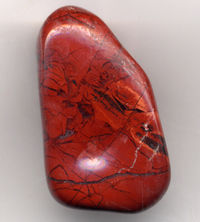
Meanwhile, Midrash Rabba identifies יָשְׁפֵה, stating בנימין מרגליטוס - that Binyamin's stone was margalithos. Jastrow (pg 836) corrects the vav to a yud, and identifies it with Greek margarites chersaios, the name of a precious stone corresponding to יָשְׁפֵה.
I do not know to what this corresponds. margarites in general appears to correspond to pearl, but Jastrow avoids this identification. Anyway, here is a wikipedia article on pearls.
Jewish Encyclopedia did a much more comprehensive discussion of all these stones. See here.
yāšəp̄ēh certainly sounds like jasper. Indeed, according to the Wikipedia article on jasper:
The name means "spotted stone", and is derived from Anglo-French jaspre, from Old French jaspe, from Latin iaspidem, the accusative of iaspis, from Greek iaspis, via a Semitic language (cf. Hebrew yashepheh, Akkadian yashupu), ultimately from Persian yashp.From the same article:
Jasper is an opaque, impure variety of quartz that is usually red, yellow or brown in color. This mineral breaks with a smooth surface, and is often used for ornamentation or as a gemstone.And here is an image of a jasper:

Meanwhile, Midrash Rabba identifies יָשְׁפֵה, stating בנימין מרגליטוס - that Binyamin's stone was margalithos. Jastrow (pg 836) corrects the vav to a yud, and identifies it with Greek margarites chersaios, the name of a precious stone corresponding to יָשְׁפֵה.
I do not know to what this corresponds. margarites in general appears to correspond to pearl, but Jastrow avoids this identification. Anyway, here is a wikipedia article on pearls.
Jewish Encyclopedia did a much more comprehensive discussion of all these stones. See here.
parshat Tetzaveh: Identifying the Stones: שֹׁהַם - šoham
šoham is the second stone on the fourth row - the stone of Yosef. What is this stone? JPS translates Shemot 28:20:
According to Wikipedia:
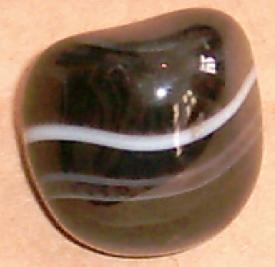 Here is an image of black-banded onyx.
Midrash Rabba states: יוסף פראלוקין - that Yosef's stone was paralvakin. What is this? According to Jastrow (pg 1213): it means "whitish" and corresponds to Greek paraleukos (?? Josh: perhaps corresponding to LXX's "the leek-green stone" ??) or perhaps a corruption of beirullion, that is, beryl, as discussed in the previous entry.
I will not show a stone here, but will link to Wikipedia's entry on beryl.
According to Wikipedia:
Onyx is a banded variety of chalcedony, a cryptocrystalline form of quartz. The colors of its bands are white and black.
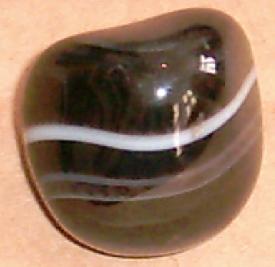 Here is an image of black-banded onyx.
Midrash Rabba states: יוסף פראלוקין - that Yosef's stone was paralvakin. What is this? According to Jastrow (pg 1213): it means "whitish" and corresponds to Greek paraleukos (?? Josh: perhaps corresponding to LXX's "the leek-green stone" ??) or perhaps a corruption of beirullion, that is, beryl, as discussed in the previous entry.
I will not show a stone here, but will link to Wikipedia's entry on beryl.
parshat Tetzaveh: Identifying the Stones: תַּרְשִׁישׁ - taršîš
The first stone on the fourth row, that of Asher, is taršîš - תַּרְשִׁישׁ. What is this?
JPS translates Shemot 28:20:
chosen as beryl. It probably depends on JPS's source. According to Wikipedia,
The mineral beryl is a beryllium aluminium cyclosilicate with the chemical formula Be3Al2(SiO3)6... It has a vitreous lustre and can be transparent or translucent. Its cleavage is poor basal and its habit is dihexagonal bipyramidal. Pure beryl is colorless, but it is frequently tinted by impurities; possible colors are green, blue, yellow, red, and white. The name comes from the Greek beryllos for the precious blue-green color of sea water.
Until I find contrary information, I will assume they do not mean emerald (smaragd) here but rather either the colorless or the the aquamarine variety, since this would be simply beryl, or would be equal to the ancient Greek beryl. Here is a picture of aquamarine beryl.
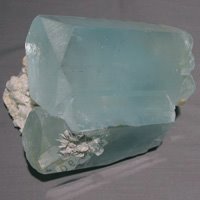
This makes some sense because Tarshish was a Biblical site that sent out ships.
Midrash Rabba discusses תַּרְשִׁישׁ, saying: אשר קרומטיסין, that Asher's stone was kromatisin.
What is this? Jastrow (pg 1414) defines this as cover (or color) of gold foils, name of a jewel in the High Priest's breastplate. The Greek is chrusolithos.
According to the International Standard Bible Encyclopedia:
We include no picture here since the specific identification is uncertain.
JPS translates Shemot 28:20:
chosen as beryl. It probably depends on JPS's source. According to Wikipedia,
The mineral beryl is a beryllium aluminium cyclosilicate with the chemical formula Be3Al2(SiO3)6... It has a vitreous lustre and can be transparent or translucent. Its cleavage is poor basal and its habit is dihexagonal bipyramidal. Pure beryl is colorless, but it is frequently tinted by impurities; possible colors are green, blue, yellow, red, and white. The name comes from the Greek beryllos for the precious blue-green color of sea water.
Until I find contrary information, I will assume they do not mean emerald (smaragd) here but rather either the colorless or the the aquamarine variety, since this would be simply beryl, or would be equal to the ancient Greek beryl. Here is a picture of aquamarine beryl.
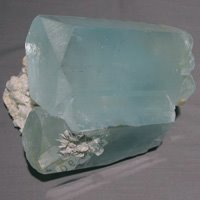
This makes some sense because Tarshish was a Biblical site that sent out ships.
Midrash Rabba discusses תַּרְשִׁישׁ, saying: אשר קרומטיסין, that Asher's stone was kromatisin.
What is this? Jastrow (pg 1414) defines this as cover (or color) of gold foils, name of a jewel in the High Priest's breastplate. The Greek is chrusolithos.
According to the International Standard Bible Encyclopedia:
Note that this is not the same as modern chrysolite, but that didn't stop someone from puting in the Wikipedia article on chrysolite/olivine that Rabbenu Baycha identifies tarshish as chrysolite as the stone of Asher.According to Septuagint chrusolithos was one of the stones of the breastplate (lst stone, 4th row), but there is uncertainty as to the Hebrew text of the Septuagint in respect of this word; the name is not mentioned by Theophrastus. The chrysolithus of Pliny was a "transparent stone with a refulgence like that of gold." Those were most valued which "when placed by the side of gold, impart to it a sort of whitish hue, and so give it the appearance of silver."
It may perhaps have included the yellow sapphire (alumina), the yellow quartz (citrine, silica) and the yellow jargoon (zircon; silicate of zirconium) of the present day. The term "chrysolite" is now applied to a different mineral, namely, to a yellow variety of olivine (silicate of magnesium and iron), a species that includes the green precious stone peridot as another of its varieties.
We include no picture here since the specific identification is uncertain.
parshat Tetzaveh: Identifying the Stones: אַחְלָמָה - ʾaḥlāmāh
The third stone on the third row, that of Gad, is אַחְלָמָה - ʾaḥlāmāh. To cite JPS's translation of Shemot 28:19:
What is אַחְלָמָה? JPS translated it "amethyst." According to Wikipedia,
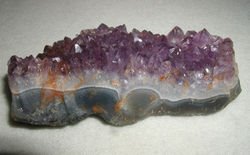
and the second is a cut amethyst gem
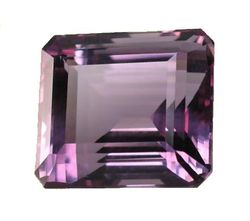
In antiquity, amethyst was quite costly, but nowadays has lost much value when large deposits were found in places such as Brazil.
Meanwhile, Midrash Rabba states regarding אַחְלָמָה:
גד פימיסיון - that the stone of Gad was pimisyon.
Alas, I cannot find any entry for pimisyon in Jastrow - perhaps a reader will have better luck.
If I were forced to guess, I would put forth "pumice," which is a stone. The etymology, via American Heritage Dictionary, via dictionary.com:
[Middle English, from Anglo-Norman pomis, from Late Latin p mex, from Latin p
 mex, alteration of spma, foam.]
Here is the Wikipedia article on pumice:
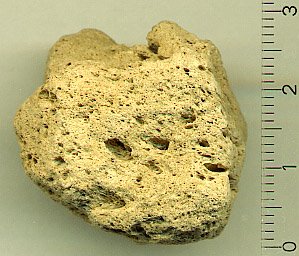 Citing the Wikipedia article:
"Pumice is a light, porous type of pyroclastic igneous rock. It is formed during explosive volcanic eruptions when liquid lava is ejected into the air as a froth containing masses of gas bubbles. As the lava solidifies, the bubbles are frozen into the rock. Any type of igneous rock — andesite, basalt, dacite or rhyolite — can form pumice given suitable eruptive conditions."
But perhaps it is something entirely different. Suggestions welcome.
| יט וְהַטּוּר, הַשְּׁלִישִׁי--לֶשֶׁם שְׁבוֹ, וְאַחְלָמָה. | 19 and the third row a jacinth, an agate, and an amethyst; |
Amethyst (SiO2) is a violet or purple variety of quartz...Here are two pictures included in the Wikipedia article. The first is a bed of amethyst on base rock,
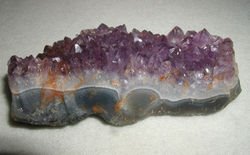
and the second is a cut amethyst gem
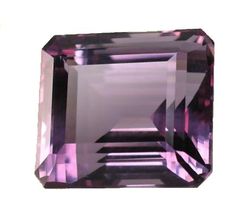
In antiquity, amethyst was quite costly, but nowadays has lost much value when large deposits were found in places such as Brazil.
Meanwhile, Midrash Rabba states regarding אַחְלָמָה:
גד פימיסיון - that the stone of Gad was pimisyon.
Alas, I cannot find any entry for pimisyon in Jastrow - perhaps a reader will have better luck.
If I were forced to guess, I would put forth "pumice," which is a stone. The etymology, via American Heritage Dictionary, via dictionary.com:
[Middle English, from Anglo-Norman pomis, from Late Latin p
mex, from Latin pmex, alteration of spma, foam.]Here is the Wikipedia article on pumice:
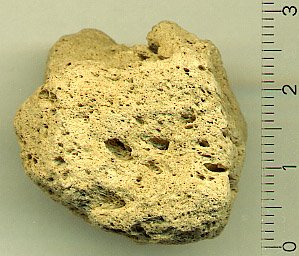 Citing the Wikipedia article:
"Pumice is a light, porous type of pyroclastic igneous rock. It is formed during explosive volcanic eruptions when liquid lava is ejected into the air as a froth containing masses of gas bubbles. As the lava solidifies, the bubbles are frozen into the rock. Any type of igneous rock — andesite, basalt, dacite or rhyolite — can form pumice given suitable eruptive conditions."
But perhaps it is something entirely different. Suggestions welcome.
Hunting Hares in the Haggadah
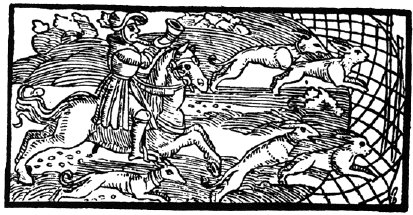 While I think that the "commentaries" on the bottom are a bit silly, given the explicit reason for the pictures, the top part of the page is interesting.
Apparently, because Yaknehaz (yayin kiddush ner havdalah zeman) sounds similar in German to "jag den Has," meaning "hunt the hare," some medieval haggadot included a picture of a rabbit hunt.
Heh.
Check out this site for more.
Thursday, March 16, 2006
parshat kî ṯiśśāʾ: If you read only one thing on the parsha this week...
 If you read only one thing on the parsha this week, it should be Ibn Ezra on the egel, the golden calf. (And you should read it inside, rather than relying on my partial discussion, which also strays to add other interesting points.) He does his usual masterful job, taking on the classic midrashic approaches in order to put forth what he considers peshat.
In this instance, he presents a defense of Aharon based on the text - not for the purpose of apologetics, or hagiography, but because it makes for good peshat.
While the Golden Calf certainly was not a shining moment in our history, and we see that many people were punished for the sin, we do not see Aharon being punished for this sin. Indeed, when Aharon dies, a sin is listed: {Bemidbar 20:24}:
Furthermore, Hashem honors him after this. He and his children are perpetual priests in the service of Hashem, which seems strange if he did such a great sin. Furthermore, other prophecies are directed to him. Also, if Moshe commands the sons of Levi to kill those guilty in the sin of the golden calf, even if they be brothers, he should have to kill his own brother, or else look quite hypocritical.
Furthermore, Aharon defends himself to Moshe shortly thereafter. We need to make sense of the words his defense.
These and other factors suggest that as a matter of peshat, what Aharon did was not so bad. This is strange, since if worship of the calf is bad, certainly constructing it, and building an altar for it (if that is what he did) should be.
Thus, a defense of Aharon need not be looked at as apologetics, but rather simply a means of obtaining peshat, and Ibn Ezra is a pashtan par excellence.
(BTW, there are two accounts of the egel in close proximity - one in the initial narrative, and the second shortly thereafter, in Aharon's defense of his actions to Moshe. In arriving at peshat, or derash, one should compare and contrast these two. Perhaps read the entirely of Shemot 32 first, so as to see what Ibn Ezra is talking about.)
Ibn Ezra first sets out on the task of rejecting several midrashic explanations of the event. Some of these are interesting in there own right.
For example, Ibn Ezra rejects as nonsense an explanation that this was a different fellow named Aharon who constructed the golden calf!
Ibn Ezra also rejects the suggestion that he did this because he "saw" (see וַיַּרְא אַהֲרֹן in Shemot 32:5) them kill Chur. After all, this would make him less of a man than Chur, or than Daniel's friends who were willing to be thrown into a fiery furnace rather than worship an idol. He also rejects suggestions that he was thus saving the nation from the sin of killing him, for which there would be no going back. He should have stood up to the nation as Moshe did when he returned.
He rejects the interpretation that he was just throwing the gold into the cauldron and did not know that evildoers had tricked him, putting the mold for a calf in there, for that would make Aharon foolish. He rejects the interpretation that when Aharon says חַג לַה' מָחָר, he means that there will punishment for this, in the slaughter of all the sinners.
Read it all in detail, for it offers good details of some interesting defenses, and one can then then see how they arise from the text. Obviously, Ibn Ezra rejects them, and the process of their rejection as peshat is also quite interesting.
Ibn Ezra explains that there was a difference between what the people asked of Aharon and what Aharon did, on the one hand, and what some of the people (about 3000 of them) did subsequently on the other hand.
Moshe disappeared for 40 days and 40 nights, and had not told the people at all when he would return. The people asked Aharon for a replacement for Moshe, and this is what Aharon agreed to do. They said קוּם עֲשֵׂה-לָנוּ אֱלֹהִים אֲשֶׁר יֵלְכוּ לְפָנֵינוּ--כִּי-זֶה מֹשֶׁה הָאִישׁ אֲשֶׁר הֶעֱלָנוּ מֵאֶרֶץ מִצְרַיִם, לֹא יָדַעְנוּ מֶה-הָיָה לוֹ. The word אֱלֹהִים means not a god, but something that will lead the way for them, directed by God. (And indeed, אֱלֹהִים on occassion does mean things other than "god.") Aharon then deliberately constructed a Golden Calf.
However, some people (those killed by the Levites) then turned around and declared this their god, saying אֵלֶּה אֱלֹהֶיךָ יִשְׂרָאֵל, אֲשֶׁר הֶעֱלוּךָ מֵאֶרֶץ מִצְרָיִם. Aharon, meanwhile, tried to rally people to the service of Hashem, building an altar to Hashem, and declared a festival to as the pasuk says explicitly - וַיַּרְא אַהֲרֹן, וַיִּבֶן מִזְבֵּחַ לְפָנָיו; וַיִּקְרָא אַהֲרֹן וַיֹּאמַר, חַג לַה' מָחָר.
Thus, idolatry was not intended by Aharon, or even by the majority of the Israelites -- only by a minority of the Israelites, who were killed.

Monday, March 13, 2006
parshat Tetzaveh: Identifying the Stones: שְׁבוֹ - šəḇo
The second stone on the third row, that of Naftali, is שְׁבוֹ - šəḇo. As Shemot 28:17-21 states:
Midrash Rabba states: נפתלי אבאטיס
Jastrow (pg 2) writes that this is a scribal error and the word should be read אכאטיס, with a kaf in place of the bet. One page 62, he states it is the Greek term for "agate."
What is agate?
According to Wikipedia,
 but look around for other pictures.
Midrash Rabba states: נפתלי אבאטיס
Jastrow (pg 2) writes that this is a scribal error and the word should be read אכאטיס, with a kaf in place of the bet. One page 62, he states it is the Greek term for "agate."
What is agate?
According to Wikipedia,
Agate is a term applied not to a distinct mineral species, but to an aggregate of various forms of silica, chiefly chalcedony.Wordnet defines it as
an impure form of quartz consisting of banded chalcedony; used as a gemstone and for making mortars and pestlesAccording to Easton's 1897 Bible Dictionary, under agate, (cited by dictionary.com) they write:
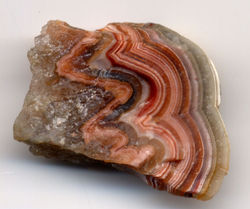
(Heb. shebo), a precious stone in the breast-plate of the high priest (Ex. 28:19; 39:12), the second in the third row. This may be the agate properly so called, a semi-transparent crystallized quartz, probably brought from Sheba, whence its name. In Isa. 54:12 and Ezek. 27:16, this word is the rendering of the Hebrew cadcod, which means "ruddy," and denotes a variety of minutely crystalline silica more or less in bands of different tints. This word is from the Greek name of a stone found in the river Achates in Sicily.Here is a picture of some banded agate
 but look around for other pictures.
parshat Tetzaveh: Identifying the Stones: לֶשֶׁם - lešem
The next stone, which is the first stone on the third row, is the stone of Dan. The Torah calls it לֶשֶׁם - lešem.
The pesukim describing the stones on the choshen (Shemot 28:17-21):
What is this lešem? JPS translates it jacinth. What is jacinth?
Wikipedia:
Midrash Rabba states: דן כוחלין.
Jastrow (pg 618) defines this as "carbuncle." We have already discussed carbuncle, since it was JPS's definition of nop̄eḵ (and apparently other people's definition of bareqet.) Copying what I wrote there:
The pesukim describing the stones on the choshen (Shemot 28:17-21):
What is this lešem? JPS translates it jacinth. What is jacinth?
Wikipedia:
Jacinth is a red transparent variety of zircon used as a gemstone. Jacinth is also a flower of a reddish blue or deep purple (hyacinth), and hence a precious stone of that colour (Revelation 21:20). It has been supposed to designate the same stone as the ligure (Hebrew leshem) mentioned in Exodus 28:19 as the first stone of the third row in the high priest's breast-plate, the Hoshen. In Revelation 9:17 the word is simply descriptive of colour.I am uncertain in what sense JPS intends it - whether they mean the modern sense of red zircon. Jacinth is the same as hyacinth, which in ancient times might have meant blue sapphire, and in the Middle Ages meant yellow gems (including yellow zircon) from East India. I have already discussed this by bareqet, since Midrash Rabba identifies bareqet as hyacinth. Read up on it there. I won't put a picture of it here, since there are many possibilities of what JPS meant.
Midrash Rabba states: דן כוחלין.
Jastrow (pg 618) defines this as "carbuncle." We have already discussed carbuncle, since it was JPS's definition of nop̄eḵ (and apparently other people's definition of bareqet.) Copying what I wrote there:
There, they write:Interestingly, so far, all stones in the first column seem to be red, based on Midrash Rabba's account, assuming I have reconstructed it accurately.The word carbuncle occurs in three places in most translations of the Bible. Each use originates from the same Hebrew word בָּרְקַת בָּרְקַת or bâreqath bâreqath (baw-reh'-keth, baw-rek-ath'). In this sense, a carbuncle is usually taken to mean a gem, particularly a deep-red garnet, unfaceted and convex; however, the Hebrew definition is less definite and the precise color of the gems is not known.Assuming the same definition will apply to nop̄eḵ, perhaps it is the "deep-red garnet, unfaceted and convex," mentioned above. For scientific identification of garnet, see the Wikipedia article on garnet:The garnet group of minerals show crystals with a habit of rhombic dodecahedrons and trapezohedrons. They are nesosilicates with the same general formula, A3B2(SiO4)3. The chemical elements in garnet include calcium, magnesium, aluminium, iron2+, iron3+, chromium, manganese, and titanium.Here is possibly an image of the carbuncle being described, from probertencyclopedia:Though it matches the aforementioned description, I cannot be sure this is in fact the carbuncle described, because this encyclopedia writes to the side of it:
Carbuncle is a beautiful gem of a deep red colour (with a mixture of scarlet) . It was called by the Greeks anthrax and is found in the East Indies. When held up to the sun, it loses its deep tinge, and becomes of the colour of burning coal. The name belongs for the most part to ruby sapphire, though it has been also given to red spinel and garnet.
parshat Tetzaveh: Identifying the Stones: יָהֲלֹם - yāhalom
The third stone on the second row of the choshen is יָהֲלֹם - yāhalom. JPS translates this as "emerald."
In Shemot 28:17-21:
smaragdos, which is emerald, though it can also mean a "colored crystal."
This is confusing to me, because JPS already used "smaragd" to translate bareqet, so if smaragd = emerald, how can they use "emerald" here.
On bareqet, this is what I wrote about emeralds:
In Shemot 28:17-21:
smaragdos, which is emerald, though it can also mean a "colored crystal."
This is confusing to me, because JPS already used "smaragd" to translate bareqet, so if smaragd = emerald, how can they use "emerald" here.
On bareqet, this is what I wrote about emeralds:
Now, smaragd is just another name for emerald. According to Wiktionary, emerald comes from:Middle English emeraude, from Old French esmeraude, from Vulgar Latin *esmaralda, *esmaraldus, variant of Latin smaragdus, from Greek σμάραγδος, μάραγδος (smaragdos, maragdos), from Sanskrit मरकत (marakata).It is a green transparent form of beryl.
And here is a picture of emeralds.


parshat Tetzaveh: Identifying the Stones: סַפִּיר - sappîr
The next stone on the chosen is the סַפִּיר - sappîr. The identification of this stone should be obvious, but it is not, because of a likely shift in the meaning of "sapphire."
In Shemot 28:17-21, which describes the stones of the chosen:
יששכר סנפירינון
Now, sanpirinon is Greek sapphire. Jastrow's entry on the word (pg 1008) refers refers us to סמפירונין (pg 1003), which is sapphire, which in general = lapis lazuli.
The problem here is that there seems to have been another shift in terms. To cite Wikipedia on lapiz lazuli:
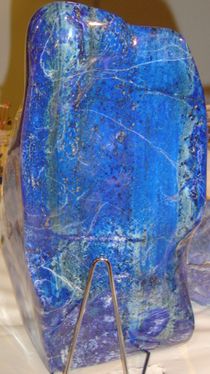 The composition of lapis lazuli:
Now, the article in Wikipedia mentioned two points. Firstly, Pliny uses the term "sapphire" to refer to lapis lazuli, since he talks of gold specks in it, which matches the flecks of golden pyrite in lapis lazuli.
Secondly, another pasuk in Tanach, where the Hebrew is also סַפִּיר - sappîr strongly suggests that it also had specks of "gold" therein, and is thus lapis lazuli.
They referred to Iyyov 28:6:
which then matches Pliny's description.
Thus, this ancient definition of sapphire may well be different than the more recent one, of blue corundum (unless the ancient blue sapphire was equal to our modern sapphite). The modern other sapphire is entirely different. According to the Wikipedia article on sapphire,
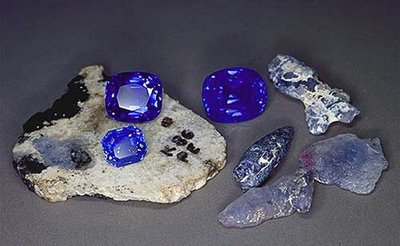
a
a
In Shemot 28:17-21, which describes the stones of the chosen:
יששכר סנפירינון
Now, sanpirinon is Greek sapphire. Jastrow's entry on the word (pg 1008) refers refers us to סמפירונין (pg 1003), which is sapphire, which in general = lapis lazuli.
The problem here is that there seems to have been another shift in terms. To cite Wikipedia on lapiz lazuli:
In ancient times, lapis lazuli was known as sapphire, which is the name that is used today for the blue corundum variety sapphire. It appears to have been the sapphire of ancient writers because Pliny refers to sapphirus as a stone sprinkled with specks of gold. A similar reference can be found in the Hebrew Bible in Job 28:6.and indeed, lapis lazuli is blue sprinkled with specks of gold. Earlier in the article:
The finest color is intense blue, lightly dusted with small flecks of golden pyrite.A picture:
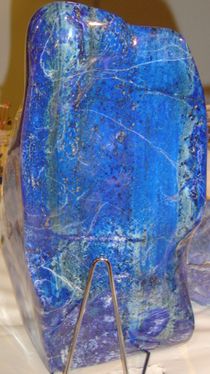 The composition of lapis lazuli:
The main component of lapis lazuli is lazurite (25 to 40 percent), a feldspathoid silicate mineral composed of sodium, aluminium, silicon, oxygen, sulfur, and chlorine. Most lapis also contains calcite (white), sodalite (blue) and pyrite (yellow). Other possible constituents are augite, diopside, enstatite, mica, hauynite, hornblende and nosean. Lazurite's formula is (Na,Ca)8(AlSiO4)6(S,SO4,Cl)1-2and here is an image of lapis lazuli, from the same article:
Now, the article in Wikipedia mentioned two points. Firstly, Pliny uses the term "sapphire" to refer to lapis lazuli, since he talks of gold specks in it, which matches the flecks of golden pyrite in lapis lazuli.
Secondly, another pasuk in Tanach, where the Hebrew is also סַפִּיר - sappîr strongly suggests that it also had specks of "gold" therein, and is thus lapis lazuli.
They referred to Iyyov 28:6:
| ו מְקוֹם-סַפִּיר אֲבָנֶיהָ; וְעַפְרֹת זָהָב לוֹ. | 6 The stones thereof are the place of sapphires, and it hath dust of gold. |
Thus, this ancient definition of sapphire may well be different than the more recent one, of blue corundum (unless the ancient blue sapphire was equal to our modern sapphite). The modern other sapphire is entirely different. According to the Wikipedia article on sapphire,
Sapphire is the single-crystal form of aluminium oxide (Al2O3), a mineral known as corundum. It can be found naturally as gemstones or manufactured in large crystal boules for a variety of applications.On the previous row, for bareqeṯ, I suggested sapphire, as in our modern sapphire. This is because "hyacinth," which was Midrash Rabba's translation of bareqeṯ, was most likely equal to our modern sapphire. But "hyacinth" also shifted in meaning, and in the Middle Ages meant yellow zircon, or yellow gems from East India. Here is a picture of modern sapphire, but remember, the sapphire here seems to be the lapis lazuli pictured above.
a
a
parshat Tetzaveh: Identifying the Stones: nop̄eḵ - נֹפֶךְ
So far, we have discussed ʾoḏem, piṭeḏah, and bareqeṯ as defined by the JPS translation and as defined by Midrash (Shemot) Rabbah.
Now we turn to the next stone - nop̄eḵ. This is the first stone on the second row, and according to the Midrash was the stone of Yehuda (assuming we progress across one row at a time, in the order of the tribes).
According to Shemot 28:17-21:
What is carbuncle? Here is wikipedia's main article on Carbuncle. Someone has inserted something about carbuncle in the Bible, and claimed that it is always a translation of bareqeṯ, and is the third gem in the first row. This is the danger of relying upon one translation and then speaking authoritatively. I could edit the article and claim that alternatively, carbuncle is the translation of nop̄eḵ.
There, they write:
Though it matches the aforementioned description, I cannot be sure this is in fact the carbuncle described, because this encyclopedia writes to the side of it:
יהודה ברדינין.
What is baredinin? According to Jastrow (pg 190), the text should instead read כדכדון, kadkedon.
What is kadkedon ? Jastrow (pg 614) states it is the Greek word χαλxηδών, that is, chalcedony. We have actually already mentioned in a a previous post, on the first stone, ʾoḏem. JPS had claimed that ʾoḏem was carnelian, which is red form of chalcedony, while Midrash Rabbah's sardonyx seemed to be onyx with red stripes instead of black stripes alternating with white stripes, and which is also a type of chalcedony.
According to Wikipedia:
Similarly, while The New Testament Greek Lexicon defines chalcedony (which occurs in Revelations) as "a precious stone of misty grey colour, clouded with blue, yellow, or purple," it seems they are using the modern definition, which perhaps is not the same as the ancient or Middle-Ages one. I would need to see their basis for this identification.
It certainly is not sardonyx, since we already have that. Perhaps it is onyx (with black stripes, matching the red striped chalcedony of the stone above)? Perhaps it is some other form of chalcedony. Thus, I am going to leave the picture out. You can find images of chalcedony over at Wikipedia.
We need to know what chalcedony was in ancient times -- or, if this midrash was composed in the Middle Ages, what it meant in the Middle Ages.
Easton's 1897 Bible Dictionary, cited at dictionary.com, states:
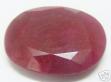
Pliny's naming of Indian ruby as chalcedony seems promising, because Pliny lives closer to th. Here is an image of an Indian ruby:
Now we turn to the next stone - nop̄eḵ. This is the first stone on the second row, and according to the Midrash was the stone of Yehuda (assuming we progress across one row at a time, in the order of the tribes).
According to Shemot 28:17-21:
What is carbuncle? Here is wikipedia's main article on Carbuncle. Someone has inserted something about carbuncle in the Bible, and claimed that it is always a translation of bareqeṯ, and is the third gem in the first row. This is the danger of relying upon one translation and then speaking authoritatively. I could edit the article and claim that alternatively, carbuncle is the translation of nop̄eḵ.
There, they write:
The word carbuncle occurs in three places in most translations of the Bible. Each use originates from the same Hebrew word בָּרְקַת בָּרְקַת or bâreqath bâreqath (baw-reh'-keth, baw-rek-ath'). In this sense, a carbuncle is usually taken to mean a gem, particularly a deep-red garnet, unfaceted and convex; however, the Hebrew definition is less definite and the precise color of the gems is not known.Assuming the same definition will apply to nop̄eḵ, perhaps it is the "deep-red garnet, unfaceted and convex," mentioned above. For scientific identification of garnet, see the Wikipedia article on garnet:
The garnet group of minerals show crystals with a habit of rhombic dodecahedrons and trapezohedrons. They are nesosilicates with the same general formula, A3B2(SiO4)3. The chemical elements in garnet include calcium, magnesium, aluminium, iron2+, iron3+, chromium, manganese, and titanium.Here is possibly an image of the carbuncle being described, from probertencyclopedia:
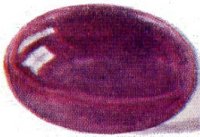 Though it matches the aforementioned description, I cannot be sure this is in fact the carbuncle described, because this encyclopedia writes to the side of it:
Carbuncle is a beautiful gem of a deep red colour (with a mixture of scarlet) . It was called by the Greeks anthrax and is found in the East Indies. When held up to the sun, it loses its deep tinge, and becomes of the colour of burning coal. The name belongs for the most part to ruby sapphire, though it has been also given to red spinel and garnet.Midrash Rabbah gives a different definition of nop̄eḵ. It states:
יהודה ברדינין.
What is baredinin? According to Jastrow (pg 190), the text should instead read כדכדון, kadkedon.
What is kadkedon ? Jastrow (pg 614) states it is the Greek word χαλxηδών, that is, chalcedony. We have actually already mentioned in a a previous post, on the first stone, ʾoḏem. JPS had claimed that ʾoḏem was carnelian, which is red form of chalcedony, while Midrash Rabbah's sardonyx seemed to be onyx with red stripes instead of black stripes alternating with white stripes, and which is also a type of chalcedony.
According to Wikipedia:
Chalcedony is one of the cryptocrystalline varieties of the mineral quartz, having a waxy luster. Chalcedony may be semitransparent or translucent and is usually white to gray, grayish-blue or some shade of brown, sometimes nearly black. Other shades have been given different names. A clear red chalcedony is known as carnelian or sard; a green variety colored by nickel oxide is called chrysoprase. Prase is a dull green and onyx is black and white banded. Plasma is a bright to emerald-green chalcedony that is sometimes found with small spots of jasper resembling blood drops; it has been referred to as blood stone or heliotrope. Flint is also a variety of chalcedony.I do not know what specific chalcedony, and what specific color, is intended here. We cannot simply rely on the common modern definition of chalcedony, which dictates that "Chalcedony may be semitransparent or translucent and is usually white to gray, grayish-blue or some shade of brown, sometimes nearly black," giving different names to different shades (wikipedia), or
Similarly, while The New Testament Greek Lexicon defines chalcedony (which occurs in Revelations) as "a precious stone of misty grey colour, clouded with blue, yellow, or purple," it seems they are using the modern definition, which perhaps is not the same as the ancient or Middle-Ages one. I would need to see their basis for this identification.
It certainly is not sardonyx, since we already have that. Perhaps it is onyx (with black stripes, matching the red striped chalcedony of the stone above)? Perhaps it is some other form of chalcedony. Thus, I am going to leave the picture out. You can find images of chalcedony over at Wikipedia.
We need to know what chalcedony was in ancient times -- or, if this midrash was composed in the Middle Ages, what it meant in the Middle Ages.
Easton's 1897 Bible Dictionary, cited at dictionary.com, states:
Mentioned only in Rev. 21:19, as one of the precious stones in the foundation of the New Jerusalem. The name of this stone is derived from Chalcedon, where it is said to have been first discovered. In modern mineralogy this is the name of an agate-like quartz of a bluish colour. Pliny so names the Indian ruby. The mineral intended in Revelation is probably the Hebrew _nophekh_, translated "emerald" (Ex. 28:18; 39:11; Ezek. 27:16; 28:13). It is rendered "anthrax" in the LXX., and "carbunculus" in the Vulgate.So according to Easton's 1897 Bible Dictionary, Revelations 2:19 uses the same Greek equivalent of nophech as does the Midrash Rabba. Perhaps. But I am not certain we can then use other translations of the same to identify chalcedony - e.g., to claim it is emerald, carbuncle, or anthrax. But perhaps (?) this is part of what led JPS to render this carbuncle.
Pliny's naming of Indian ruby as chalcedony seems promising, because Pliny lives closer to th. Here is an image of an Indian ruby:

Subscribe to:
Posts (Atom)
LinkWithin
