

Thursday, January 09, 2014


Posts so far for parshat Beshalach

- Darshening psiks in parashat Bo -- Birkas Avraham interprets three of them. I present them, with minimal comment. One of them is based on Targum Yonasan in Beshalach, that Dasan And Aviram did not leave Egypt with the Bnei Yisrael. (And here I thought it was only Nachum.)
. - Darshening psiks in parashat Beshalach -- Thus, Psik after the word מצרים, that they saw the sar [heavenly prince] of Egypt traveling from heaven to aid them; and The trup symbol of psik hints to words which are not written, to elucidate what was standing before you 'there'. Should we take the Targum Yonasan to refer to an anthropomorphic God?
. - Beshalach sources, 2012 edition.
. - YUTorah on parashat Beshalach, 2012. And also for 2013.
. - The meaning of Ki Karov Hu -- Does Ki mean 'because' or 'although'? And if peshat may mean 'although', then is Rashi saying peshat or derash?
- When did the Bnei Yisrael say חֲדַל מִמֶּנּוּ? It makes sense, chronologically, that it would fall somewhere in Va'era. I explore some approaches which are open and closed canon to varying degrees.
. - Did Levi outlive Ephraim? This is unlikely. Rashi's mention of shevatim who died is perhaps imprecise -- he means Yosef's brothers, which would not include Ephraim and Menashe.
. - Beshalach sources -- further improved. For example, many more meforshei Rashi.
. - The Karaites and Naturally Occurring Manna -- identifying the non-Karaite who said this, Chivi.
. - Who asks that manna doesn't fall today in the Sinai? Correcting an error in the JewishEncyclopedia. It wasn't Chivi! It was Ibn Ezra, rejecting Chivi.
. - All the king's horse -- Considering the singular, and how Rashi deviates from the midrash..
- YU Torah on parashat Beshalach
2010
- Beshalach sources -- more than 100 meforshim on the parsha and haftarah, organized by topic.
. - Feeding the birds on Shabbos Shirah.
. - Was it the Egyptians or the Israelites on the seashore? Two parses of the pasuk וַיַּרְא יִשְׂרָאֵל אֶת-מִצְרַיִם מֵת עַל-שְׂפַת הַיָּם? The traditional one is that the Egyptians were dead on the seashore. Rashbam and Ibn Ezra differ from Rashi and the midrash, and claim that the Israelites were standing on the seashore when they saw the Egyptians dead. I side with Rashi and Shadal, in the traditional explanation. Also, does the trup indicate anything in this regard?
. - How could it say "lest" the nation repent? Touching on Bechira vs. Omniscience, what is meant by the opening of Beshalach, thatpen the nation see war and return to Egypt? Ibn Ezra vs. Ibn Caspi.
. - Two rights -- Considering a Rashi and Mechilta about two right hands.
. - The zakef on mikkedash -- Rashi interprets the the zakef on the word מקדש in the Shirat Hayam, and is absolutely correct. Plus, considering what some supercommentators say.
. - Twisting a pasuk, to make it accord with the scientific fact of spontaneous generation -- A Mechilta, Rashi, and Ramban, all believe in spontaneous generation, and therefore grapple to understand a pasuk which seems to contradict it. This is unsurprising, since spontaneous generation was accepted as scientific fact until the recent past.
. - Rav Belsky on Anisakis Worms in Fish, and his (mis-)interpretation of Rashi -- I make reference to the aforementioned Mechilta in this piece.
2009
- Beshalach sources -- links to an online Mikraos Gedolos, by perek and aliyah, as well as to a vast array of meforshim on the parshah and haftarah. Great for preparing the parsha.
. - Beshalach commentary, first pass, pt i -- an experimental format of running commentary on a sequence of psukim.
. - Is the command not to leave one's place intended leDoros? Ramban vs. Rambam, and my own reading of the pesukim into the Ramban, on a peshat level.
. - The dangers of mispredicting the ketz -- where according to Tg Yonatan, some Israelites mispredicted the ketz and left 30 years too early. Hashem took the present Israelites in a circuitous route so that they would not encounter the results of that war and be discouraged. As I conclude there:This is certainly the case for me, in that knowledge of previous failed messianic attempts and predictions, and their repercussions (physical and theological), stands to caution me about present messianic attempts. It does not help, of course, when I see that their prooftexts are often extremely kvetched and go against the meaning in context. And perhaps that is one of the reasons I often take stands against thisketz-ism which is so prevalent today.
- Followup to mispredicting the ketz -- Addressing the question of why exactly the Bnei Ephraim left 30 years early, according to some midrashim. I claim it would be based on misunderstanding a pasuk. But would the ancient Israelites have such a pasuk to misinterpret? I address that as well.
. - After you, or after them? A derash in Chizkuni, based on neermu mayim in Beshalach and a seemingly different pasuk than we have in parshat Ekev.
2008
- Why did Yosef adjure the descendants? Trying to explain Rashi's motivation, and how Bnei Yisrael means the children of Israel rather than the children of Yaakov.
. - In his discussion on the age of trup, Shadal notes how the Mechilta reads the word in shirat haYam as nod rather than ned, and discusses what this may mean.
. - When Moshe says "Hu Asher Dibber Hashem," is this something already known, or some new and surprising information? cross-listed from parshat Shemini.
2007
- Beshalach and the Weak Fa -- explaining the first Ibn Ezra on the parsha. He is not talking about the letter feh but rather the "weak fa," a grammatical feature in Arabic, with a parallel in the vav here.
. - The Sanctuary, O Lord [which] Your Hands Founded -- and how the trup on the word mikdash removes an ambiguity and bolsters the Biblical parallelism.
. - Is VaEd In Hashem Yimloch LeOlam Vaed Spelled With a Patach or A Kamatz? No, and I don't think Rashi had it so either. (And against some who read this into Rashi.)
. - Parshat HaMan -- there is a spreading practice to say it specifically on Tuesday of parshat Beshalach. Here is a post detailing the reasons why specifically this day. And here is a post regarding my flippancy in that other post, and the difference between internalizing the message of parshat haman on the one hand, and saying it as a magical formula or incantation on the other. I mention the practice as well in 2008 in a post about Tu BeShvat seders, and that post contains a link to the (Artscroll) text.
. - Tu BeShvat Seders -- Why I oppose them (2007) and Why I *really* oppose them (2008)
2006
- Midrashic Literalism: 180 Billion in Egypt?! A Response -- A response to an article on midrashic literalism. One portion of this is an analysis of chamushim who left Egypt.
. - עָזִּי vs. עֻזִּי in actual practice -- As was leined in my shul. Heh.
. - Az Yashir: Use of the Imperfect to Designate Desire -- Moshe will sing in the future. So stated a midrash. How are we to understand this construction on a peshat level? Parallels to English "will." Also, an analysis of עָזִּי וְזִמְרָת קָהּ, וַיְהִי-לִי לִישׁוּעָה. Plus a great comment.
. - Issi ben Yehuda's Five as Disambiguated by Trup -- Cross-listed from Vayigash/Vayechi. Issi ben Yehuda gives five pesukim that are ambiguous in that they can be parsed in one of two ways. Yet trup is a logical and syntactic system of division within pesukim, and can thus disambiguate, choosing one of the two parsings. We go through each example, and one example is a pasuk from parshat Beshalach: Is Moshe saying that Yehoshua will go out to fight Amalek on the morrow, or is he saying that Moshe will stand on the top of the hill on the morrow?
2005
- Puns in the Parsha -- about the word nacham, though not the joke that poor Nachum was the only one not to leave Egypt.
. - `ain muqdam um`uchar baTorah -- in Shirat haYam, and elsewhere. Why? What else can we say?
. - Write it in the book. Which Book? After Yehoshua's victory over Amalek, Moshe is told to write something in the book. Which book? Some suggestions.
2004
- Beshalach Trivia -- Two groaners. Plus a relatively unknown, and positive spin on the chamushim with which the Israelites left Egypt, from Targum Yonatan.
. - Each According to His Appetite/Number of Eaters: Rashi's Commentary on Exodus 16:17-- An 20-page paper I wrote for a Revel class, "Rashi as an Exegete," analyzing a particular Rashi and how it connects to, and deviates from, its midrashic basis.
BTW, the filename of the image reveals what relevance it has to the parsha. ;)
to be continued...
Sunday, January 05, 2014
Word choice
In Beshalach:
Why וְחִזַּקְתִּי? It is of course a valid word choice. But sometimes כבד is used. But see later in this pasuk, with וְאִכָּבְדָה בְּפַרְעֹה. This avoids a parallelism / echoing.
End.
| ד וְחִזַּקְתִּי אֶת-לֵב-פַּרְעֹה, וְרָדַף אַחֲרֵיהֶם, וְאִכָּבְדָה בְּפַרְעֹה וּבְכָל-חֵילוֹ, וְיָדְעוּ מִצְרַיִם כִּי-אֲנִי יְהוָה; וַיַּעֲשׂוּ-כֵן. | 4 And I will harden Pharaoh's heart, and he shall follow after them; and I will get Me honour upon Pharaoh, and upon all his host; and the Egyptians shall know that I am the LORD.' And they did so. |
Why וְחִזַּקְתִּי? It is of course a valid word choice. But sometimes כבד is used. But see later in this pasuk, with וְאִכָּבְדָה בְּפַרְעֹה. This avoids a parallelism / echoing.
End.

Thursday, January 02, 2014
Interesting Posts and Articles #391
1. At Cross-Currents, Are they really Reshaim?
2. Was the Israeli snowstorm predicted in Daf Yomi and in Tanach? See at Matzav, with both, and at Shirat Devorah, with just the Daf Yomi one.
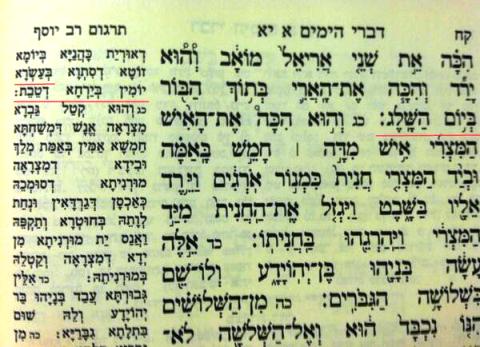
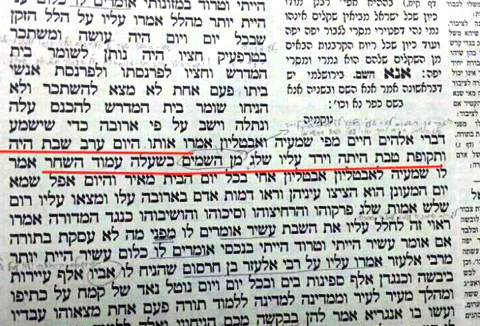
Cool, certainly at first glance. But don't make too much out of it, and of stuff like this. They reason yom hasheleg is defined by the Targum as the Yoma Zota deSitva (of winter), defined as the 10th of Tevet, is that Tevet is the height of winter. And so too, the point of the gemara's statement that it was Tevet was foreshadowing for the expected snow, just as the point of the gemara's statement that it was erev Shabbos was to prepare for the violation of Shabbos to save the frozen Hillel.
The odds are such that we would expect a Tevet with snow on a Friday. Of course, one can argue about the odds of coinciding with the Daf Yomi on the same day.
3. Dreaming of Moshiach lets us know of two stories: "All the details are absolutely true. 2 stories Translated from Russian by Chaim Zehavi." The second one.
4. Can you use a cat to turn on a light on Shabbos?
5. The Internet Archive now has a bunch of old console games, which are playable in your web browser via an emulator. Here is a game I remember from my youth, from an IBM PC version, Dig Dug. Use the letter R to start, the arrow keys to move, and the Ctrl key to fire your weapon.
6. One hundred years of techelet research, and the Gadol and the snail.
7. Frei
2. Was the Israeli snowstorm predicted in Daf Yomi and in Tanach? See at Matzav, with both, and at Shirat Devorah, with just the Daf Yomi one.


Cool, certainly at first glance. But don't make too much out of it, and of stuff like this. They reason yom hasheleg is defined by the Targum as the Yoma Zota deSitva (of winter), defined as the 10th of Tevet, is that Tevet is the height of winter. And so too, the point of the gemara's statement that it was Tevet was foreshadowing for the expected snow, just as the point of the gemara's statement that it was erev Shabbos was to prepare for the violation of Shabbos to save the frozen Hillel.
The odds are such that we would expect a Tevet with snow on a Friday. Of course, one can argue about the odds of coinciding with the Daf Yomi on the same day.
3. Dreaming of Moshiach lets us know of two stories: "All the details are absolutely true. 2 stories Translated from Russian by Chaim Zehavi." The second one.
Again, WWII. Lithuania. The Japanese Ambassador, who was a compassionate and noble person, disagreed with the Nazi crimes, and was concerned with the future of the European Jewry. He used his status and provided them with visas to Japan. From Japan they immigrated to America. Thus he saved the lives of thousands of Jews. When the Germans found out they demanded that the Ambassador will be removed. The Japanese, allies of the Nazis, followed the request. But he still had 2 weeks until his return, and he used these 2 weeks, and worked around the clock, days and nights, and recruited people to help him issue more visas. The lives of many more Jews were saved this way. This was a very dangerous act, deserving of admiration. Prior to his leaving a mission of Jews from the Vilna Synagogue came to thank him. "What you have done for the Jewish People will never be forgotten, and we will pray to God to bless you and your descendants." This wonderful person returned to Japan, and miraculously all his punishment was that he was fired and lost his pension. In order to help his family he started a small workshop.
His name was Mitsubishi.See the discussion of this "true" inspirational story at Snopes. That is:
Japan didn't establish an embassy in Lithuania until 1997, so there was no Japanese ambassador there during World War 2. However, there was a Japanese vice-consul named Chiune Sugihara, and he did help several thousand Jews leave the country. He didn't have anything to do with the Mitsubishi company, which was founded thirty years before he was born and isn't named after a person.Meanwhile, there was a real righteous and great person who has been stripped of his accomplishment, Chiune Sugihara:
ETA: Spanked! Mitsubishi built the famous Mitsubishi A6M "Zero" fighter plane.
 |
| Chiune Sugihara |
4. Can you use a cat to turn on a light on Shabbos?
5. The Internet Archive now has a bunch of old console games, which are playable in your web browser via an emulator. Here is a game I remember from my youth, from an IBM PC version, Dig Dug. Use the letter R to start, the arrow keys to move, and the Ctrl key to fire your weapon.
6. One hundred years of techelet research, and the Gadol and the snail.
7. Frei
Wednesday, January 01, 2014
YUTorah on parashat Bo


Subscribe to:
Posts (Atom)
LinkWithin
