Showing posts with label ibn caspi. Show all posts

Thursday, August 07, 2014

Ibn Caspi: Has Elokim essayed to take Him a nation

There is a nice ambiguous set of pesukim in the beginning of vaEtchanan, in Devarim 4:34. A small selection:

לב  כִּי שְׁאַל-נָא לְיָמִים רִאשֹׁנִים אֲשֶׁר-הָיוּ לְפָנֶיךָ, לְמִן-הַיּוֹם אֲשֶׁר בָּרָא אֱלֹהִים אָדָם עַל-הָאָרֶץ, וּלְמִקְצֵה הַשָּׁמַיִם, וְעַד-קְצֵה הַשָּׁמָיִם:  הֲנִהְיָה, כַּדָּבָר הַגָּדוֹל הַזֶּה, אוֹ, הֲנִשְׁמַע כָּמֹהוּ.32 For ask now of the days past, which were before thee, since the day that God created man upon the earth, and from the one end of heaven unto the other, whether there hath been any such thing as this great thing is, or hath been heard like it?
לג  הֲשָׁמַע עָם קוֹל אֱלֹהִים מְדַבֵּר מִתּוֹךְ-הָאֵשׁ, כַּאֲשֶׁר-שָׁמַעְתָּ אַתָּה--וַיֶּחִי.33 Did ever a people hear the voice of God speaking out of the midst of the fire, as thou hast heard, and live?
לד  אוֹ הֲנִסָּה אֱלֹהִים, לָבוֹא לָקַחַת לוֹ גוֹי מִקֶּרֶב גּוֹי, בְּמַסֹּת בְּאֹתֹת וּבְמוֹפְתִים וּבְמִלְחָמָה וּבְיָד חֲזָקָה וּבִזְרוֹעַ נְטוּיָה, וּבְמוֹרָאִים גְּדֹלִים:  כְּכֹל אֲשֶׁר-עָשָׂה לָכֶם ה אֱלֹהֵיכֶם, בְּמִצְרַיִם--לְעֵינֶיךָ.34 Or hath God assayed to go and take Him a nation from the midst of another nation, by trials, by signs, and by wonders, and by war, and by a mighty hand, and by an outstretched arm, and by great terrors, according to all that the LORD your God did for you in Egypt before thine eyes?
לה  אַתָּה הָרְאֵתָ לָדַעַת, כִּי ה הוּא הָאֱלֹהִים:  אֵין עוֹד, מִלְּבַדּוֹ.35 Unto thee it was shown, that thou mightest know that the LORD, He is God; there is none else beside Him.

The concluding words are Ain Od Milvado. There is only one deity. This is YKVK, mentioned in pasuk 35 as the only Elokim.

If so, what are we to make of  אוֹ הֲנִסָּה אֱלֹהִים? Are we asking whether God with a capital G did this for any other nation? This is possible, if the purpose is to show how unique we are. Hashem did this for us -- unto thee it was shown -- so that we might know this.

But on the other hand, other nations have their own national deities. For instance, Moav had Kemosh. If so, אוֹ הֲנִסָּה אֱלֹהִים might be profane, meaning a god with a lowercase g. No other deity has done this, because those deities do not exist. Hashem took these elaborate steps in order to demonstrate that he does exist.

If the latter is the meaning, then the pasuk is temporarily ascribing existence to those other gods purely in order to dismiss them from existence. They are hypothetical until they are ultimately dismissed. And in the duration, they are discussed as if they exist, but their non-action is noted. This would be from the perspective of the idolatrous other nations, or from the perspective of the Israelites before they have been shown the light.

This latter interpretation is something that might be too difficult for some to allow into the Biblical text. Or, there might be other reasons for disregarding the interpretation. I would like to present Rashi, Ibn Ezra, and finally Ibn Caspi. Because Ibn Ezra and Ibn Caspi sometimes speak cryptically, I cannot say definitively that I have entirely understood their intent. But I present it nonetheless.

Rashi writes that it is profane. Thus:


Or has any god performed miracles to come and take him a nation from the midst of a[nother] nation, with trials, with signs, and with wonders, and with war and with a strong hand, and with an outstretched arm, and with great awesome deeds, as all that the Lord your God did for you in Egypt before your eyes? לד. אוֹ | הֲנִסָּה אֱלֹהִים לָבוֹא לָקַחַת לוֹ גוֹי מִקֶּרֶב גּוֹי בְּמַסֹּת בְּאֹתֹת וּבְמוֹפְתִים וּבְמִלְחָמָה וּבְיָד חֲזָקָה וּבִזְרוֹעַ נְטוּיָה וּבְמוֹרָאִים גְּדֹלִים כְּכֹל אֲשֶׁר עָשָׂה לָכֶם יְהֹוָה אֱלֹהֵיכֶם בְּמִצְרַיִם לְעֵינֶיךָ:
Or has any god performed miracles: Heb. הֲנִסָּה אלֹהִים. Has any god performed miracles (נִסִּים) ? הנסה אלהים: הכי עשה נסים שום אלוה:


Onkelos takes it as holy:

ד,לד אוֹ הֲנִסָּה אֱלֹהִים, לָבוֹא לָקַחַת לוֹ גוֹי מִקֶּרֶב גּוֹי, בְּמַסֹּת בְּאֹתֹת וּבְמוֹפְתִים וּבְמִלְחָמָה וּבְיָד חֲזָקָה וּבִזְרוֹעַ נְטוּיָה, וּבְמוֹרָאִים גְּדֹלִים:  כְּכֹל אֲשֶׁר-עָשָׂה לָכֶם יְהוָה אֱלֹהֵיכֶם, בְּמִצְרַיִם--לְעֵינֶיךָ.אוֹ נִסִּין עֲבַד יְיָ, לְאִתְגְּלָאָה לְמִפְרַק לֵיהּ עַם מִגּוֹ עַם, בְּנִסִּין בְּאָתִין וּבְמוֹפְתִין וּבִקְרָבָא וּבְיַד תַּקִּיפָא וּבִדְרָעָא מְרָמְמָא, וּבְחֶזְוָנִין רַבְרְבִין:  כְּכֹל דַּעֲבַד לְכוֹן יְיָ אֱלָהֲכוֹן, בְּמִצְרַיִם--לְעֵינֵיכוֹן.

Ibn Ezra says it is kodesh, and chas veshalom that it is profane!

[ד, לד]
או הנסה אלהים -
יש אומרים:
 
שהוא לשון חול וחלילה חלילה, רק לשון קדושה.

הנסה -כדרך בני אדם, כדי שיבינו השומעים.

"Or has Elokim tried: Some say that it is profane, and forfend! Rather it is holy.
Tried: In the way of people, so that the hearers may understand."

This is a facet which is new and interesting. That is (maybe), one might object to it being holy, referring to Hashem, based on HaNisa. Or maybe the point is orthogonal to the previous. There is no effort involved in Hashem performing anything, so why use the word HaNisa? The answer is a sort of dibra Torah kilshon benei Adam. Just as people try to do something, or set out to do something. One can thus use this idiom about a possible action of Hashem. And it a useful idiom, for the sake of the audience understanding. But we, who know better, understand that this is just an idiom, and would not ascribe an 'attempted action' to God.

This makes sense to me, even though I would prefer the interpretation of Rashi.

Ibn Caspi writes:

"Did [Elokim] Attempt: the Torah speaks in the language of people. And Elokim is holy [meaning a reference to Hashem, rather than profane, to idols]. Because He is the first Actor, and there are many 'elohim' below him, Yisbarach, working from him."
This is somewhat cryptic, but I think that learning through Ibn Ezra first can help clarify, at least a little bit. This is true in general, that it is important to get a sense of the intellectual climate in which a commentator writes.

I might have thought that when Ibn Caspi wrote "the Torah speaks in the language of people", he was explaining that this refers to their belief in the existence of other gods, which would then (at first) be in contrast with his immediately following statement that Elokim in kodesh, but not in contrast with the last statement (of God being the first Actor atop other Elohim beneath).

But now that I've seen Ibn Ezra, I think that when Ibn Caspi said upon Hanisa that "the Torah speaks in the language of people", he means that the concept and idiom of "attempted action" ascribed to God is the language of people. Further, that Elokim is kodesh, just as Ibn Ezra and Onkelos said.

But then a refinement, possibly motivated by theology or possibly motivated by peshat concerns, I think he is harmonizing this with Rashi. Suddenly, those actors, the אֱלֹהִים, in all those pesukim are actually not entirely God with a capital G. They are the lower actors, secondary causes without free will, all propelled by Hashem who is the First Cause. And that is peshat in all these pesukim. So indeed, chalila that the pesukim would even temporarily posit the existence of other gods, but rather, these do exist, but are part of, an extension of Hashem.

What then to make of the closing line,  אַתָּה הָרְאֵתָ לָדַעַת, כִּי ה הוּא הָאֱלֹהִים:  אֵין עוֹד, מִלְּבַדּוֹ? Isn't the function of this to deny those other beings existence?

No. The purpose is to say that Hashem is the overlord and first cause of those other powers, which are just extensions of His Divine Will. Hashem is those Elohim. There is none beside Him. Those others are not true gods.

Maybe. This is what Ibn Caspi says on that pasuk, 35:


Tuesday, December 03, 2013

ACH in אַךְ טָרֹף טֹרָף -- an expression of certainty, doubt, or reduction?

Famously, אך and רק midrashically come only to exclude, to be memaet. And this is interesting because according to Biblical scholars, this usage of אך is only in Rabbinic Hebrew, while in Biblical Hebrew it means "surely", or "indeed". If so, this is an anachronistic sort of derasha, and so one reads in alternate meanings to what would have been intended by the Biblical author.

You could argue and say that the meaning in Rabbinic Hebrew is also the meaning in Biblical Hebrew. This would require analysis of how it is used across Tanach.

There is an אך in Vayigash that caught my eye. Yaakov relates the loss of Yosef, in Bereishit 44:28:

 The one went away from me, and I said, "He has surely been torn to pieces, and I have not seen him since."כח. וַיֵּצֵא הָאֶחָד מֵאִתִּי וָאֹמַר אַךְ טָרֹף טֹרָף וְלֹא רְאִיתִיו עַד הֵנָּה:
Or HaChaim is therefore impelled to interpret it as an exclusion:


"ACH TAROF etc.: He hints, by saying אך, that it is a reduction of טָרֹף טֹרָף, for he [Yosef] is not in the distress of servitude nor in the distress of prison. And that is why he concludes וְלֹא רְאִיתִיו עַד הֵנָּה, behold he is relating that he does exist, but he has yet to see him until now.

Further is intended by אַךְ טָרֹף טֹרָף etc. to explain that אך is a reduction specifically in the tearing [טָרֹף], but regarding that which he said 'a wild animal ate him", which they za'"l said was intended as a reference to the wife of Potifar, in this, there is no reduction, for he was already [????] that which she caused him [Yosef] to lose 10 seons, for he had been destined to raise 12 tribes, as they za'l said, and via this wickedness [??] ten drops [of semen] fell from him and thus only two [Ephraim and Menashe] came from him."

OK, not exactly what I would call peshat, even though it comes from the Or HaChaim. But this sort of close reading / midrashic reading makes a great deal of the Rabbinic understanding of אך.

Onkelos translates this אך as ברם. But is he saying "only" or "indeed"?

Look at Jastrow, who shows that in Aramaic it has both meanings:

Though maybe we should restrict our investigation to Targum.

Rabbenu Yonah Ibn Janach writes as follows, taking this אך as a doubt -- thus, perhaps, a miut -- as opposed to the usual "surely":

"The word אך here does NOT come to relate that it is a certain thing, as it meant in [Bereishit 29:14, Lavan speaking to Yaakov]

יד  וַיֹּאמֶר לוֹ לָבָן, אַךְ עַצְמִי וּבְשָׂרִי אָתָּה; וַיֵּשֶׁב עִמּוֹ, חֹדֶשׁ יָמִים.14 And Laban said to him: 'Surely thou art my bone and my flesh.' And he abode with him the space of a month.

but rather for a doubt. And a proof to this is [the end of the pasuk] וְלֹא רְאִיתִיו עַד הֵנָּה. And had it been the case in truth, it would not have been correct to say this." (Sefer HaShorashim 28)

Presumably, Ibn Janach's reason is that "I have not seen him" indicates some uncertainty. Well, I haven't seen him, so presumably he is dead. And why say this if you saw his bloody clothing? Of course you would not be expecting to see him after this.

But one (meaning Josh) could argue in the opposite direction. For instance: Yaakov is saying that this was what he was convinced of, based on the evidence, at the time. Yes, maybe Yosef could have lost the clothing and survived the attack. But Yaakov is further convinced that his interpretation of Yosef's death was true because Yosef never did surface.

Moreover, one should not ignore the emotion of the statement. This loss / disappearance of Yosef profoundly affected Yaakov, and a grieving father confronted with this loss would say, emotionally, surely this has happened. Whether or not there is absolute hard evidence.

Ibn Ezra, I think, says much of the same thing, though projecting the certainly to the present day:

אך טרף טרף. והעד כי לא ראיתיו עד הנה:

He has אך [certainly] been torn. And the evidence of this is that I have not seen him until now.

Meanwhile, Rabbi Yosef Ibn Caspi argues, and introduces a safek into the proceedings:


"The import is 'I said, and estimated [J: back then] that he was torn, though this had an element of doubt. But regardless, I have not seen him until now.' And see [says Ibn Caspi] the difference between my position and that of the Chacham Ibn Ezra who said 'and the evidence is לא ראיתיו עד הנה. For this is no evidence at all!"

Monday, November 25, 2013

The Documentary Hypothesis and the Doublet of Pharoah's Dream

An interesting thought occurred to me while reading over Ibn Caspi on Miketz, and, baruch shekivanti, I see that others have raised something similar before me.

Pharoah's dreams are related twice -- once by the narrator and once in Pharaoh's retelling. (And a third time, within Yosef's interpretation.) This is thus a "doublet". And there are slight "inconsistencies" between the two, in terms of descriptions, and details in one and not in the other. Does the Documentary Hypothesis divide these into different documents? And if not, why not? Why do they make a big deal of some doublets and not others, and why some inconsistencies (which are, upon close examination, making a mountain out of a molehill) and not others?

To cite Ibn Caspi about the inconsistencies:

"And Pharaoh said to Yosef, in my dream...: I have already written in the sefer Tiras Kesef the reason of the repetition and the change in words which appear."

Here is what Ibn Caspi says on that page (124) of Tiras Kesef:

The changes in the dream are minor, and might simply be natural variation, or else the true elaboration that emerges as one naturally tells over a dream. But a midrash picks up on these changes, and that Yosef changed them back in the interpretation, to proffer that Pharaoh deliberately changed the dream as a test, and Yosef passed the test by telling Pharaoh his true dreams.

Examples of the sorts of variations one might spot:
When Pharaoh repeated his dream to Joseph, he changed it a bit, either purposely to see if Joseph really knew, or unintentionally, as we often don't remember exact details. For example, Pharaoh started off on the shore of the river (taking a sun tan!) while the original dream said "On the river," stressing the Nile as the sustenance of Egypt. Pharaoh stressed the aesthetic aspect of the cows: "I never saw such poor cows in all of Egypt" (Genesis 41:19), instead of the fact that they were skinny and fat.
Or, as voiced by Tanchuma Miketz, siman 3:
ויוסף ענו בכבל רגלו ברזל באה נפשו (תהלים קה) 
ונתרומם, שנאמר: ויוסף הוא השליט על הארץ.
אמר ליה פרעה: חלום חלמתי. אמר יוסף: בלעדי אלהים יענה וגו', תלה הגדולה בבעליה. 
אמר הקב"ה: אתה לא רצית להתגדל בעצמך, חייך, שעל ידי כך תעלה לגדולה ולמלוכה.
אמר פרעה: חלום חלמתי, כשבא לומר לו את החלום בקש לבודקו, והיה מהפך לו את החלום. אמר ליה: והנה מן היאור עולות שבע פרות. 
אמר ליה יוסף: לא כך ראית, אלא יפות מראה ובריאות בשר. 
אמר ליה: הנה שבע פרות דלות ורעות. 
א"ל: לא כך ראית, אלא רעות מראה ודקות בשר. 
א"ל: הנה שבע שבלים מלאות וטובות. 
א"ל: לא כך ראית, אלא בריאות וטובות. 
א"ל: והנה שבע שבלים צנומות דקות. 
א"ל: לא כך ראית, אלא דקות שדופות קדים. 
התחיל פרעה תמה בעצמו. 
א"ל: אחרי היית כשחלמתי, שנאמר: אחרי הודיע אלהים אותך את כל זאת, הוא שאביו מברכו: בן פורת יוסף (בראשית מט), אל תקרא בן פורת אלא בן הפרות יוסף. 
השיב פרעה: אתה תהיה על ביתי. 
These are, perhaps, weak sorts of variations. (But then, I consider Yishmaelim / Medanim / Medanim as the ones who bought Yosef from the brothers to also be a somewhat weak variation.)

Yet, all these are assigned to E.

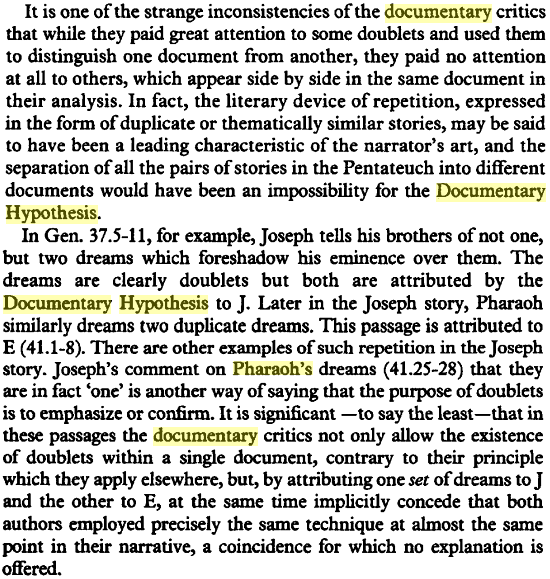
I looked into it a bit (meaning a few minutes of Googling), and I saw that a similar (but not precisely identical point) was made by Whybray in The Making of the Pentateuch: A Methodological Study, pg 78:

Thus, the doublets he points out are the fact that Yosef has two dreams with the same message; Pharaoh has two dreams with the same message. (Similarly, I would point out, the butler and baker have similar dreams with slight contrasts which lead to opposite messages.) And these are assigned to the same author, J and E, respectively, and it is understood that parallelism from doublets are used by both authors as a technique.
a

Monday, August 05, 2013

Ibn Caspi on the where of Aharon's death

In my previous post, I mentioned the yada yada yada theory of Aharon's death, that a seeming discrepancy between the location of Aharon's death in Masei (Hor Hahar) and Ekev (Mosera) could be explained as a difference in purpose. In the mussar shmuess in Ekev, Moshe's concern is not detailed history, but that Aharon died at a later encampment, and not at Har Sinai. As such, the shortened list of masaot are meant as a quick stand-in, and the reader can be expected to fill in the rest, and know that שָׁם מֵת אַהֲרֹן וַיִּקָּבֵר שָׁם means not at that very next encampment, Mosera, but somewhere along the lines.

I mentioned that Ibn Caspi said likewise, that it was a yada yada yada. Here I present Ibn Caspi's words.

The pasuk in Ekev, in Devarim 10:6:
ו  וּבְנֵי יִשְׂרָאֵל, נָסְעוּ מִבְּאֵרֹת בְּנֵי-יַעֲקָן--מוֹסֵרָה; שָׁם מֵת אַהֲרֹן וַיִּקָּבֵר שָׁם, וַיְכַהֵן אֶלְעָזָר בְּנוֹ תַּחְתָּיו.6 And the children of Israel journeyed from Beeroth-benejaakan to Moserah; there Aaron died, and there he was buried; and Eleazar his son ministered in the priest's office in his stead.

Ibn Caspi writes:

וּבְנֵי יִשְׂרָאֵל, נָסְעוּ מִבְּאֵרֹת...: it is known that the matter of the first and second Tablets [mentioned in the preceding section] were at Har Sinai. And behold, at the beginning of the second year they traveled from there, for then, Hashem said to him לֵךְ עֲלֵה מִזֶּה (Shemot 33:1). And so too [in parallel], קוּם לֵךְ לְמַסַּע לִפְנֵי הָעָם (in Devarim 10:11).

And the separation of the Levites was then, for to this is that בָּעֵת הַהִוא, הִבְדִּיל ה אֶת-שֵׁבֶט הַלֵּוִי is alluding to (in Devarim 10:8).

And further it said (Devarim 10:10) וְאָנֹכִי עָמַדְתִּי בָהָר, relating what was involved in his standing for the second set of Tablets.

If so, it is a great wonder that, inserted into this story [between the second Tablets in Devarim 10:1 and the standing for those Tablets in 10:10], is [verse 10:6] וּבְנֵי יִשְׂרָאֵל, נָסְעוּ מִבְּאֵרֹת בְּנֵי-יַעֲקָן. And certainly that it states שָׁם מֵת אַהֲרֹן, whereas Aharon only died on Har HaHar [see Bemidbar 33 for example].

Therefore I say that Moshe intended in this to shorten and skip over all the matters who occurred from their traveling from the wilderness of Sinai until the death of Aharon, which was in the 40th year, for at that point he began to chastise him, as he said [Devarim 10:12]:
יב  וְעַתָּה, יִשְׂרָאֵל--מָה ה אֱלֹהֶיךָ, שֹׁאֵל מֵעִמָּךְ:  כִּי אִם-לְיִרְאָה אֶת-ה אֱלֹהֶיךָ לָלֶכֶת בְּכָל-דְּרָכָיו, וּלְאַהֲבָה אֹתוֹ, וְלַעֲבֹד אֶת-ה אֱלֹהֶיךָ, בְּכָל-לְבָבְךָ וּבְכָל-נַפְשֶׁךָ.12 And now, Israel, what doth the LORD thy God require of thee, but to fear the LORD thy God, to walk in all His ways, and to love Him, and to serve the LORD thy God with all thy heart and with all thy soul;
This is as if saying: behold, your fathers committed many sins in the wilderness of Sinai, and from there we traveled and arrived here. And no leader is left for you except me, for Aharon has died, and so will I do in this year. 

Howbeit, that which Ibn Ezra wrote [in resolution of the order discrepancy / Aharon death discrepancy] that the place names mentioned here are not like the named mentioned in parashat Masei, it indeed is true according to my opinion, for [in Devarim 10:7] גֻּדְגֹּדָה and יָטְבָתָה are general names for the later travelings, for it is very correct that a Big Name [? perhaps a Proper Noun ?] or an individual place can describe both the general and the specific, and all the more so by virtue of the fact that there is a great length to that border."

End quote Ibn Caspi.

Thursday, May 10, 2012

A literal eye for an eye

Summary: according to Ibn Caspi, Ibn Ezra, Rambam, and Shadal. Plus, what is morally called for?

Post: Consider the following pasuk from parashat Emor, perek 24:

19. And a man who inflicts an injury upon his fellow man just as he did, so shall be done to him [namely,]יט. וְאִישׁ כִּי יִתֵּן מוּם בַּעֲמִיתוֹ כַּאֲשֶׁר עָשָׂה כֵּן יֵעָשֶׂה לּוֹ:
20. fracture for fracture, eye for eye, tooth for tooth. Just as he inflicted an injury upon a person, so shall it be inflicted upon him.כ. שֶׁבֶר תַּחַת שֶׁבֶר עַיִן תַּחַת עַיִן שֵׁן תַּחַת שֵׁן כַּאֲשֶׁר יִתֵּן מוּם בָּאָדָם כֵּן יִנָּתֶן בּוֹ:

Thus, if we interpret this most literally, a literal eye for a literal eye. He inflicted an injury upon a person, so that precise injury should be inflicted upon him.

Rashi cites Chazal on this pasuk:

so shall be done to him: Heb. כֵּן יִנָּתֵן בּוֹ. Our Rabbis explained that this does not mean the actual infliction of a wound, but payment of money. [And how is an injury estimated? The victim] is evaluated as a slave [if he would not have had the injury, and how much with the injury, and the difference is the compensation]. This is why Scripture uses the expression נְתִינָה, “giving,” [thereby alluding to] something that is “handed over (הַנָתוּן)” from hand to hand. — [B.K. 84a]כן ינתן בו: פירשו רבותינו, שאינו נתינת מום ממש אלא תשלומי ממון, שמין אותו כעבד, לכך כתוב בו לשון נתינה, דבר הנתון מיד ליד:

The word yinaten is the nif'al, that is, the passive. So if it does not mean 'so shall be inflicted upon him [the injurer]', it would mean here 'so shall he [the injuree] be given [monetary payment].' I've discussed this in the past, but let us see what Ibn Caspi has to say here:

It is possible I misunderstand him here, but it certainly seems as if he adopts the more literal explanation as the plain meaning, perhaps even without any modification! He points us to Ibn Ezra and the Rambam. Here is what Ibn Ezra says:

כד, כ]
כן ינתן בו -
יש בי"ת תחת על כמו: אשר אני רוכב בה ורבים כן. 
או פירושו כן ינתן בו, אם לא יפדה.

That is, regarding the ב of בו, 'there is a ב which functions in place of על' and thus this means עליו, such that it means "so shall he be given for it", 'as we see in Nechemiah 2:

יב  וָאָקוּם לַיְלָה, אֲנִי וַאֲנָשִׁים מְעַט עִמִּי, וְלֹא-הִגַּדְתִּי לְאָדָם, מָה אֱלֹהַי נֹתֵן אֶל-לִבִּי לַעֲשׂוֹת לִירוּשָׁלִָם; וּבְהֵמָה, אֵין עִמִּי, כִּי אִם-הַבְּהֵמָה, אֲשֶׁר אֲנִי רֹכֵב בָּהּ.12 And I arose in the night, I and some few men with me; neither told I any man what my God put into my heart to do for Jerusalem; neither was there any beast with me, save the beast that I rode upon.

and many others like it.


Alternatively, its explanation is "so shall it be inflicted upon him" -- if he does not redeem.'

Related, see Ibn Ezra on cutting off a woman's hand, towards the end of parashat Ki Teitzei. Thus, we see Ibn Ezra ready to establish this literal reading as the true meaning of the pasuk, but letting it be superseded by the concept of kofer.

Ibn Caspi says that Rambam hints at his opinion in this. Perhaps he is referring to the following from Mishneh Torah, hilchos chovel umazik, perek 1:
ג  זֶה שֶׁנֶּאֱמָר בַּתּוֹרָה "כַּאֲשֶׁר יִתֵּן מוּם בָּאָדָם, כֵּן יִנָּתֶן בּוֹ" (ויקרא כד,כ)--אֵינוּ לַחְבֹּל בְּזֶה כְּמוֹ שֶׁחָבַל בַּחֲבֵרוֹ, אֵלָא שְׁהוּא רָאוּי לְחַסְּרוֹ אֵבֶר אוֹ לַחְבֹּל בּוֹ כְּמוֹ שֶׁעָשָׂה; וּלְפִיכָּךְ מְשַׁלֵּם נִזְקוֹ.  וַהֲרֵי הוּא אוֹמֵר "וְלֹא-תִקְחוּ כֹפֶר לְנֶפֶשׁ רֹצֵחַ" (במדבר לה,לא), לָרוֹצֵחַ בִּלְבָד הוּא שְׁאֵין כֹּפֵר; אֲבָל לְחֶסְרוֹן אֵבָרִים אוֹ לְחַבְלוֹת, יֵשׁ כֹּפֶר.ש

ד  וְכֵן זֶה שֶׁנֶּאֱמָר בַּחוֹבֵל בַּחֲבֵרוֹ וּמַזִּיקוֹ "לֹא תָחוֹס, עֵינֶךָ" (דברים כה,יב), שֶׁלֹּא תָחוֹס בַּתַּשְׁלוּמִין:  שֶׁמֶּא תֹּאמַר עָנִי הוּא זֶה, וְשֶׁלֹּא בְּכַוָּנָה חָבַל בּוֹ; אֲרַחֲמֶנּוּ.  לְכָּךְ נֶאֱמָר "לֹא תָחוֹס, עֵינֶךָ".ש
"This that the Torah stated {in Emor, the pasuk above}, 'Just as he inflicted an injury upon a person, so shall it be inflicted upon him.' -- this is not to inflict upon him {the actual injury} that he inflicted upon his fellow, but rather that he is fitting to lose a limb or to get inflicted upon as he did. And therefore, he should pay his damages. And behold, it states in Bemidbar 35:31 'and you shall not take kofer for the life of the murderer'. For a murderer alone is there no kofer, but for loss of limbs or injuries, there is kofer.


And so too this is stated by one who injures his fellow and damages him {in the aforementioned pasuk in Ki Teitzei, Devarim 25:12, about a woman who crushes a man's testicles}, 'your eye shall not spare', that you should not have mercy in the payment, lest you say 'he is a pauper', or 'he did not injure him intentionally, and therefore I will have mercy on him'. Therefore it is stated, 'your eye shall not spare.' "

(And Shadal says on the pasuk in Bemidbar 35:31, upon 'and you shall not take kofer for the life of the murderer', the comment that "they said well in Shas: but you shall take kofer for matters of limbs, an eye  for an eye." Shadal intends the same.)

There was a case recently in the news about an Austrian dentist who removed all of her ex-boyfriend's teeth. Her punishment was three years in prison. I would imagine that in addition, the ex-boyfriend could sue her civilly for monetary compensation. But imagine it was just money. Is that really justice, that someone can ruin someone's life in this manner and walk away with such a minor penalty? Viscerally, emotionally, there does seem to be some merit to 'an eye for an eye'. On the other hand, are you truly going to take the most horrific actions that sick, twisted or evil people do and, in a civilized society, appoint an agent for the people to act in precisely the same manner? Here is a case from Iran from last year, where a spurned suitor threw acid in a woman's face, blinding her in both her eyes. The punishment was to blind one of his eyes, since a man is worth two women. In the end, right before the court was to impose this punishment, she pardoned him and spared him this penalty.

Sunday, May 06, 2012

Who was the Shifcha Charufa?

Summary: Is she only not fully redeemed? Or is she actually completely a maidservant? What is bothering Ibn Caspi? We can look to Shadal, I think.

Post: Consider this pasuk and Rashi in Kedoshim. There is a lot to read:

20. If a man lies carnally with a woman, and she is a handmaid designated for a man, and she had not been [fully] redeemed nor had her document of emancipation been granted her, there shall be an investigation; they shall not be put to death, because she had not been [completely] freed.כ. וְאִישׁ כִּי יִשְׁכַּב אֶת אִשָּׁה שִׁכְבַת זֶרַע וְהִוא שִׁפְחָה נֶחֱרֶפֶת לְאִישׁ וְהָפְדֵּה לֹא נִפְדָּתָה אוֹ חֻפְשָׁה לֹא נִתַּן לָהּ בִּקֹּרֶת תִּהְיֶה לֹא יוּמְתוּ כִּי לֹא חֻפָּשָׁה:
designated for a man: נֶחֱרֶפֶת, designated and specified for a [particular] man. And [regarding this term נֶחֱרֶפֶת,] I do not know of [a term] resembling it anywhere in Scripture, but the Scripture is speaking of a Canaanite handmaid, partly a handmaid and partly a free woman [i.e., she belonged to two partners and one freed his part of her], who is betrothed to a Hebrew slave, who is permitted to [marry] a handmaid. — [Torath Kohanim 19:52; Kereithoth 11a]נחרפת לאיש: מיועדת ומיוחדת לאיש, ואיני יודע לו דמיון במקרא. ובשפחה כנענית שחציה שפחה וחציה בת חורין המאורסת לעבד עברי שמותר בשפחה, הכתוב מדבר:
and she had not been [fully] redeemed: Heb. וְהָפְדֵּה לֹא נִפְדְּתָה, she is redeemed, but not redeemed. And when the unqualified term פִּדְיוֹן, “redemption” is employed, it means [redeeming with money. — [Torath Kohanim 19:53]והפדה לא נפדתה: פדויה ואינה פדויה וסתם פדיון בכסף:
nor had her document of emancipation been granted her:[the unqualified term חפשׁ, “freeing,” refers to doing so] with a document [of release]. — [Torath Kohanim 19:53]או חפשה: בשטר:
there shall be an investigation: Heb. בִּקֹרֶת תִּהְיֶה [which will result in] the woman being given lashes but not the man (Torath Kohanim 19:54) The court is obligated to investigate the matter in order not to sentence him [her] to death, since “she had not been [completely] freed” [and therefore,] her marriage is not completely binding. Our Rabbis, however, learned from [this verse], that whoever is sentenced to lashes [as this woman, those lashes] shall be accompanied by a “recitation” [בִּקֹרֶת בִּקְרִיאָה, derived from the בִּקֹרֶת, so that the phrase בִּקֹרֶת תִּהְיֶה is expounded to mean “she is to be given lashes with a קֹּרֶת, a recitation.” And what is the recitation referred to here? It is] that the judges who mete out the lashes, shall recite to the one receiving them (Deut. 28:58-59),“If you will not observe to fulfill [all the words of this Torah]…the Lord will bring upon you…uniquely [horrible] plagues!”- [Kereithoth 11a]בקרת תהיה: היא לוקה ולא הוא, יש על בית דין לבקר את הדבר שלא לחייבו מיתה, כי לא חפשה, ואין קידושיה קידושין גמורין. ורבותינו למדו מכאן שמי שהוא במלקות יהא בקריאה, שהדיינים המלקין קורין על הלוקה (דברים כח נח - נט) אם לא תשמור לעשות וגו' והפלא ה' את מכותך וגו':
because she had not been [completely] freed: And therefore, the man is not liable to the death penalty because of [his intimacy with] her, since her marriage is not binding. It follows then, that if she had been freed, her marriage would be binding, and he would be liable to the death penalty. — [Torath Kohanim 19:55; Gittin 43b]כי לא חפשה: לפיכך אין חייב עליה מיתה, שאין קידושיה קידושין, הא אם חופשה, קידושיה קידושין וחייב מיתה:

Ibn Caspi respectfully declines the opportunity to discuss the Shifcha Charufa. He writes:

"See in the commentary of Rabbenu Shelomo {=Rashi} the tradition of the Talmud, for I am not able to contradict its say-so."

This might be a ringing endorsement. At the same time, one can read in the tension and temptation, that he saw the potential, at least, for interpreting the pasuk in another way, which might strike someone as more along the lines of peshat.

How might we interpret this pasuk otherwise? Let us examine what Shadal says:
כ בקרת תהיה : כפירוש רמב"ן הפקר , כלומר אין לה דין נשואה מאחר שלא חופשה ותהיה נחשבת כהפקר לענין שלא יומתו כנואפים . ולדעתי ולדעת ראב"ע ישראלית היא ולא כנענית ; ולדעת רז"ל ( כריתות י"א ע"א ) אף הכנענית אם נשתחררה , קדושיה קדושין ככל בת ישראל . וטעם המצווה שלא יחשוב האדון להשתמש בה כשפחה , וגם למשכב , אלא או ישחררנה וייקחנה כמשפט הבנות , או תהיה הפקר לו ולאחרים בשווה . והנה גם האשם הזה הוא שגגה 
ignorantia juris, 
 כמו למעלה סימן ה', כי השוכב עמה חושב שהיא הפקר ממש , והרי היא מותרת לכל אדם , ואין הדבר כן , אך בקורת תהיה בדיעבד לענין שלא יומתו , אך לא בקורת היא שיבוא עליה מי שירצה לכתחילה  .
"As in the commentary of the Ramban, hefker, ownerless. That is to say that she does not have the law of a fully-married woman since he did not free her, and so she is considered like hefker in the matter that they shall not die as adulterers.


And in my opinion, and in the opinion of Ibn Ezra, she was an Israelite woman and not a Canaanite. And in the opinion of Chazal (Krisus 11a), even the Canaanite, if she were freed, her kiddushin would be kiddushin like any daughter of an Israelite.


And the reason for the commandment is in order that the owner does not think to make use of her as a maidservant, as well as for intercourse. Rather, he should either free her and take {=marry} her in the proper law of daughters {of Israel}, or else she shall be hefker to him and to others equally. 


And behold, this transgression as well is a shegaga {accident} of ignorantia juris {ignorance of the law, which apparently is so an excuse}, just as above in perek 5, for the one who sleeps with her believes that she is literally hefker, and that she is permitted to every man, while the matter is not so -- rather, she is bikores {=hefker} after the fact, bedieved, in terms of that they shall not die, but she is not bikores such that anyone can sleep with he lichatchila."

As well as in Mishtadel:
 ב " המשתדל " לשד"ל לס' ויקרא בא עוד : האדון משתמש בשפחתו כשפחה וגם למשכב , ואין כן רצון בעל התורה ית', אלא ישחררנה וייקחנה כמשפט הבנות , ואם לא ישחררנה הרי היא " בקורת " כלומר הפקר ( כפירוש רמב"ן ), ואם ישכב איש אותה אין עליו משפט נואף , הואיל ולא חפשה , כי אין אשת איש אלא בת חורין , וכמו שמצאנו באשת יפת תואר לא תתעמר בשפחה אשר עניתה ( דברים כ"א י"ד). והנה האשה הזאת מצד אחד היא מיוחדת לאדוניה אשר קנה אותה ומזונותיה עליו , ואין ראוי לה שתפקיר עצמה לאחרים , ואין ראוי לאחרים שינהגו בה מנהג הפקר , לפיכך השוכב עמה חוטא ; ומצד אחר היא הפקר , כי התורה ענשה את האדון שלא תהיה לו כאשת איש , כל זמן שלא הוציאה לחרות ; לפיכך השוכב עמה יש לו צד היתר ומתכפר בקרבן .

The Mishtadel, from Shadal, on sefer Vaakra further comes to say: "The mater makes use of his maidservant as a maidservant as well as for intercourse, and such is not the desire of the Giver of the Torah, yisbarach. Rather, he should either free her and marry her as the law is for {Israelite} daughters, or, if he does not free her, behold she is bikores, that is to say, hefker (as in the commentary of the Ramban). And if a man sleeps with her, there is not upon him the law of an adulterer, since he {=the master} did not free her, for a married woman is only a free woman, just as we find by an eshes yefas toar, that you shall not betray her as a maidservant with whom you had intercourse. (See Devarim 21:14.) And behold, this woman, by one aspect, is reserved for her master who bought her, and who has her sustenance upon him, and it is not appropriate that she make herself hefker to others, nor is it appropriate for others to conduct themselves with her in a custom of hefker. Therefore, one who sleeps with her sins. And from another aspect, she is hefker, since the Torah punished the master that she is not to him like a married woman, so long as he does not send her out to freedom. Therefore, one who sleeps with her has to himself a side of permission, and is atoned for by a korban."

The Karaites, as well, consider this to be a simple amah ivriyah as discussed in parashat Mishpatim, rather than someone who is half slave and half-free.

LinkWithin

Blog Widget by LinkWithin