
- Rav Belsky on the concert ban.
- Yehuda has a post about the fifth cup.
- In a recent post in my translation of Vikuach al Chochmat haKabbalah, Shadal mentions the compelling theory that the (/an) author of the Zohar was Avraham Abulafia, a false messiah.
- Rafi G. posts on a segulah of reading a particular letter on erev Pesach. And Nava posts the text of the letter in a comment at the bottom.
- A Masculine Haggadah?
Not so much:
It is quite possible I am incorrect in this, but my assessment is not that this Exodus is a result of an over-focus on gender. Thus, Reform promoting feminism in the name of Judaism makes men uncomfortable. The solution should not be to say that women will do this and men will do that. I think it is just being remarkably silly and misguided, along the similar paths as the initial mistake. Not to mention that it is a transparent ploy, which I think many men will see through as inauthentic.In an effort to stanch a modern-day Exodus — men fleeing its synagogues — Judaism’s largest denomination has for the first time adopted a new seder and Haggadah for men only.
Not even female cantors are allowed.
“It uses the structure of a Haggadah to bring men together to explain contemporary Jewish men’s issues,” said Doug Barden, executive director of the Men of Reform Judaism, which represents 250 temple brotherhoods and its 20,000 members.
The authors of the Haggadah — Dan Moskovitz, a Reform rabbi, and Perry Netter, a Conservative rabbi — note in an introduction that there are “certain experiences that only men can share ... Men need the company of men, to be men.”
How about a focus instead on the meaning of the seder, exodus from Egypt, freedom, faith, etc.? Not everything has to tie into a feminist, or masculist agenda. There can be things which are just as they are.
The key, that is, is not to encourage the trend and say women can have their seder and men can have their own. Rather, it is to discourage the feminist seders in the first place. Judaism should be Judaism, and a seder should be a sefer, not just a way to advance a particular agenda over and over and over again.
Thursday, April 17, 2008
Interesting Posts and Articles #21

The Authenticity of Kabbalah pt iii
Shadal continues his Vikuach al Chochmat haKabbalah. (See previous segment.) The guest continues to draw his distinction between believing the Mishna and the Neviim are not forgeries, on the one hand, and believing the Zohar is, on the other. The text of the Vikuach follows:
 And so it is in the matter of the Mishna, and so too in the matter of Neviim and the holy writings, and so too in the matter of the Torah itself. For behold, the Torah, and the Mishna, and the books of the New Testament of the Christians, all of them inform that the Torah of Moshe was widespread and accepted in our nation at the beginning of the exile and at the end of the time of the second Temple; and the Temple itself, and the service which was done in it, is clear testimony to the widespread faith in this Torah from the day that the Temple was established and on.
And the books of Ezra and Nechemiah, and Chronicles, and Yechezkel and Yirmiyah, all of them testify and tell about how the Torah was widespread in the days of the exile of Bavel and at the end of the first Temple. And the book of Melachim and Shmuel, and Tehillim, Shofetim and Yehoshua testify on how it {=the Torah} was widespread in
 the days of the {first} Temple and in all the days of the Judges, until the generation of the Wilderness, in which the Torah was written.
And not because we find that these books testify about the Torah do we rely upon them and upon it, but rather, because of the tradition which extends in an unbroken chain, which shows true to us how these books were well known in the nation from the time of their composition until the present day. Therefore, we are obligation from the straightforward intellect to rely upon them, and upon the Torah of Moshe, in the same way that we are compels to believe in the works of the Roman translator {? melitz} Cicero, because of how they were widespread among the nations from that day until today.
But if a person comes to you, and prints in this generation, prophecies of Natan the prophet and Gad the seer, even though it is not impossible that it is so in fact, even so, no man in Israel is obligated to accept them, after no general tradition came upon them from one generation to the next.
And behold, so is the sefer haZohar, after it is not mentioned at all in the Mishna and Talmud, and was not known or publicized in the days of the geonim, nor even in that days of Rashi and Rabbi Avraham Ibn Ezra, and Rambam and Ramban and the Rosh, as the author of the Minchat Yehuda admits (in the introduction), behold it lacks the trustworthy testimony such that each man of Israel and every man of intellect is required to accept it -- is it not the widespread acceptance without interruption, and it is nothing more, except as amongst the books which were found in later generations attributed to earlier authors, such as the sefer haYashar and Divrei haYamim of Moshe Rabbenu, and their fellows, where the permission is given to anyone wise of heart to draw them near or to distance them, according to what appears to the eyes of his intellect, without their being in their any place for faith, for faith is not in that which has no tradition, and the sefer haZohar does not have upon it a tradition from the time of its composition until today.
 And so it is in the matter of the Mishna, and so too in the matter of Neviim and the holy writings, and so too in the matter of the Torah itself. For behold, the Torah, and the Mishna, and the books of the New Testament of the Christians, all of them inform that the Torah of Moshe was widespread and accepted in our nation at the beginning of the exile and at the end of the time of the second Temple; and the Temple itself, and the service which was done in it, is clear testimony to the widespread faith in this Torah from the day that the Temple was established and on.
And the books of Ezra and Nechemiah, and Chronicles, and Yechezkel and Yirmiyah, all of them testify and tell about how the Torah was widespread in the days of the exile of Bavel and at the end of the first Temple. And the book of Melachim and Shmuel, and Tehillim, Shofetim and Yehoshua testify on how it {=the Torah} was widespread in
 the days of the {first} Temple and in all the days of the Judges, until the generation of the Wilderness, in which the Torah was written.
And not because we find that these books testify about the Torah do we rely upon them and upon it, but rather, because of the tradition which extends in an unbroken chain, which shows true to us how these books were well known in the nation from the time of their composition until the present day. Therefore, we are obligation from the straightforward intellect to rely upon them, and upon the Torah of Moshe, in the same way that we are compels to believe in the works of the Roman translator {? melitz} Cicero, because of how they were widespread among the nations from that day until today.
But if a person comes to you, and prints in this generation, prophecies of Natan the prophet and Gad the seer, even though it is not impossible that it is so in fact, even so, no man in Israel is obligated to accept them, after no general tradition came upon them from one generation to the next.
And behold, so is the sefer haZohar, after it is not mentioned at all in the Mishna and Talmud, and was not known or publicized in the days of the geonim, nor even in that days of Rashi and Rabbi Avraham Ibn Ezra, and Rambam and Ramban and the Rosh, as the author of the Minchat Yehuda admits (in the introduction), behold it lacks the trustworthy testimony such that each man of Israel and every man of intellect is required to accept it -- is it not the widespread acceptance without interruption, and it is nothing more, except as amongst the books which were found in later generations attributed to earlier authors, such as the sefer haYashar and Divrei haYamim of Moshe Rabbenu, and their fellows, where the permission is given to anyone wise of heart to draw them near or to distance them, according to what appears to the eyes of his intellect, without their being in their any place for faith, for faith is not in that which has no tradition, and the sefer haZohar does not have upon it a tradition from the time of its composition until today.
Early Seder
Note: Not intended halacha lemaaseh. Certainly not. Just something to think about.
 The Mishna in the 10th perek of Pesachim (99b) says that erev Pesach close to Mincha (and on), one should not eat until it gets dark. Similarly, a Yerushalmi has a brayta from Rabbi Chiyya that one should not taste anything until it gets dark.
This idea seems to be so as not to spoil one's appetite. Yet elsewhere we see that one can fill his belly with betzeikot shel nochrim and just eat a kezayit of matzah at the end.
What gives? Tosafot d"h סמוך למנחה לא יאכל asks this question and offers an answer. Within the same meal, one is conscious not to spoil his appetite.
Another question is that "until it gets dark" is obvious, and furthermore, in other cases, such as by erev Shabbos and erev Yom Tov, no explicit mention is made of "until it gets dark." An answer offered is that indeed, by the other cases, one can eat before it gets dark. Based on Berachot 27b, one may daven Shabbos davening early early and say kiddush haYom early, and then eat early. And Tosafot understands the same is true for Yom Tov. However, specifically on Pesach, there is a Tosefta which states that the commandment of the korban Pesach, of matzah, and of marror are specifically at night. Rabbenu Yechiel offers that it is because the korban Pesach may not be eaten until the night, and it is agav urchei that it mentions it. And Rabbenu Yehudah answers that even if one needs wait by Shabbos and erev Pesach until it gets dark, here it is necessary to teach it since here it is not obvious, since the slaughter of the korban Pesach is while it is yet day. And he cites a Yerushalmi, a brayta that from Mincha and on on erev Shabbos, one may not taste anything until it gets dark. (He is citing Yerushalmi Pesachim 68a, not lehalacha, for this is explicitly there the opinion of Rabbi Yehuda -- but rather showing that such a distinction need not be made.)
In general, we accept the idea that one can make an early Shabbos. So let us assume that we want to rule like the first explanation of Tosafot, based on a gemara, that one can make an early Shabbos and also an early Yom Tov. But that the particulars of the mitzvot of Pesach interfere.
This brings us to present practice. I have been to sedarim which have ended at 2:30 AM. And I have been to sedarim which ended at 1 AM, where one or more participants fell asleep and did not finish drinking the four kosot. The proper approach would be to cut maggid short, because it is already longer than it should be and perhaps includes all sorts of meta-material of vehiggadata levincha -- but that for another post. And perhaps there is a cut-off point for the eating of the matzah, and the drinking of the cups, which we might be violating.
Let us now assume that we can rule like Tosafot above. If so, let us start our seder 3 hours before nightfall. If so, we can daven the davening of Pesach. We can drink the first cup, for it is kiddush haYom which is permitted. We can eat wash and eat karpas. We can break the middle matzah, for that is not the mitzvah of eating it. We can recite maggid. Towards the end of maggid, it will become dark. Then, it will be time to eat the matzah. And that will be at the proper time. And everyone will be awake.
There is no problem drinking the wine, or eating the karpas, for it is within the same meal.
One possible objection, besides the fact that it seems at first glance to be against the explicit Mishna (but not really so, for the aforementioned reason), is that we darshen the time for saying the haggadah, and it is baavur zeh, at the time the matzah and marror are munachim before you. They are resting there, for it is the seder night. But if their mitzvah is not yet chal, even though you accepted Pesach, perhaps sippur yetzias mitzrayim is not yet chal either.
More complications would arise on a year like this year, where erev Pesach is on Shabbos. When do you make havdalah? The very gemara deals with this situation. But still it complicates matters.
To reiterate: Don't do this. Just musings here.
 The Mishna in the 10th perek of Pesachim (99b) says that erev Pesach close to Mincha (and on), one should not eat until it gets dark. Similarly, a Yerushalmi has a brayta from Rabbi Chiyya that one should not taste anything until it gets dark.
This idea seems to be so as not to spoil one's appetite. Yet elsewhere we see that one can fill his belly with betzeikot shel nochrim and just eat a kezayit of matzah at the end.
What gives? Tosafot d"h סמוך למנחה לא יאכל asks this question and offers an answer. Within the same meal, one is conscious not to spoil his appetite.
Another question is that "until it gets dark" is obvious, and furthermore, in other cases, such as by erev Shabbos and erev Yom Tov, no explicit mention is made of "until it gets dark." An answer offered is that indeed, by the other cases, one can eat before it gets dark. Based on Berachot 27b, one may daven Shabbos davening early early and say kiddush haYom early, and then eat early. And Tosafot understands the same is true for Yom Tov. However, specifically on Pesach, there is a Tosefta which states that the commandment of the korban Pesach, of matzah, and of marror are specifically at night. Rabbenu Yechiel offers that it is because the korban Pesach may not be eaten until the night, and it is agav urchei that it mentions it. And Rabbenu Yehudah answers that even if one needs wait by Shabbos and erev Pesach until it gets dark, here it is necessary to teach it since here it is not obvious, since the slaughter of the korban Pesach is while it is yet day. And he cites a Yerushalmi, a brayta that from Mincha and on on erev Shabbos, one may not taste anything until it gets dark. (He is citing Yerushalmi Pesachim 68a, not lehalacha, for this is explicitly there the opinion of Rabbi Yehuda -- but rather showing that such a distinction need not be made.)
In general, we accept the idea that one can make an early Shabbos. So let us assume that we want to rule like the first explanation of Tosafot, based on a gemara, that one can make an early Shabbos and also an early Yom Tov. But that the particulars of the mitzvot of Pesach interfere.
This brings us to present practice. I have been to sedarim which have ended at 2:30 AM. And I have been to sedarim which ended at 1 AM, where one or more participants fell asleep and did not finish drinking the four kosot. The proper approach would be to cut maggid short, because it is already longer than it should be and perhaps includes all sorts of meta-material of vehiggadata levincha -- but that for another post. And perhaps there is a cut-off point for the eating of the matzah, and the drinking of the cups, which we might be violating.
Let us now assume that we can rule like Tosafot above. If so, let us start our seder 3 hours before nightfall. If so, we can daven the davening of Pesach. We can drink the first cup, for it is kiddush haYom which is permitted. We can eat wash and eat karpas. We can break the middle matzah, for that is not the mitzvah of eating it. We can recite maggid. Towards the end of maggid, it will become dark. Then, it will be time to eat the matzah. And that will be at the proper time. And everyone will be awake.
There is no problem drinking the wine, or eating the karpas, for it is within the same meal.
One possible objection, besides the fact that it seems at first glance to be against the explicit Mishna (but not really so, for the aforementioned reason), is that we darshen the time for saying the haggadah, and it is baavur zeh, at the time the matzah and marror are munachim before you. They are resting there, for it is the seder night. But if their mitzvah is not yet chal, even though you accepted Pesach, perhaps sippur yetzias mitzrayim is not yet chal either.
More complications would arise on a year like this year, where erev Pesach is on Shabbos. When do you make havdalah? The very gemara deals with this situation. But still it complicates matters.
To reiterate: Don't do this. Just musings here.
Wednesday, April 16, 2008
One who eats matzah on erev Pesach
(Note: Not halacha lemaaseh. And this winds and winds, but it makes sense to me. And it is a creative exercise.)
"One who eats matzah on erev Pesach..."
So goes the famous statement in Yerushalmi Pesachim 68b:
"One who eats matzah on erev Pesach..."
So goes the famous statement in Yerushalmi Pesachim 68b:
א"ר לוי האוכל מצה בערב הפסח כבא על ארוסתו בבית חמיו
והבא על ארוסתו בבית חמיו לוקה
והבא על ארוסתו בבית חמיו לוקה
The context of surrounding statements could yield all sorts of interpretations for this statement. See inside. But I am fairly convinced of the straightforward idea at play here. There is a mitzvah of eating matzah that very night. Yet because of this impulse, because of this desire to eat matzah, he preempts the proper time and acts incorrectly. He could have just waited! Instead, he took action which is frowned upon. And why is it frowned upon? Perhaps because one will then not eat the matzah at the time of the mitzvah with the same vigor and desire -- and this once again goes back to the mashal, and why it is problematic to do so.
Even so, I am not convinced that there is a prohibition at play here. One would not be lashed for eating matzah on erev Pesach, surely. It still might be a din deRabbanan not to do.
Indeed, while the Yerushalmi continues and suggests that Rabbi ate neither chametz or matzah, and no matzah because of this statement of Rabbi Levi, it rejects it as a reason for him to eat no chametz, for he was no student of Rabbi Yehuda ben Beteira. Therefore, in general, it was because he was a firstborn, or rather, because he was an istenis, and wanted to ensure he would be able to eat with an appetite. Either reason would overwhelm the reason for not eating matzah as Rabbi Levi's reason. So we have no support from there.
Other explanations involve not eating anything, specifically to preserve an appetite for that night. Thus
At any rate, I think that Rabbi Levi's statement was not really a prohibition. (Besides for the fact that in the end, it might not have been binding.) Rather, we can cast it as a strong reason not to do something, and there are strong practical and philosophical reasons not to do so.
However, on erev Pesach which falls out on Shabbat, perhaps it is different. Chazal had no problem with this. They rose at sunrise, and indeed, our extremely early zeman kriat Shema is the time the lazy princes would finally arise! So they got up early. And their tefillah was likely much shorter. Thus, they arrived at the Shabbos meal fairly early in the morning. In contrast, in America (though not in Israel), we are accustomed to waking up fairly late on a typical Shabbos. And by the time shul is over, it is rapidly approaching chatzos. Which means on this Shabbos, we need to conduct ourselves atypically in order to eat before this particular time.
I think that we might cast Rabbi Levi's statement as establishing an ideal, which is better to satisfy (again, assuming we rule like him). But there are other rabbinic ideals at play as well. Eating challah rushed, before the zeman sets in, and perhaps in a place distant from your makom seudah, and (needlessly) worrying about crumbs is not an ideal either. If you have a chiyuv in the opposite direction to eat something with a bracha of hamotzi, then perhaps there would be no problem fulfilling it with matzah. The act would not come from the same impetuousness, but rather as a normal way of fulfilling a chiyyuv. And the length of time maggid usually takes, one would likely have an appetite for matzah once again anyway. Though there is something to the newness that is lost.
What would you say if somehow the time passed, and no matzah ashira was available, for those who hold like Tosafot that matzah ashira is acceptable on erev Pesach? Would you say that he should not fulfill לחם משנה on erev Pesach because of this statement of Rabbi Levi?
On to an analysis of the statement. I am not so convinced that the second half of the statement, which elaborates that it is a really wrong thing to do, is really part of Rabbi Levi's statement.
Rather, it seems to stem from Yerushalmi Kiddushin 39a:
Finally, it a really colorful and apt simile. But what inspired it? I would suggest the Mishna, also known to the Yerushalmi:
Even so, I am not convinced that there is a prohibition at play here. One would not be lashed for eating matzah on erev Pesach, surely. It still might be a din deRabbanan not to do.
מהו לוכל מיני כיסנים מהו לוכל מיני תרגימא.
ר' יודן נשייא סחה וצחא שאל לר' מנא בגין דאתא צחי מהו נישתי.
א"ל תני ר' חייה אסור לאדם לטעום כלום עד שתחשך
ר' יודן נשייא סחה וצחא שאל לר' מנא בגין דאתא צחי מהו נישתי.
א"ל תני ר' חייה אסור לאדם לטעום כלום עד שתחשך
תני ר' יודה בן בתירה אומר בין חמץ בין מצה אסור
רבי סימון בשם ר' יהושע בן לוי רבי לא היה אוכל לא חמץ ולא מצה לא מצה מן הדא דר' לוי ולא חמץ מן הדא דר' יודה בן בתירה ור' תלמידי דר' יודה בן בתירה הוה. לא תלמידיה דר' יעקב בן קודשיי הוה. אלא בגין דהוה בכור
אמר רב מנא רב יונה אבא הוה בכור והוה אכיל. אמר רב תנחומא לא מן הדא אלא מן הדא ר' איסתניס הוה כד אכיל ביממא לא הוה אכיל ברמשא ולמה לא הוה אכיל הכא ביממא כדי שיכנס לשבת בתאוה
רבי סימון בשם ר' יהושע בן לוי רבי לא היה אוכל לא חמץ ולא מצה לא מצה מן הדא דר' לוי ולא חמץ מן הדא דר' יודה בן בתירה ור' תלמידי דר' יודה בן בתירה הוה. לא תלמידיה דר' יעקב בן קודשיי הוה. אלא בגין דהוה בכור
אמר רב מנא רב יונה אבא הוה בכור והוה אכיל. אמר רב תנחומא לא מן הדא אלא מן הדא ר' איסתניס הוה כד אכיל ביממא לא הוה אכיל ברמשא ולמה לא הוה אכיל הכא ביממא כדי שיכנס לשבת בתאוה
Indeed, while the Yerushalmi continues and suggests that Rabbi ate neither chametz or matzah, and no matzah because of this statement of Rabbi Levi, it rejects it as a reason for him to eat no chametz, for he was no student of Rabbi Yehuda ben Beteira. Therefore, in general, it was because he was a firstborn, or rather, because he was an istenis, and wanted to ensure he would be able to eat with an appetite. Either reason would overwhelm the reason for not eating matzah as Rabbi Levi's reason. So we have no support from there.
Other explanations involve not eating anything, specifically to preserve an appetite for that night. Thus
א"ל תני ר' חייה אסור לאדם לטעום כלום עד שתחשך
This seems quite tied with the Mishna of not eating close to Mincha until it gets dark. And perhaps Rabbi Yudah ben Beteira was along the same lines. I am not sure it is as the gemara seems to cast it, that both chametz and matzah are forbidden all day (and against both Rabbi Meir and Rabbi Yehuda in the Mishna about the sof zeman achila), and that Rabbi Yudah ben Beteira's innovation is the matzah. Indeed, there are times fixed early in the day for eating chametz. Perhaps it is in the context of the previous brayta, that אסור לאדם לטעום כלום עד שתחשך which would seem to be from samuch leMincha and on. Then, Rabbi Yudah ben Beteira would be saying "of course one cannot eat chametz from this time. But even matzah one cannot eat." In which case his prohibition is only during that time, but not earlier. And it would seem that we do not even pasken like him, and Rabbi did not pasken like him.תני ר' יודה בן בתירה אומר בין חמץ בין מצה אסור
At any rate, I think that Rabbi Levi's statement was not really a prohibition. (Besides for the fact that in the end, it might not have been binding.) Rather, we can cast it as a strong reason not to do something, and there are strong practical and philosophical reasons not to do so.
However, on erev Pesach which falls out on Shabbat, perhaps it is different. Chazal had no problem with this. They rose at sunrise, and indeed, our extremely early zeman kriat Shema is the time the lazy princes would finally arise! So they got up early. And their tefillah was likely much shorter. Thus, they arrived at the Shabbos meal fairly early in the morning. In contrast, in America (though not in Israel), we are accustomed to waking up fairly late on a typical Shabbos. And by the time shul is over, it is rapidly approaching chatzos. Which means on this Shabbos, we need to conduct ourselves atypically in order to eat before this particular time.
I think that we might cast Rabbi Levi's statement as establishing an ideal, which is better to satisfy (again, assuming we rule like him). But there are other rabbinic ideals at play as well. Eating challah rushed, before the zeman sets in, and perhaps in a place distant from your makom seudah, and (needlessly) worrying about crumbs is not an ideal either. If you have a chiyuv in the opposite direction to eat something with a bracha of hamotzi, then perhaps there would be no problem fulfilling it with matzah. The act would not come from the same impetuousness, but rather as a normal way of fulfilling a chiyyuv. And the length of time maggid usually takes, one would likely have an appetite for matzah once again anyway. Though there is something to the newness that is lost.
What would you say if somehow the time passed, and no matzah ashira was available, for those who hold like Tosafot that matzah ashira is acceptable on erev Pesach? Would you say that he should not fulfill לחם משנה on erev Pesach because of this statement of Rabbi Levi?
On to an analysis of the statement. I am not so convinced that the second half of the statement, which elaborates that it is a really wrong thing to do, is really part of Rabbi Levi's statement.
א"ר לוי האוכל מצה בערב הפסח כבא על ארוסתו בבית חמיו
והבא על ארוסתו בבית חמיו לוקה
והבא על ארוסתו בבית חמיו לוקה
Rather, it seems to stem from Yerushalmi Kiddushin 39a:
מר עוקבא בשם שמואל אמר תלת המקדש בלא שידוכין לוקה
והבא על ארוסתו בבית חמיו לוקה.
והמבזה שליח בית דין לוקה
Note that this is Mar Ukba citing Shmuel, so that it is Shmuel's statement. No problem, for two Amoraim can say the same statement. Still, it is unnecessary in Pesachim to define the punishment, for it is already implies that this is a bad thing, while it makes a lot more sense for the specific punishment to be mentioned amidst this trio in Kiddushin. But I would suggest that not only is it identical, but the vav on והבא is also drawn from Kiddushin. Note how there is no vav on המקדש. The vav admittedly makes sense without this claim, but it really feels as if the statement, with the vav, was drawn from here. Though knowledge of that other statement might have caused him to seize upon that simile.והבא על ארוסתו בבית חמיו לוקה.
והמבזה שליח בית דין לוקה
Finally, it a really colorful and apt simile. But what inspired it? I would suggest the Mishna, also known to the Yerushalmi:
ההולך לשחוט את פסחו ולמול את בנו ולאכול סעודת אירוסין בבית חמיו ונזכר שיש לו חמץ בתוך ביתו אם יכול לחזור ולבער ולחזור למצותו יחזור ואם לא יבטל בלבו להציל מיד הגייס ומיד הנהר ומן הדליקה ומן המפולת יבטל בלבו ולשבות שביתת הרשות יחזור מיד
Thus, going to eat a meal of erusin at one's father-in-law is something done on erev Pesach, for some reason. (Don't ask me when!) And eating on erev Pesach is tied in to being at the father-in-law's house, and to the status of betrothal rather than full marriage. This would seem to set the stage well for Rabbi Levi's statement.
(Again, this post twisted and turned, and there may well be a mistake or two in it.)
(Again, this post twisted and turned, and there may well be a mistake or two in it.)
Lavaya Info for Rav Henoch Liebowitz
It is scheduled for 1:30 PM today.
My brother forwarded me the following email:
My brother forwarded me the following email:
1. To accomodate the huge interest in listening to tomorrow's Levaya (our regular service could only accomodate 150 lines), we have arranged a second service with 1000 lines, at a different, second number. Call 712-432-1001, and use access number 431 23 8585#.
2. The Yeshiva has also been able to set up a live video feed of the Levaya which you can access from your personal computer. Connect to http://pointers.audiovideoweb.com/asxfiles-live/1c2winlive69 There are no limits to the number of people who can access this video feed, and it is accessible from anywhere in the world.51.asx.
3. To accomodate the fact that all the local yeshivos are already off for Pesach and kids are home, some local girls have volunteered and offered to create a babysitting room during the Levaya, to enable mothers to attend Rebbe's Levaya undisturbed. Mothers should prepare by writing their child's name and their cell phone/emergency number on a small card and pin it to each child or infant they bring. Include any allergy information. Mothers should also be aware that there are no toys or supplies in Yeshiva and should send everything their child may need, labeled with their child's name, including (but not limited to) diapers, wipes, pacifiers, bottles, snacks, drinks, toys, books, anything these girls will need to take care of your young child (please only boys till age 6) during the Levaya. They cannot take responsibility for any lost items. Babysitting will begin a few minutes before the Levaya and will conclude a few minutes after the Levaya. This babysitting room will be in the Blatt Shiur Room on the lower level of the Yeshiva, across the hall from where women will be able to sit during the Levaya.
4. All women who come to the Levaya should please enter through the side entrance to the Yeshiva on 147th Street and proceed downstairs to the Dining Room where chairs and a large video screen have been set up for them. If you are bringing a stroller and/or need to use the elevator, enter the building through the left side of the Campus Plaza, near the office, and proceed to the elevator.
5. Any private busses that may be coming should park on 150th Street. The police have set up that street as a staging area.
6. 147th Street in front of the Yeshiva will be closed to vehicular traffic beginning at 12:30 pm, from 73rd Avenue through 77th Avenue. Please attempt to car pool as parking near the Yeshiva is very limited.
7. After the Levaya, the aron will be driven up to Union Turnpike and will make a right turn onto Union Turnpike. Any and all cars going to the Bais Hakevaros should line up behind the hearse on Union Turnpike and down 147th Street. The local police department plans to shut down Union Turnpike to other vehicular traffic, to enable the expected, large funeral procession to proceed unencumbered.
7. Rabbi Welcher shlita has paskened that any talmid who went through the Rosh HaYeshiva's Blatt Shiur and/or who feels very saddened by the passing of Rebbe zatzal should tear kriah on their shirt after the Levaya, with shem umalchus, Those not attending the Levaya should do so at 3 pm DST.
8. We hope everyone understands the huge operation that we are attempting to perform and will bear with us if there are any snags. We apologize in advance for any difficulties we may experience. We just want to perform Kavod Acharon for our beloved Rebbe zatzal.
The Authenticity of Kabbalah pt ii
Shadal continues his Vikuach al Chochmat haKabbalah. (See previous segment.) Here, the guest attacks the idea that Chazal held that one who wears tefillin on chol haMoed is liable to death. He argues that Chazal in Yerushalmi held it was a mitzvah. And the fact that this is attributed to Tannaim in the Zohar means nothing, for who says the Tannaim wrote it? The author replies that the proof is within its pages, since it cites and attributes many statements to Tannaim, just as there is testimony from within for sifrei Tanach, and for the Mishna and gemara. The guest draws a distinction, claiming that for those, we believe they are authentic because of a continuous tradition of consensus from its time of composition until today. The text of the Vikuach follows:
 And the man became enraged and said: One who performs the commandment of his God is liable to death? Woe to the ears which hear this! And how do you speak to put deviation of the Sages of the Mishna, to place in their mouths something like this, that one who puts on tefillin on a day of the days in liable to death? And is it not that even on Shabbat and Yom Tov they did not say that it is forbidden to put on tefillin, and that one who puts them on is liable to a punishment, neither light nor stringent, but rather they only said that Shabbat and Yom Tov are not the time of tefillin, for they themselves are a sign. And how is it forbidden to put on tefillin on chol haMoed? And do we not find in the Talmud Yerushalmi (brought down in hagahot Maimoniyot) that one of the Sages commended a scribe that he write tefillin on chol haMoed for his own needs, so that he will be able to give his tefillin to another person who lost his tefillin on chol haMoed? And if one who puts on tefillin on chol haMoed is liable to death, what will be the penalty of the scribe who writes them on chol haMoed to put them on himself, in order to lend his own to another Jew so that he too will put them on on chol haMoed?
I said to him: And how shall we deny that which is written in the sefer? And behold, our eyes are the ones that see that so is written in the sefer haZohar in the name of our Rabbis, that one who puts on tefillin on chol haMoed is liable to death; and if it is implied from the Yerushalmi that there is no prohibition in the matter {of putting them on}, sitting and doing nothing is better. {in a case of doubt}
 And the man answered and said: And who are the witnesses of the sefer haZohar who testify about it that the Sages of the Mishna and Talmud wrote it?
I said to him: Its witnesses are within it, for it is written in it on each and every page, "Rabbi Shimon said," "Rabbi Eleazar said," "Rabbi Chiyya said," "Rabbi Abba began." And who are the witnesses of the Talmud? And who are the witnesses of the Mishna? And who are the witnesses of the Neviim and Ketuvim? And who are the witnesses of the Torah of Moshe itself? Rather, that it is written within the sefer, "and Hashem said to Moshe," "and Moshe wrote," "the vision of Yeshayahu," "the words of Yirmeyahu," "the proverbs of Shlomo," "a praise from David." And so too, "Rabbi Meir said," "Rabbi says," "Abaye said," "Rav Ashi said." And if you want to deny the sefer haZohar, deny as well in the Mishna and the Talmud, and after this deny also in the Torah and Neviim, and deny and say "I have no portion in the God of Israel."
And the man answered me and said: The matter is not as you have said, for our faith in the sefarim are not based on the sefarim themselves, for many, many books are forgeries, which are attributed to men who never wrote them. But we believe in sefarim upon which the tradition {kabbalah} has come upon them from generation to generation, from the time of their composers until today; behold, we believe in the Talmud, because it is clear to us that it was accepted by the entirety of our nation from its time of composition until today; and we trust that the matters written in it are in truth the words of the Sages mention in it, for we know clearly that even these hundred years, and even these 200, and even these 1000 years and more, such was accepted by all of Israel entirely, and so was the belief of the late and early geonim, and so was the belief of the Rabbanan Savorai, who were close in time and place to the Sages of the Talmud, and this tradition was widespread in all the congregation of Israel from generation to generation, from father to son and from teacher to student, and this is what drives out from our heart all worry of forgery in the matter of the Talmud.
 And the man became enraged and said: One who performs the commandment of his God is liable to death? Woe to the ears which hear this! And how do you speak to put deviation of the Sages of the Mishna, to place in their mouths something like this, that one who puts on tefillin on a day of the days in liable to death? And is it not that even on Shabbat and Yom Tov they did not say that it is forbidden to put on tefillin, and that one who puts them on is liable to a punishment, neither light nor stringent, but rather they only said that Shabbat and Yom Tov are not the time of tefillin, for they themselves are a sign. And how is it forbidden to put on tefillin on chol haMoed? And do we not find in the Talmud Yerushalmi (brought down in hagahot Maimoniyot) that one of the Sages commended a scribe that he write tefillin on chol haMoed for his own needs, so that he will be able to give his tefillin to another person who lost his tefillin on chol haMoed? And if one who puts on tefillin on chol haMoed is liable to death, what will be the penalty of the scribe who writes them on chol haMoed to put them on himself, in order to lend his own to another Jew so that he too will put them on on chol haMoed?
I said to him: And how shall we deny that which is written in the sefer? And behold, our eyes are the ones that see that so is written in the sefer haZohar in the name of our Rabbis, that one who puts on tefillin on chol haMoed is liable to death; and if it is implied from the Yerushalmi that there is no prohibition in the matter {of putting them on}, sitting and doing nothing is better. {in a case of doubt}
 And the man answered and said: And who are the witnesses of the sefer haZohar who testify about it that the Sages of the Mishna and Talmud wrote it?
I said to him: Its witnesses are within it, for it is written in it on each and every page, "Rabbi Shimon said," "Rabbi Eleazar said," "Rabbi Chiyya said," "Rabbi Abba began." And who are the witnesses of the Talmud? And who are the witnesses of the Mishna? And who are the witnesses of the Neviim and Ketuvim? And who are the witnesses of the Torah of Moshe itself? Rather, that it is written within the sefer, "and Hashem said to Moshe," "and Moshe wrote," "the vision of Yeshayahu," "the words of Yirmeyahu," "the proverbs of Shlomo," "a praise from David." And so too, "Rabbi Meir said," "Rabbi says," "Abaye said," "Rav Ashi said." And if you want to deny the sefer haZohar, deny as well in the Mishna and the Talmud, and after this deny also in the Torah and Neviim, and deny and say "I have no portion in the God of Israel."
And the man answered me and said: The matter is not as you have said, for our faith in the sefarim are not based on the sefarim themselves, for many, many books are forgeries, which are attributed to men who never wrote them. But we believe in sefarim upon which the tradition {kabbalah} has come upon them from generation to generation, from the time of their composers until today; behold, we believe in the Talmud, because it is clear to us that it was accepted by the entirety of our nation from its time of composition until today; and we trust that the matters written in it are in truth the words of the Sages mention in it, for we know clearly that even these hundred years, and even these 200, and even these 1000 years and more, such was accepted by all of Israel entirely, and so was the belief of the late and early geonim, and so was the belief of the Rabbanan Savorai, who were close in time and place to the Sages of the Talmud, and this tradition was widespread in all the congregation of Israel from generation to generation, from father to son and from teacher to student, and this is what drives out from our heart all worry of forgery in the matter of the Talmud.
Tuesday, April 15, 2008
Interesting Posts and Articles #20
- Introducing the 2008 edition of the Absolut Haggadah.
- In The Jewish Press, an argument for drinking the fifth cup. I am not convinced, but anyway:
Rabbi Menachem Kasher, in his edition of the Haggadah, strongly advocates drinking the fifth cup. The Cup of Elijah can be passed to all the participants as the fifth cup. Rabbi Kasher believes that we have been privileged to live in a time when the fifth expression of redemption has actually come to pass, and the Jewish People has returned to its own land and established the State of Israel. Therefore, it is right and proper that we drink a fifth cup to recognize that reality and express our gratitude and thanksgiving to G-d.
- OnTheMainLine points to the interesting post at HolyHyrax about changing Haggada illustrations from the 16th century to fit modern religious sensibilities. I remember when I was reworking a centuries-old ketuba for a new couple, and they had me take out the cherubs because it was not frum to have them there.
- Balashon has a post on the development of the meaning of the word mesubin.
- A lawsuit about a derivative work based on Harry Potter.
- All of Rif on Pesachim, over at my Alfasi blog.
Rebbe Moshiach Concert by MBD and Shweky
 As noted in the previous post, MBD and Shweky performed in a concert in honor of the Rebbe Melech haMoshiach.
I just saw a picture on Vos is Neiaz that shows that this was not just in the posters for the event, but was featured prominently. Look at that tarp on the ground, with a picture of a crown, and the word משיח in Hebrew. I really have to wonder whether Rav Ovadiah Yosef was apprised of this important aspect of this concert when they requested his imprinteur, or whether there was manipulation. But his son, Rabbi Yaakov Yosef, was present at the concert! How could he be unaware of it? Perhaps they just do not see this belief in a dead messiah, or that the Rebbe is not dead, as a big deal.
The Authenticity of Kabbalah pt i
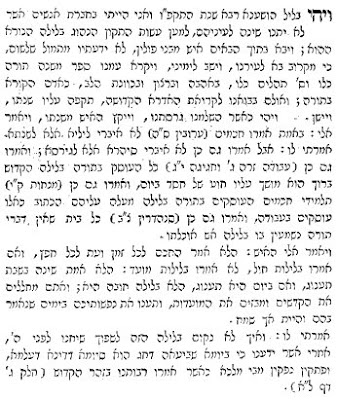
Here begins Shadal's Vikuach al Chochmat haKabbalah. We actually began translation work at a later chapter, the one about the age of trup. Having translated the entirety of the book from that point, we now come around to the beginning of the book. Shadal, as author, describes a fictional encounter with a guest from Poland, and they engage in a dispute about the truth and value of kabbalah. As Shadal notes in his addendum (see previous segment), this guest is fictional, and so Shadal is really coming up with both sides of the debate. The text of the Vikuach follows:
 FIRST NIGHT
And it was on the night of Hoshana Rabba, in the year 586 {=1826}, and I was in a group of men who did not give sleep to their eyes, in order to perform the tikkun which was customary on that awesome night; and there came, within those who came, a man from the residents of Poland, whom I did not know beforehand, for he only recently came to our city, and he say to my right, and read with us the sefer Mishneh Torah {=Devarim} in its entirety, and the sefer of Tehillim in its entirety, with love and desire and with the intent of the hear, like a man who reads from the Torah. And yet, when we cam to the reading of האדרא הקדושה {?? - perhaps this ?? }, sleep overcame him, and he slept.
And it was, when we finished our reading, the man awoke from his sleep, and said to me: In truth did the Sages say (Eruvin 65) {stated by Rav Yehuda}, "night was only created for sleep."
I said to him: But they also said {on the same daf, Resh Lakish's statement}, "the moon{light} is only created for learning." And they also said (Avodah Zarah daf 3, and Chagiga daf 13), "anyone who engages in Torah at night, the Holy One, Blessed Be He, extends to him a cord of grace in the day." And they said as well (Menachot 110), "Torah scholars who engage in Torah at night, Scriptures reckons them as if they engaged in the {Temple} service." And they said as well (Sanhedrin 92), "any house in which Torah is not heard at night, fire will consume it."
And the man said to me: Did not the wise one say {in Kohelet 3:1}:
and if they said this for weeknights, they did not say it for night of a Festival. Is it not true that "sleep on Shabbat is a delight {taanug}," and if in the day it is a delight, is it not obligatory by day; and you desecrate the sanctified and belittle the Festivals, and afflict your souls on days which are said about them {Devarim 16:15} "and you should be only happy."
I said to him: And how could we not arise on this night, to pour our speech before Hashem, once who know that on the seventh day of Succot is the completion of the judgment of the word, and notes go out from the house of the King, as our Rabbis say in the holy Zohar (chelek 3, page 31)?
 And in the midst of this we left the house in which he had made the tikkun, and each mean turned to go to his house, and this man did not do so, but joined with me and occupy me with his claims.
And the man was silent until every man was distant from us, and he turned this way and that, and saw that there was no man {an allusion to Moshe Rabbenu when hitting the Mitzri}, and he stood on the crossroads, and he opened his mouth, and said: Woe to you guilty ones, for you deny the words of our ancient ones the fathers of the world, the instituters of the prayer, who established to say on Yom Kippur, "an end for forgiveness and pardon," while you {plural} say that the decree is not signed until the day of Hoshana Rabba. And not only that but you also deny the words of the Torah itself, which states {Vayikra 16:30}:
tefillin.
I answered him: We did not do this from our own hearts, forfend for us! Rather, our Rabbis, the Sages of the Mishna were the ones who decreed. It says it the Zohar Chadash, Shir haShirim (page 60) that anyone who puts on tefillin on chol haMoed is liable to death, and this is for concealed reasons, which are known to authorized people who stand in the secret assembly of Hashem.
 FIRST NIGHT
And it was on the night of Hoshana Rabba, in the year 586 {=1826}, and I was in a group of men who did not give sleep to their eyes, in order to perform the tikkun which was customary on that awesome night; and there came, within those who came, a man from the residents of Poland, whom I did not know beforehand, for he only recently came to our city, and he say to my right, and read with us the sefer Mishneh Torah {=Devarim} in its entirety, and the sefer of Tehillim in its entirety, with love and desire and with the intent of the hear, like a man who reads from the Torah. And yet, when we cam to the reading of האדרא הקדושה {?? - perhaps this ?? }, sleep overcame him, and he slept.
And it was, when we finished our reading, the man awoke from his sleep, and said to me: In truth did the Sages say (Eruvin 65) {stated by Rav Yehuda}, "night was only created for sleep."
I said to him: But they also said {on the same daf, Resh Lakish's statement}, "the moon{light} is only created for learning." And they also said (Avodah Zarah daf 3, and Chagiga daf 13), "anyone who engages in Torah at night, the Holy One, Blessed Be He, extends to him a cord of grace in the day." And they said as well (Menachot 110), "Torah scholars who engage in Torah at night, Scriptures reckons them as if they engaged in the {Temple} service." And they said as well (Sanhedrin 92), "any house in which Torah is not heard at night, fire will consume it."
And the man said to me: Did not the wise one say {in Kohelet 3:1}:
| א לַכֹּל, זְמָן; וְעֵת לְכָל-חֵפֶץ, תַּחַת הַשָּׁמָיִם. {פ} | 1 To every thing there is a season, and a time to every purpose under the heaven: {P} |
I said to him: And how could we not arise on this night, to pour our speech before Hashem, once who know that on the seventh day of Succot is the completion of the judgment of the word, and notes go out from the house of the King, as our Rabbis say in the holy Zohar (chelek 3, page 31)?
 And in the midst of this we left the house in which he had made the tikkun, and each mean turned to go to his house, and this man did not do so, but joined with me and occupy me with his claims.
And the man was silent until every man was distant from us, and he turned this way and that, and saw that there was no man {an allusion to Moshe Rabbenu when hitting the Mitzri}, and he stood on the crossroads, and he opened his mouth, and said: Woe to you guilty ones, for you deny the words of our ancient ones the fathers of the world, the instituters of the prayer, who established to say on Yom Kippur, "an end for forgiveness and pardon," while you {plural} say that the decree is not signed until the day of Hoshana Rabba. And not only that but you also deny the words of the Torah itself, which states {Vayikra 16:30}:
tefillin.
I answered him: We did not do this from our own hearts, forfend for us! Rather, our Rabbis, the Sages of the Mishna were the ones who decreed. It says it the Zohar Chadash, Shir haShirim (page 60) that anyone who puts on tefillin on chol haMoed is liable to death, and this is for concealed reasons, which are known to authorized people who stand in the secret assembly of Hashem.
Manipulating the Gedolim III - Rav Ovadia Yosef Unfortunately Does *Not* Ban A Concert
As I mentioned before, the information presented to a Gadol is critical to their being able to give accurate psak and direction.
It is for a very similar reason that I am reluctant to pronounce judgment upon the recent case of the banned wedding. How can I say anything about it, and its propriety, if I do not know the details. And critical details about shidduchim and their inner workings are often kept secret. So suggesting the X was wrong or X was right when I do not know the metzius would be the wrong path to take. In such circumstances criticism could be extremely hypocritical.
Together with this caveat, that everyone should know that I don't know what I am talking about and you don't know what you are talking about, I feel comfortable saying the following: If the gedolim involved authorized putting out kol korehs in their name, and protesting the wedding in their name, and especially if they did so without full knowledge or with inaccurate knowledge of the situation, then it was ill-advised.
But it is possible that there are hidden details that can change all that, about the people involved, in all sorts of ways. And every year at Purim, Professor Moshe Koppel prints up kol korehs which he puts up in Meah Shearim, and it is the same printer that everyone else uses. Anyone can print up a kol korei saying whatever. It is entirely plausible that the father of the kallah asked these gedolim to write a letter addressed personally to the father of the chassan, and then trying to do everything possible to break up what he (either correctly or incorrectly) saw as a terrible match, printed up the kol korei, and hired these protesters (which he did) to protest what he could now label as a violation of the gedolim's ruling. This would indeed be manipulation on his part, if so, and one which devalues any kol korei, but we know this about kol koreis in general anyway already. And we see, not many people actually showed up to protest. What was it? Six people who were being paid to show up?
But again, I am so far removed from the situation. One thing I do know is that I do not know, and this is important knowledge.
Another interested case is the MBD and Shwekey concert. They did the smart thing, and preemptively got an endorsement from haRav Ovadiah Yosef for their concert, knowing that others would try to ban it. And from his son's presence at the concert, and from his son's statement not to pay attention to the extremists, it seems that this was understood as a step against those who are trying to impose bans on concerts.
What concerns me is whether Rav Ovadiah Yosef also was shown the advertising for the concert. This is by no means the first time they have advertised this concert in this way. It is in honor of the birthday of the Rebbe King Mashiach. And they feature Yechi prominently.
While in his letter response, Rav Ovadiah Yosef said this was in honor of the Admor of Chabad, he did not mention any messianic connections. And there are indeed messianic and non-messianic Lubavitch, in which case it is quite possible that this was not information he was told. I wonder if they would have gotten his endorsement of the concert in such a case. Perhaps he would have given it anyway.
But if they held back this information, then this is once again manipulation of gedolim, feeding only that information necessary to get the response you want, so that you can tout it to the world.
It is for a very similar reason that I am reluctant to pronounce judgment upon the recent case of the banned wedding. How can I say anything about it, and its propriety, if I do not know the details. And critical details about shidduchim and their inner workings are often kept secret. So suggesting the X was wrong or X was right when I do not know the metzius would be the wrong path to take. In such circumstances criticism could be extremely hypocritical.
Together with this caveat, that everyone should know that I don't know what I am talking about and you don't know what you are talking about, I feel comfortable saying the following: If the gedolim involved authorized putting out kol korehs in their name, and protesting the wedding in their name, and especially if they did so without full knowledge or with inaccurate knowledge of the situation, then it was ill-advised.
But it is possible that there are hidden details that can change all that, about the people involved, in all sorts of ways. And every year at Purim, Professor Moshe Koppel prints up kol korehs which he puts up in Meah Shearim, and it is the same printer that everyone else uses. Anyone can print up a kol korei saying whatever. It is entirely plausible that the father of the kallah asked these gedolim to write a letter addressed personally to the father of the chassan, and then trying to do everything possible to break up what he (either correctly or incorrectly) saw as a terrible match, printed up the kol korei, and hired these protesters (which he did) to protest what he could now label as a violation of the gedolim's ruling. This would indeed be manipulation on his part, if so, and one which devalues any kol korei, but we know this about kol koreis in general anyway already. And we see, not many people actually showed up to protest. What was it? Six people who were being paid to show up?
But again, I am so far removed from the situation. One thing I do know is that I do not know, and this is important knowledge.
Another interested case is the MBD and Shwekey concert. They did the smart thing, and preemptively got an endorsement from haRav Ovadiah Yosef for their concert, knowing that others would try to ban it. And from his son's presence at the concert, and from his son's statement not to pay attention to the extremists, it seems that this was understood as a step against those who are trying to impose bans on concerts.
What concerns me is whether Rav Ovadiah Yosef also was shown the advertising for the concert. This is by no means the first time they have advertised this concert in this way. It is in honor of the birthday of the Rebbe King Mashiach. And they feature Yechi prominently.
While in his letter response, Rav Ovadiah Yosef said this was in honor of the Admor of Chabad, he did not mention any messianic connections. And there are indeed messianic and non-messianic Lubavitch, in which case it is quite possible that this was not information he was told. I wonder if they would have gotten his endorsement of the concert in such a case. Perhaps he would have given it anyway.
But if they held back this information, then this is once again manipulation of gedolim, feeding only that information necessary to get the response you want, so that you can tout it to the world.
Monday, April 14, 2008
A Redefined KeZayis, Because They Had A Smaller Strain of Olives
(Note: Not halacha lemaaseh, as should be clear even from my choice of language.)
I am all for realia. Still, I am not sure I am entirely convinced. It is perhaps a gemara, about the existence of olives of different sizes.
First, the research:
Berachot 38b-39a:
So what is this distinction between beinoni and gadol? I have always read it as referring to species of olives, and still incline towards that reading. Do they account for this? If not, perhaps one could read the gemara as referring to different sized olives within the same species. After all, these researchers to give spans. But it would have to be that within the same species, the size of a large olive is greater than a small olive by the size of its pit. I don't know if this is so for the range of sizes of the olives they identify here. If between species, perhaps the Nabali olives could be reckoned the large ones while Syrian olives would be the middle ones. Or perhaps they had in mind certain uncommon olives which were still larger. We should make some kind of determination of what is "small," "medium," and "large." It does make sense, though, that the beinoni upon which the kezayit measure is based would be a common one.
I also would not assume that this is necessarily a kula. While it is a kula for eating matzah, as they cast it, it is a chumra in terms of certain prohibited minimum eating, and other things. Even within the laws of Pesach, the violation of bal yeraeh and bal yimatzei is on chametz the size of a kezayis.
There are other gemaras and Yerushalmis which relate the size of a kezayit to other sizes, such that this is perhaps calculable. For example, a reviit is supposed to be able to be nikrash (congeal/shrink) to the size of kezayit, but there are different measures as to the reviit, quite possible influenced by girsology (though Tosafot IIRC explains it otherwise). I don't think I'll have a chance to discuss it this year, as I've already sat on that post for several years running.
I am all for realia. Still, I am not sure I am entirely convinced. It is perhaps a gemara, about the existence of olives of different sizes.
First, the research:
Prof. Mordechai Kislev, who headed the team with Dr. Orit Simhoni, Yonit Tabak and Ofer Tzarfati-Zuta, maintains that Syrian and Nabali strains, whose weight per olive is only around five grams (about a sixth of the weight of a machine-made matza), are the model for the halachic standard. The researchers said these types of olives, smaller than today's olives, were the most common during ancient times.and so on. Read it all.
...
Kislev and his colleagues said Syrian olives, which each weigh 2.5-3.5 gr., and Nabali, which each weigh 4-6 gr., were common in this area during Talmudic times. About 2,000 well-preserved olive pits of these two varieties were identified in archeological digs at the Masada fortress near the Dead Sea - destroyed in 73 CE. In addition, the Bar-Ilan researcher said, there are dozens of three-millennia-old olive trees of these strains around the country that still produce fruit.
Berachot 38b-39a:
אמר ר' חייא בר אבא אני ראיתי את ר' יוחנן שאכל זית מליח ובריך עליו תחלה וסוף
...
אמר ליה רבי ירמיה לרבי זירא רבי יוחנן היכי מברך על זית מליח כיון דשקילא לגרעיניה
בצר ליה שיעורא אמר ליה מי סברת כזית גדול בעינן כזית בינוני בעינן (והא איכא) וההוא דאייתו לקמיה דרבי יוחנן זית גדול הוה דאע"ג דשקלוה לגרעינותיה פש ליה שיעורא דתנן זית שאמרו לא קטן ולא גדול אלא בינוני וזהו אגורי ואמר רבי אבהו לא אגורי שמו אלא אברוטי שמו ואמרי לה סמרוסי שמו ולמה נקרא שמו אגורי ששמנו אגור בתוכו
...
אמר ליה רבי ירמיה לרבי זירא רבי יוחנן היכי מברך על זית מליח כיון דשקילא לגרעיניה
בצר ליה שיעורא אמר ליה מי סברת כזית גדול בעינן כזית בינוני בעינן (והא איכא) וההוא דאייתו לקמיה דרבי יוחנן זית גדול הוה דאע"ג דשקלוה לגרעינותיה פש ליה שיעורא דתנן זית שאמרו לא קטן ולא גדול אלא בינוני וזהו אגורי ואמר רבי אבהו לא אגורי שמו אלא אברוטי שמו ואמרי לה סמרוסי שמו ולמה נקרא שמו אגורי ששמנו אגור בתוכו
So what is this distinction between beinoni and gadol? I have always read it as referring to species of olives, and still incline towards that reading. Do they account for this? If not, perhaps one could read the gemara as referring to different sized olives within the same species. After all, these researchers to give spans. But it would have to be that within the same species, the size of a large olive is greater than a small olive by the size of its pit. I don't know if this is so for the range of sizes of the olives they identify here. If between species, perhaps the Nabali olives could be reckoned the large ones while Syrian olives would be the middle ones. Or perhaps they had in mind certain uncommon olives which were still larger. We should make some kind of determination of what is "small," "medium," and "large." It does make sense, though, that the beinoni upon which the kezayit measure is based would be a common one.
I also would not assume that this is necessarily a kula. While it is a kula for eating matzah, as they cast it, it is a chumra in terms of certain prohibited minimum eating, and other things. Even within the laws of Pesach, the violation of bal yeraeh and bal yimatzei is on chametz the size of a kezayis.
There are other gemaras and Yerushalmis which relate the size of a kezayit to other sizes, such that this is perhaps calculable. For example, a reviit is supposed to be able to be nikrash (congeal/shrink) to the size of kezayit, but there are different measures as to the reviit, quite possible influenced by girsology (though Tosafot IIRC explains it otherwise). I don't think I'll have a chance to discuss it this year, as I've already sat on that post for several years running.
Vikuach's Addendum pt ii
Shadal now concludes his addendum to his Vikuach al Chochmat haKabbalah. (See previous segment.) He explains that he is unsure about the preceding theory of combined contributions of Avraham Abulafia and Rabbi Moshe de Leon, and leaves it to others to investigate. He explains that the guest is not real, but rather is a way of putting forth his own thoughts to convince his friends. {Perhaps like he suggests for Rav Yosef Karo's maggid!} He explains how he did not publish this Vikuach for 25 years, but finally did so at the urging of a non-fictional Jew from Poland, since it would be useful to oppose Chassidut. The text of the Vikuach follows:
 However, the matter is not entirely clear to me, and I am not judging a judgment, and I am leaving place to others to make a border {?} in it; and there is no doubt that in these matters there is left no shortage of mysteries, which will in the future be revealed via men of truth, who seek the truth with a straightforward heart.
And behold, please, dear reader, there is no doubt that already, your heart has said to you that the story of the guest who came to me from the land of Poland and disputed with me all the disputation written in this book, never was not was created, but was rather an allegory {mashal}.
And so it is in truth, for I, from the beginning of my childhood delved and inverstigated, to elucidate and clarify for myself what the beliefs are that are fitting to cling to, and which are fitting to distance oneself from.
And since there were to me in those days a few friends who were very dear to my eyes, and my thoughts were not as their thoughts in the matter of the wisdom of the kabbalah, I wrote this work to be for me as an advocate {meilitz}, to inform them upon what foundations my belief is founded, so that they would be able to point out my errors. And not only did they not find an answer, but they even agreed with my words and held my belief.
And after I came here, I showed my book to a few of my students and friends, and it did not arise in my thoughts to distribute it in Israel, since as events came about {?} and in these times, those who engage in the works of kabbalah are few, and most of them draw from them mussar and fear of God, and there intent is desirable, and their actions are also desirable to Heaven and people, and what is it for me to confuse their thoughts with my investigations?
 However, this past summer, a certain bachur came from Poland (and this is truth, not an allegory), who while yet a lad abandoned his land and ascended to the land of Israel, and from there came to here, and I found in him good traits. And after he left me and traveled around the cities of Italy, he saw a copy of this Vikuach in the possession of one of my students. Then he wrote to me complaining that I did not bring it out to the light of day, since he was certain that it was able to be to great purpose for the people of our nation, and specifically for the people of his hand, since there are there many who have become Chassidim, who desecrate the honor of the nation and the honor of the Torah will their nonsenses and with the evilness of their deeds.
And it was only these words of his which roused me up to publish this book, after 25 years in which it was hidden in my tent and in the tents of a few of my students.
And now, one think I ask from Hashem, this I request: That this book should be for good and to positive purpose to our brothers, the children of Israel, and to strengthen their faith, and to improve their traits, and that there should not come from this a problem or a loss in any way; for not to weaken the faith was my intent, but rather to strengthen and embolden; to build, and not to overthrow; to plant, and not to root out {based on Yirmeya 1:10}. And whoever walks in the straight path, and does not wear a mantle of hair in order to fool, even if his faith is distant in some matters from my own faith, he is dear and honored in my eyes and I love him, and in love and peace together we will serve the God of peace. May Hashem grant strength to His nation, may Hashem bless His nation with peace.
Padua, 25 Kislev, Shadal the Little
 However, the matter is not entirely clear to me, and I am not judging a judgment, and I am leaving place to others to make a border {?} in it; and there is no doubt that in these matters there is left no shortage of mysteries, which will in the future be revealed via men of truth, who seek the truth with a straightforward heart.
And behold, please, dear reader, there is no doubt that already, your heart has said to you that the story of the guest who came to me from the land of Poland and disputed with me all the disputation written in this book, never was not was created, but was rather an allegory {mashal}.
And so it is in truth, for I, from the beginning of my childhood delved and inverstigated, to elucidate and clarify for myself what the beliefs are that are fitting to cling to, and which are fitting to distance oneself from.
And since there were to me in those days a few friends who were very dear to my eyes, and my thoughts were not as their thoughts in the matter of the wisdom of the kabbalah, I wrote this work to be for me as an advocate {meilitz}, to inform them upon what foundations my belief is founded, so that they would be able to point out my errors. And not only did they not find an answer, but they even agreed with my words and held my belief.
And after I came here, I showed my book to a few of my students and friends, and it did not arise in my thoughts to distribute it in Israel, since as events came about {?} and in these times, those who engage in the works of kabbalah are few, and most of them draw from them mussar and fear of God, and there intent is desirable, and their actions are also desirable to Heaven and people, and what is it for me to confuse their thoughts with my investigations?
 However, this past summer, a certain bachur came from Poland (and this is truth, not an allegory), who while yet a lad abandoned his land and ascended to the land of Israel, and from there came to here, and I found in him good traits. And after he left me and traveled around the cities of Italy, he saw a copy of this Vikuach in the possession of one of my students. Then he wrote to me complaining that I did not bring it out to the light of day, since he was certain that it was able to be to great purpose for the people of our nation, and specifically for the people of his hand, since there are there many who have become Chassidim, who desecrate the honor of the nation and the honor of the Torah will their nonsenses and with the evilness of their deeds.
And it was only these words of his which roused me up to publish this book, after 25 years in which it was hidden in my tent and in the tents of a few of my students.
And now, one think I ask from Hashem, this I request: That this book should be for good and to positive purpose to our brothers, the children of Israel, and to strengthen their faith, and to improve their traits, and that there should not come from this a problem or a loss in any way; for not to weaken the faith was my intent, but rather to strengthen and embolden; to build, and not to overthrow; to plant, and not to root out {based on Yirmeya 1:10}. And whoever walks in the straight path, and does not wear a mantle of hair in order to fool, even if his faith is distant in some matters from my own faith, he is dear and honored in my eyes and I love him, and in love and peace together we will serve the God of peace. May Hashem grant strength to His nation, may Hashem bless His nation with peace.
Padua, 25 Kislev, Shadal the Little
Sunday, April 13, 2008
Acharei Mot: Goral La'Azazel
What is the meaning of goral in the beginning of Acharei Mot?
Shadal brings the Arabic cognate goralon, which means stone: גרלון בערבית אבן. This word apparently is the source of the word coral -- see this post at Balashon, towards the bottom.
There are two issues with a goral to Azazel parallel to a goral to Hashem. One is theological -- how in the world can we send something off to some other entity? Is this not idolatry that the Torah is commanding us here to engage in?
Secondly, we know that the practice in Rabbinic Judaism was to throw the goat to Azazel off a cliff. But the local pesukim just seem to speak of sending it off, and later in the same perek,
earlier post on Achrei Mot, where I note that in the years leading up to the destruction of the Second Temple (when there were Sadducee priests), the goat would accidentally escape into the wilderness where it was eventually caught and eaten by bandits. And I suggested that this recurring accident was not accident.
Rashi solves both problems in his way -- he says that Azazel was not a deity or a goat-god, but rather a cliff. And that is the meaning of the later pasuk 22. Thus, citing Rabbinic sources:
Shadal sees this Rashi, but endorses a different explanation. To put it in my own words and using my own mashal first, an atheist might have no problem telling me to go to hell. This does not mean that he believes in hell. Rather, there is a conception in society of hell, he does not subscribe to the reality of it, but still can use this as an idiom. And many people who say "go to hell" do not mean it literally.
Similarly, in Israeli society today, and especially in subtitles of movies, every curse word becomes "lech la'Azazel." This does not mean that they believe in the reality of a goat-demon, if that is what Azazel really means. Nor does it mean that they even really literally want the person to be cast off a cliff, which is more of the meaning.
So, Shadal says:
 Let us now give the Karaites a change to be frum. The block text images are from the Karaite scholar Aharon ben Yosef, and the images in Rashi script are the words of a Karaite supercommentary.
 In terms of the definition of Azazel, he Aharon ben Yosef strongly rejects the idea that it refers to a bribe to Samael. He considers such to be idolatrous, and rejects this idea as expressed by Ibn Ezra, Ramban and Pirkei deRabbi Yishmael.
 He rejects it as well on the level of peshat, not just out of religious conviction. See inside. He views every goat offering as a rejection of the practice of Egypt of sacrificing to seirim.
He also rejects the deconstruction of the word, as offered by Rashi citing Chazal. He argues that it is the name of a place, and offers other examples such as II Divrei HaYamim 20:16 with midbar Yeruel and other constructions, dismissing the problem of the aleph between the zayins in עזאזאל.
eretz gezeira as a cliff, and thus in accordance with Rabbinic practice. There is more to read inside. Enjoy.
Shadal brings the Arabic cognate goralon, which means stone: גרלון בערבית אבן. This word apparently is the source of the word coral -- see this post at Balashon, towards the bottom.
There are two issues with a goral to Azazel parallel to a goral to Hashem. One is theological -- how in the world can we send something off to some other entity? Is this not idolatry that the Torah is commanding us here to engage in?
Secondly, we know that the practice in Rabbinic Judaism was to throw the goat to Azazel off a cliff. But the local pesukim just seem to speak of sending it off, and later in the same perek,
earlier post on Achrei Mot, where I note that in the years leading up to the destruction of the Second Temple (when there were Sadducee priests), the goat would accidentally escape into the wilderness where it was eventually caught and eaten by bandits. And I suggested that this recurring accident was not accident.
Rashi solves both problems in his way -- he says that Azazel was not a deity or a goat-god, but rather a cliff. And that is the meaning of the later pasuk 22. Thus, citing Rabbinic sources:
Azazel This is a strong and hard mountain, [with] a high cliff, as the Scripture says [in describing Azazel] (verse 22 below),“a precipitous land (אֶרֶץ גְּזֵרָה),” meaning a cut-off land [i.e., a sheer drop]. — [Torath Kohanim 16:28; Yoma 67b]Thus, Azazel is the cliff to which the goat is sent. And the cut off-land does not mean a wilderness, put rather a sudden cut-off, namely a cliff, which is in the wilderness.
Shadal sees this Rashi, but endorses a different explanation. To put it in my own words and using my own mashal first, an atheist might have no problem telling me to go to hell. This does not mean that he believes in hell. Rather, there is a conception in society of hell, he does not subscribe to the reality of it, but still can use this as an idiom. And many people who say "go to hell" do not mean it literally.
Similarly, in Israeli society today, and especially in subtitles of movies, every curse word becomes "lech la'Azazel." This does not mean that they believe in the reality of a goat-demon, if that is what Azazel really means. Nor does it mean that they even really literally want the person to be cast off a cliff, which is more of the meaning.
So, Shadal says:
עזאזל : נראה שהיה מקודם של האל הרע , ושטן , אל עז , ומילת עזאזל מן עז עז אל . והמאמינים באחדות האל שלא האמינו במציאות האל הרע נשארה אצלם המילה הזאת להוראת הרע הגמור והאבדון , על דרך שגם היום אומרים " שטן " להרות על כל רעה גדולה ועל האבדון ; והנה השעיר היה משתלח לאבדון במדבר שימות ברעב . והנה בזמן שהיתה ארץ ישראל רחבת ידים לישראל להיותם המעט מכל העמים היה אפשר למצוא בתוך ארצם ארץ גזרה ו רחבה שיתעה בה השעיר וימות , אבל אחר זמן , כשרבתה האומה ונתיישבה הארץ ולא היתה שם ארץ גזרה , הוצרכו להתקין שיידחף השעיר מעל הצוק , שאם לא כן היה נכנס לעיר נושבת . ואמנם המכוון בשילוח השעיר לעזאזל נראה שהוא על דרך ( מיכה ז ' י " ט ) ותשליך במצולות ים כל חטאתם , כי הכהן בדיבורו היה נותן כל עונות העם על השעיר , ואח " כ היה משלח השליח ועמו העונות כולם אל ארץ גזרה , והעם היה נשאר נקי מכל עונותם .
That is, he claims that it initially did mean some opponent, some Satan, to God. But those who believe in the Unity of Hashem do not believe in the existence of an evil God. Even so, this word was preserved for them, to convey complete evil and devastation. And this was the meaning in Biblical times. He compares it to the word Satan.
This goat was sent into the wilderness, where there was desolation, to die of hunger. And so the word was fitting.
And what about this shift? Well, this was an historical shift rather than a dispute in meaning. All the while, it was agreed that it was to be sent to destruction with their sins, in the same manner we see in Micha 7:19 the idea of sending sins into the depths of the sea. But initially, when Eretz Yisrael was not so settled, they could send it into the wilderness and it would not wander into some settled city. When settlement expanded, they could no longer do this so they fulfilled this by sending it off a cliff.
This goat was sent into the wilderness, where there was desolation, to die of hunger. And so the word was fitting.
And what about this shift? Well, this was an historical shift rather than a dispute in meaning. All the while, it was agreed that it was to be sent to destruction with their sins, in the same manner we see in Micha 7:19 the idea of sending sins into the depths of the sea. But initially, when Eretz Yisrael was not so settled, they could send it into the wilderness and it would not wander into some settled city. When settlement expanded, they could no longer do this so they fulfilled this by sending it off a cliff.
 Let us now give the Karaites a change to be frum. The block text images are from the Karaite scholar Aharon ben Yosef, and the images in Rashi script are the words of a Karaite supercommentary.
 In terms of the definition of Azazel, he Aharon ben Yosef strongly rejects the idea that it refers to a bribe to Samael. He considers such to be idolatrous, and rejects this idea as expressed by Ibn Ezra, Ramban and Pirkei deRabbi Yishmael.
 He rejects it as well on the level of peshat, not just out of religious conviction. See inside. He views every goat offering as a rejection of the practice of Egypt of sacrificing to seirim.
He also rejects the deconstruction of the word, as offered by Rashi citing Chazal. He argues that it is the name of a place, and offers other examples such as II Divrei HaYamim 20:16 with midbar Yeruel and other constructions, dismissing the problem of the aleph between the zayins in עזאזאל.
eretz gezeira as a cliff,
 and thus in accordance with Rabbinic practice. There is more to read inside. Enjoy.
Vikuach's Addendum pt i
Shadal continues his Vikuach al Chochmat haKabbalah, with an addendum. (See previous segment.) Here, he notes Landauer's theory that the author of the Zohar is false prophet and messiah, Avraham Abulafia, on the basis of similarities of topic (such as of a kabbalistic sexual nature and gematriot), and because Avraham Abulafia wrote many books in which the pseudonymous author's name was the same gematria as his own, which is true for the Zohar as well since Rashbi's name works out to the same gematria. Then Jelinik's theory that it was Rabbi Moshe de Leon and others, but who took material from Avraham Abulafia. The text of the Vikuach follows:
 Addendum:
Many days after the writing of this Vikuach {Disputation}, one of the wise men of Ashkenaz (may his soul rest in peace), M. H. Landauer was his name, discovered in the library in the city of Munich (Munako which is in Bavaria) different books in manuscript, which were written by Avraham ben Shmuel Abulafia the Sefardi, who came to Italy and made himself into a prophet and messiah in the days of the Rashba. (See she`elot uTeshuvot haRashba, siman 548, and see also at the end of the introduction of Rabbi Yehuda Chayyat, that his family name of Abulafia is not mentioned in the Rashba, but it is explicit in the words of the Chayyat, and there are brought down as well the names of a few of his books, and they can be found in Munich.) And this Landauer discovered a great similarity between the ways of this aforementioned Avraham in his books and the book of the Zohar, and specifically in the matters of the father, the mother, and the son, and in the matter of the multitude of sayings and expositions on the limb of procreation and on the match itself.
See his words in Orient, 1845, Literatur Blatt, from page 322 and on). And behold, this Avraham, according to the words of the Rashba, loved gematriot, and so does Landauer testifies that his books are filled with them, and some of them extremely disgraceful, such as that the Shechina is the gematria of male and female, and also androgynus; and so too "Matatron the prince of the interior" in gematria is "seminal fluid"; And he calls himself at times by the name Raziel, and sometimes by the name Zecharyahu, and sometimes by other names, where the calculation of each of them is like the calculation of Avraham, which was his name in fact.
For example, in one of his books of prophecy is written, "so Hashem said to Zecharyahu," and in one of them called "Sefer haYashar," it is written "so said Hashem to Raziel." In his book "Imrei Shefer," he mentioned that he made a book Gan Nauel, and in the book Gan Naul (which is found as well in the aforementioned city), but it is written in the beginning of it, "Behold I convey to you my spirit, I make my words known to you." And the words "my words to you" are written in large letters with dots upon them, and Landauer found that the calculation of "my words to you" is like the calculation of Avraham ben Shmuel.
 And behold, he found as well that the calculation of Avraham Abulafia Sefaradi is exactly like the calculation of Rabbi Shimon ben Yochai z"l, and he explains based on this why this man chose to suspend his book {=the Zohar} specifically upon Rabbi Shimon ben Yochai.
And behold, everyone knows the beginning of the words of the Zohar, which are Bereish Hormenuta deMalka, that the name Rashbi {Rabbi Shimon ben Yochai} is hinted at with the word beReish; And still, Landauer found that the calculation of Hormenuta deMalka is exactly that of Avraham Abulafia Sefaradi (with the aleph written but not pronounced, based on the way of the Arabic language, from which this name is hewn). And many like these, Landauer brings to prove that this aforementioned Avraham Abulafia is the author of the sefer haZohar, and in his opinion he wrote it from the 30th year until the 40th year of the sixth millennium (1270-1280). And this was from the 30th to the 40th year of his life, for he was born in the beginning of the sixth millennium.
And will all this, behold that now, recently, the wise man Jelinik arose and printed a pamphlet (Leipzig, 1851) to prove that the sefer haZohar was the work of Rabbi Moshe de Leon and others with him, with no partnership with Avraham Abulafia, except that those composers who wrote the sefer haZohar saw the books of Abulafia and took from them a few things. And the wise man Jelinik brings a few similarities in thoughts and poetic phrases between the books of Rabbi Moshe de Leon and the book of the Zohar. And more than them one can bring from the books of Rabbi Moshe which are found in manuscript in the hands of my friend Ramshag {?? ... ??}, head of this holy community, and in the hand of my friend the sage Yosef Almantzi.
However, now, I do not have the time nor the desire to increase the readings and the investigations in these matters, for after it became clear to me in my youth that the sefer haZohar and the secrets of the kabbalah did not come from our teachers {Rabbotainu}, I withdrew my hands from them, and placed all my efforts and labors in the wisdom of the peshat. And with all this, I will not hide under my tongue that after I read here and there in the works of Rabbi Moshe de Leon, my heart leans towards declaring Rabbi Moshe righteous, and it is near in my eyes that he was not a liar and forger (as was, without a doubt, Avraham Abulafia), but rather it is possible that a copy of the sefer haZohar came to his hands, and he believed that it was from our Rabbis, z"l, and he learned from his words, and they entered into his books.
{I think that what Shadal is saying is that the similarities to the words of Rabbi Moshe de Leon is a result of Rabbi Moshe de Leon having learned the Zohar, thinking it authentic; but that the gematriot, etc., prove that the author of the Zohar was this false prophet and messiah, Avraham Abulafia.}
 Addendum:
Many days after the writing of this Vikuach {Disputation}, one of the wise men of Ashkenaz (may his soul rest in peace), M. H. Landauer was his name, discovered in the library in the city of Munich (Munako which is in Bavaria) different books in manuscript, which were written by Avraham ben Shmuel Abulafia the Sefardi, who came to Italy and made himself into a prophet and messiah in the days of the Rashba. (See she`elot uTeshuvot haRashba, siman 548, and see also at the end of the introduction of Rabbi Yehuda Chayyat, that his family name of Abulafia is not mentioned in the Rashba, but it is explicit in the words of the Chayyat, and there are brought down as well the names of a few of his books, and they can be found in Munich.) And this Landauer discovered a great similarity between the ways of this aforementioned Avraham in his books and the book of the Zohar, and specifically in the matters of the father, the mother, and the son, and in the matter of the multitude of sayings and expositions on the limb of procreation and on the match itself.
See his words in Orient, 1845, Literatur Blatt, from page 322 and on). And behold, this Avraham, according to the words of the Rashba, loved gematriot, and so does Landauer testifies that his books are filled with them, and some of them extremely disgraceful, such as that the Shechina is the gematria of male and female, and also androgynus; and so too "Matatron the prince of the interior" in gematria is "seminal fluid"; And he calls himself at times by the name Raziel, and sometimes by the name Zecharyahu, and sometimes by other names, where the calculation of each of them is like the calculation of Avraham, which was his name in fact.
For example, in one of his books of prophecy is written, "so Hashem said to Zecharyahu," and in one of them called "Sefer haYashar," it is written "so said Hashem to Raziel." In his book "Imrei Shefer," he mentioned that he made a book Gan Nauel, and in the book Gan Naul (which is found as well in the aforementioned city), but it is written in the beginning of it, "Behold I convey to you my spirit, I make my words known to you." And the words "my words to you" are written in large letters with dots upon them, and Landauer found that the calculation of "my words to you" is like the calculation of Avraham ben Shmuel.
 And behold, he found as well that the calculation of Avraham Abulafia Sefaradi is exactly like the calculation of Rabbi Shimon ben Yochai z"l, and he explains based on this why this man chose to suspend his book {=the Zohar} specifically upon Rabbi Shimon ben Yochai.
And behold, everyone knows the beginning of the words of the Zohar, which are Bereish Hormenuta deMalka, that the name Rashbi {Rabbi Shimon ben Yochai} is hinted at with the word beReish; And still, Landauer found that the calculation of Hormenuta deMalka is exactly that of Avraham Abulafia Sefaradi (with the aleph written but not pronounced, based on the way of the Arabic language, from which this name is hewn). And many like these, Landauer brings to prove that this aforementioned Avraham Abulafia is the author of the sefer haZohar, and in his opinion he wrote it from the 30th year until the 40th year of the sixth millennium (1270-1280). And this was from the 30th to the 40th year of his life, for he was born in the beginning of the sixth millennium.
And will all this, behold that now, recently, the wise man Jelinik arose and printed a pamphlet (Leipzig, 1851) to prove that the sefer haZohar was the work of Rabbi Moshe de Leon and others with him, with no partnership with Avraham Abulafia, except that those composers who wrote the sefer haZohar saw the books of Abulafia and took from them a few things. And the wise man Jelinik brings a few similarities in thoughts and poetic phrases between the books of Rabbi Moshe de Leon and the book of the Zohar. And more than them one ca
n bring from the books of Rabbi Moshe which are found in manuscript in the hands of my friend Ramshag {?? ... ??}, head of this holy community, and in the hand of my friend the sage Yosef Almantzi.However, now, I do not have the time nor the desire to increase the readings and the investigations in these matters, for after it became clear to me in my youth that the sefer haZohar and the secrets of the kabbalah did not come from our teachers {Rabbotainu}, I withdrew my hands from them, and placed all my efforts and labors in the wisdom of the peshat. And with all this, I will not hide under my tongue that after I read here and there in the works of Rabbi Moshe de Leon, my heart leans towards declaring Rabbi Moshe righteous, and it is near in my eyes that he was not a liar and forger (as was, without a doubt, Avraham Abulafia), but rather it is possible that a copy of the sefer haZohar came to his hands, and he believed that it was from our Rabbis, z"l, and he learned from his words, and they entered into his books.
{I think that what Shadal is saying is that the similarities to the words of Rabbi Moshe de Leon is a result of Rabbi Moshe de Leon having learned the Zohar, thinking it authentic; but that the gematriot, etc., prove that the author of the Zohar was this false prophet and messiah, Avraham Abulafia.}
Friday, April 11, 2008
Vikuach's Conclusion
Shadal concludes his Vikach al Chochmat haKabbalah. (See previous segment.) He discusses whether it is proper to publicize this. Indeed, as we shall see in the Addendum (still to come), Shadal sits on this work for many years until persuaded to publicize this in order to combat the dangerous movement, chassidut. The text of the Vikuach follows.
 The author: And you, if you will indeed listen to my voice and do what is right in my eyes, do the following: And any place to which you go, do not speak in the matter of kabbalah with any man in the world, unless you find a sage and true kabbalist, who is able to relate to you the mysteries of wisdom and to dispel all your doubts, and to enlighten your darkness with the light of wisdom and understanding, which gloom does not abide upon, and to bring you to the mountain of myrrh, the hill of frankincense, together will the sheep {?} of the All-Merciful, and you will draw water in joy from the upper spring, and rejoice upon Hashem in truth and faith, for He gives wisdom to the wise and knowledge to those who know understanding. For still, if you let your arguments be heard by people who have not learned the knowledge, or who have in it knowledge and do not have knowledge, your work will not be the work of one who loves wisdom, but rather the work of the Satan and the work of the tempter and one who pushes away. Will this be your glory, if on those who lack knowledge you triumph with your subtle reasoning and with your arguments?
And besides this, is it not that even according to your opinion, and even if all of the wisdom of truth is founded upon a plumb line of void and stones of emptiness, what damage is there to the general populace? Is it not so that they do not know its paths and do not understand its depths, and they will not receive any damage from it -- only a great use with they take from it, for from it their hearts will be strengthened to the worship of Hashem and the keeping of his commandments; And if you make their ears hear, and introduce into their hearts that all of it is a false vision, an illusion, and deity {?}, there is no doubt that you will weaken with this their hands from serving Hashem, and you are not fixing but rather causing a great ruin.
And specifically in this generation, where among those who consider themselves wise, the opinion of the Rambam in the matter of the reasons for the precepts, and many {then} say that now, in these days, the reason is annulled and so the decree has been annulled, there would only be left to us the secrets {sodot} of the kabbalah and the faith of the fixing and the defects in the spiritual worlds, to strengthen weak hands in the keeping of the statutes of our God, and the collapsing knees, to strengthen in walking in His Ways.
 The guest: Perhaps the matter was such in the earlier generation, where the faith was strong in the land; However, now in our days, where all the eyes are opened and all the hearts investigate, and the number of those small of faith continuously grows, it is fitting to all who seize the Torah, those who love it and strengthen it, to refine and purify it from impurities which are mixed with it over the length of generations. For the common people who are not experts, when they find in it some matter of impropriety, they will turn from after it and despise it, and he does not know how to distinguish between good and bad, truth and falsehood, and {instead} he judges from the particular to the general, and he decides that the entire Torah are words of falsehood, because of a a few matters of falsehood, which he heard from his teachers, which they said were Godly sodot {secrets}, and hidden aspects of Torah.
The author: And shall we destroy the world because of the fools? Upon this is stated {Hoshea 14:10}:
And you, my friend, go in peace, and Hashem the God of Heaven should send his angel with you and make your way prosper. And it should be that when Hashem makes it good for you, and you find rest, which he makes good for you, write to me, and my heart will also rejoice.
The guest: I will not forget your words. And you, my master and honored friend , peace, and all that is to you should have peace.
The author: Peace, peace.
 The author: And you, if you will indeed listen to my voice and do what is right in my eyes, do the following: And any place to which you go, do not speak in the matter of kabbalah with any man in the world, unless you find a sage and true kabbalist, who is able to relate to you the mysteries of wisdom and to dispel all your doubts, and to enlighten your darkness with the light of wisdom and understanding, which gloom does not abide upon, and to bring you to the mountain of myrrh, the hill of frankincense, together will the sheep {?} of the All-Merciful, and you will draw water in joy from the upper spring, and rejoice upon Hashem in truth and faith, for He gives wisdom to the wise and knowledge to those who know understanding. For still, if you let your arguments be heard by people who have not learned the knowledge, or who have in it knowledge and do not have knowledge, your work will not be the work of one who loves wisdom, but rather the work of the Satan and the work of the tempter and one who pushes away. Will this be your glory, if on those who lack knowledge you triumph with your subtle reasoning and with your arguments?
And besides this, is it not that even according to your opinion, and even if all of the wisdom of truth is founded upon a plumb line of void and stones of emptiness, what damage is there to the general populace? Is it not so that they do not know its paths and do not understand its depths, and they will not receive any damage from it -- only a great use with they take from it, for from it their hearts will be strengthened to the worship of Hashem and the keeping of his commandments; And if you make their ears hear, and introduce into their hearts that all of it is a false vision, an illusion, and deity {?}, there is no doubt that you will weaken with this their hands from serving Hashem, and you are not fixing but rather causing a great ruin.
And specifically in this generation, where among those who consider themselves wise, the opinion of the Rambam in the matter of the reasons for the precepts, and many {then} say that now, in these days, the reason is annulled and so the decree has been annulled, there would only be left to us the secrets {sodot} of the kabbalah and the faith of the fixing and the defects in the spiritual worlds, to strengthen weak hands in the keeping of the statutes of our God, and the collapsing knees, to strengthen in walking in His Ways.
 The guest: Perhaps the matter was such in the earlier generation, where the faith was strong in the land; However, now in our days, where all the eyes are opened and all the hearts investigate, and the number of those small of faith continuously grows, it is fitting to all who seize the Torah, those who love it and strengthen it, to refine and purify it from impurities which are mixed with it over the length of generations. For the common people who are not experts, when they find in it some matter of impropriety, they will turn from after it and despise it, and he does not know how to distinguish between good and bad, truth and falsehood, and {instead} he judges from the particular to the general, and he decides that the entire Torah are words of falsehood, because of a a few matters of falsehood, which he heard from his teachers, which they said were Godly sodot {secrets}, and hidden aspects of Torah.
The author: And shall we destroy the world because of the fools? Upon this is stated {Hoshea 14:10}:
And you, my friend, go in peace, and Hashem the God of Heaven should send his angel with you and make your way prosper. And it should be that when Hashem makes it good for you, and you find rest, which he makes good for you, write to me, and my heart will also rejoice.
The guest: I will not forget your words. And you, my master and honored friend , peace, and all that is to you should have peace.
The author: Peace, peace.
Thursday, April 10, 2008
What Should I Feed My Goldfish On Pesach??
Earlier this year, I bought my son Meir some pets -- five goldfish. And we make sure to feed them every day, so that they do not end up belly up.
While preparing for Pesach, we checked out the ingredients on the fish food, and the first ingredient is wheat. Presumably it is either chametz or else would become chametz after it hits the water. So I'm going to get rid of the fish flakes for Pesach.
But then, what do I feed my fish?
Does anyone out there in the Jewish Blogosphere own fish? If so, what do you do for Pesach? (Rabbi Abadi claims fish flakes are inedible, but I am not so convinced he is right on that count. And apparently Rabbi Blumenkrantz z"l held that fish food is problematic. As does Ohr haTorah Phoenix.) Are there kosher leFesach fish flakes? What about matzah meal?
After writing the above, I found the following from Rabbi Eli Mansour:
So what do you do?
While preparing for Pesach, we checked out the ingredients on the fish food, and the first ingredient is wheat. Presumably it is either chametz or else would become chametz after it hits the water. So I'm going to get rid of the fish flakes for Pesach.
But then, what do I feed my fish?
Does anyone out there in the Jewish Blogosphere own fish? If so, what do you do for Pesach? (Rabbi Abadi claims fish flakes are inedible, but I am not so convinced he is right on that count. And apparently Rabbi Blumenkrantz z"l held that fish food is problematic. As does Ohr haTorah Phoenix.) Are there kosher leFesach fish flakes? What about matzah meal?
After writing the above, I found the following from Rabbi Eli Mansour:
The simplest idea is Matzah Meal. You take a little Matzah and you crush it a little, and you put it into the fish tank, and the fish can then sustain themselves, at least the gold fish can. That’s one way you can solve that problem.I guess that is what I'll try. My big fear is that the goldfish with be makpid on gerbrochts and not eat it...
So what do you do?
Discussion of Maggid Meisharim -- pt ix
Shadal continues his Vikuach al Chochmat haKabbalah. (See previous segment.) The guest now attempts to prove his assertion that the words of the maggid are really just the thoughts of Rav Yosef Karo by showing how Rav Karo's student, Rabbi Moshe Cordevero, refers to it. The text of the Vikuach follows:
 The guest: Say what you want, but Rabbi Moshe Cordevero, who was the student of Maran Rav Yosef Karo, when he brought down in sefer haPardes (shaar seder haAtzilut, perek 3) the words of the maggid who was to Maran haRav Yosef Karo, he mentions the matter as if it is the position of Maran Rav Yosef Karo, and his reasoning. Take place the sefer haPardes.
And I took sefer haPardes, and I read in it the beginning of the chapter, and this is his language: The intent in this chapter is to explain a different opinion which is opposed to this, and this is the kabbalah of my teacher and rabbi, the pious, kevod moreinu harav Rabbi Yosef Karo, נטריה רחמנא ופרקיה, and this is his language: הא אתינא, etc., etc.
Then I said to him: Here for you is to see that he calls the matter kabbalat {the received wisdom} of Maharik {=Rav Yosef Karo}, not his thoughts and his opinion, as you said in your haste.
The guest: Descend to the end!
Then he read before me, in that same perek, like these words: "All this teaches about the strength of the opinion of my teacher, which is right and true."
And so later on, in the sixth perek, he mentions the matter twice in the name of "the words of my teacher, נטריה רחמנא ופרקיה."
The author: He still has not said that it the opinion of Maharik {=Rav Yosef Karo}, but rather for love of brevity he said it is the position of my teacher and master, and the words of my teacher, and the intent (as he said in the beginning of the chapter) is the opinion and the words which Maharik received from the mouth of the maggid who was revealed to him.
And behold, please, the sun comes {down}, and the time of the evening prayer is near. And also you have already emptied the sack-bag of your blasphemies, such there is not left with you (I think) what to add to speak to me further in these things. And I have already told you all that is with me from the answers, and my effort was empty and vain, and not only empty and vain, but also to cause you do be even freer {more hefker}, and to place a sword in your hand to wipe out and to destroy more and more.
And behold, tomorrow, when the weekdays begin, I will go early in the morning to my burdens, and with the few hours which are available to me {from now on}, I will endeavor in the investigation of peshat in language, and I have no engagements in the hidden. Therefore, I see that the best thing is for each man to separate from his brother in peace, and to leave aside all matters of the wisdom of the kabbalah to the unique few who merit to receive them from the mouth of a true kabbalist, and who is exceptional beyond me, and from you I will not seek it.
 The guest: Also I go tomorrow to my burdens {work}, but not to do holy work like you, but rather I will go on my travels to and fro on the earth, exiled and always moving about, wandering for my bread, perhaps the Lord of Hosts will grant favor and chance before me rest, which will be good for me.
The author: May Hashem answer you in the day of trouble, may Hashem give to you that you should find rest.
The guest: And I am a pauper and sufferer. Let me live 1000 years, your name will not be blotted out from the slate of my heart, and your kindness which you did wondrously with me, and your dear trains of which I tested in you in these three days shall not cease from my mouth, from now until forever.
For in truth, from the day which Hashem took from upon my head my master, my father, peace be upon him {or perhaps servant of Hashem}, and I was left an orphan, naked and lacking all, this I have done for myself for ten years, there were not for me such good days {a pun, for it was also Yom Tov} like these three days that I have been with you. These days will be remembered and recorded in my heart in every place to which I travel -- they will not stray from my heart all the days of my life.
 The guest: Say what you want, but Rabbi Moshe Cordevero, who was the student of Maran Rav Yosef Karo, when he brought down in sefer haPardes (shaar seder haAtzilut, perek 3) the words of the maggid who was to Maran haRav Yosef Karo, he mentions the matter as if it is the position of Maran Rav Yosef Karo, and his reasoning. Take place the sefer haPardes.
And I took sefer haPardes, and I read in it the beginning of the chapter, and this is his language: The intent in this chapter is to explain a different opinion which is opposed to this, and this is the kabbalah of my teacher and rabbi, the pious, kevod moreinu harav Rabbi Yosef Karo, נטריה רחמנא ופרקיה, and this is his language: הא אתינא, etc., etc.
Then I said to him: Here for you is to see that he calls the matter kabbalat {the received wisdom} of Maharik {=Rav Yosef Karo}, not his thoughts and his opinion, as you said in your haste.
The guest: Descend to the end!
Then he read before me, in that same perek, like these words: "All this teaches about the strength of the opinion of my teacher, which is right and true."
And so later on, in the sixth perek, he mentions the matter twice in the name of "the words of my teacher, נטריה רחמנא ופרקיה."
The author: He still has not said that it the opinion of Maharik {=Rav Yosef Karo}, but rather for love of brevity he said it is the position of my teacher and master, and the words of my teacher, and the intent (as he said in the beginning of the chapter) is the opinion and the words which Maharik received from the mouth of the maggid who was revealed to him.
And behold, please, the sun comes {down}, and the time of the evening prayer is near. And also you have already emptied the sack-bag of your blasphemies, such there is not left with you (I think) what to add to speak to me further in these things. And I have already told you all that is with me from the answers, and my effort was empty and vain, and not only empty and vain, but also to cause you do be even freer {more hefker}, and to place a sword in your hand to wipe out and to destroy more and more.
And behold, tomorrow, when the weekdays begin, I will go early in the morning to my burdens, and with the few hours which are available to me {from now on}, I will endeavor in the investigation of peshat in language, and I have no engagements in the hidden. Therefore, I see that the best thing is for each man to separate from his brother in peace, and to leave aside all matters of the wisdom of the kabbalah to the unique few who merit to receive them from the mouth of a true kabbalist, and who is exceptional beyond me, and from you I will not seek it.
 The guest: Also I go tomorrow to my burdens {work}, but not to do holy work like you, but rather I will go on my travels to and fro on the earth, exiled and always moving about, wandering for my bread, perhaps the Lord of Hosts will grant favor and chance before me rest, which will be good for me.
The author: May Hashem answer you in the day of trouble, may Hashem give to you that you should find rest.
The guest: And I am a pauper and sufferer. Let me live 1000 years, your name will not be blotted out from the slate of my heart, and your kindness which you did wondrously with me, and your dear trains of which I tested in you in these three days shall not cease from my mouth, from now until forever.
For in truth, from the day which Hashem took from upon my head my master, my father, peace be upon him {or perhaps servant of Hashem}, and I was left an orphan, naked and lacking all, this I have done for myself for ten years, there were not for me such good days {a pun, for it was also Yom Tov} like these three days that I have been with you. These days will be remembered and recorded in my heart in every place to which I travel -- they will not stray from my heart all the days of my life.
Dueling Chumras
Note: Not halacha lemaaseh, or intended as such. About anything like this, consult your local Orthodox rabbi.
Sometimes the only thing that stops the spread of a chumra is the bounds set by another chumra. This would be because while people are willing to roll over previously acceptable lenient practice, when someone raises the possibility that they are being lenient regarding another din, or another chumra.
I think we can cast as one such example how the stringency of Pesach cleaning up of every tiny crumb much less than a kezayis duels with the requirement not to eat matza on erev Pesach.
The obligation to do away with any chametz -- bal yeraeh / bal yimatzei really applies only to chametz equal to or more than a kezayit. This based on various gemaras which talk about dough in a vessel, or on a wall, and whether it combines to a kezayit which then must be gotten rid of. Indeed, Tur says that based on this, it is only chal on >= a kezayit.
(Other acharonim might argue, but this seems to be correct. And indeed, this seems pashut peshat in the gemara in Pesachim 6b which states
אמר רב הבודק צריך שיבטל מאי טעמא אי נימא משום פירורין הא לא חשיבי
Crumbs which are not chashivei need not be worried about.
)
But Tur notes that the Jews are holy and their accepted practice is to eliminate any chametz, no matter what amount.
There is a separate requirement not to eat chametz, and there, it is even bemashehu, any amount. These two defined requirements are counterintuitive since we would expect the issur achila to be the one with the kezayit and the other with the other shiur, and so people even today confuse them -- which may have led, IMHO, to the stringency of removing every crumb
Because of this adopted stringency, people take a lot of time getting rid of every single crumb from every crevice, and so Pesach cleaning takes much longer than it otherwise might have taken. And once all this effort has been expended, we don't want to bring chametz back into that room, for it is already kosher for Pesach, and we do not want to expend all that effort again.
I remember a year or two back, it was close to Pesach, that is that Pesach was a few days away, and I was by people who did not want to have the meal at home because it would involve dealing with chametz. They discussed buying pizza. But they would not bring the pizza into the home, to be eaten by the table. I noted that they could eat the pizza and throw out any remainders. But they were afraid of crumbs. So a sweep of the linoleum floor would suffice. But they might miss a crumb or two, and did a real thorough job (perhaps mopping, and so on), so this was not feasible. Instead, they ate out at the pizza store. So this is a stringency even in cleaning -- not only will you sweep to get rid of the crumbs which one is not required to get out, but one must be extremely careful in this elimination lest one crumb escape. And rather than doing this again and again, or rather because this effort must be done gradually over time, to maintain this non-required level of absence of chametz, no chametz may enter the house at all.
The pasuk, meanwhile, says that 7 days leaven shall not be found in your house. Not 3 weeks.
I know people who are faced with a dilemma when erev Pesach falls out on Shabbos. You can't eat matza because of another prohibition (to be dealt with in a moment). So it must be challah. But disposal is a problem. So they get a tiny amount of challah, enough to fulfill the obligation, and eat it on the porch. {Update: In fact, to clarify, they do this any Shabbos before Pesach, even if it does not fall on erev Pesach.}
If this was unchecked, I am pretty confident that Jewish practice would have evolved to remove the consumption of chametz, at least in the house, a few weeks before Pesach. For Shabbos, all we need to do is eat matza!
But there is another halachic statement, which expanded into the realm of chumra itself. The gemara states that kol h`aochel matza erev Pesach ke`ilu bo'eil arusaso beveis chamav. (Jackie Mason Achad HaAm Bialik, BTW, has an interesting line about this: "I tried both, and it's not the same.") It is not brought down by the Mechaber but it is by the Rema who prohibits the entirety of the 14th. The Mishneh Berurah notes the minhag not to eat matza from Rosh Chodesh. And elsewhere (unsourced), the minhag has developed not to eat it from Purim. (We might contrast this with the statement shebechol haleilos anu ochelin chametz umatza which might suggest that every night on which we can eat, which is not Pesach, we can eat either chametz or matza.)
So this extension of the halachic requirement blocks any potential imposition of eating (only) matza in the weeks before Pesach. :) Which is a good thing.
Sometimes the only thing that stops the spread of a chumra is the bounds set by another chumra. This would be because while people are willing to roll over previously acceptable lenient practice, when someone raises the possibility that they are being lenient regarding another din, or another chumra.
I think we can cast as one such example how the stringency of Pesach cleaning up of every tiny crumb much less than a kezayis duels with the requirement not to eat matza on erev Pesach.
The obligation to do away with any chametz -- bal yeraeh / bal yimatzei really applies only to chametz equal to or more than a kezayit. This based on various gemaras which talk about dough in a vessel, or on a wall, and whether it combines to a kezayit which then must be gotten rid of. Indeed, Tur says that based on this, it is only chal on >= a kezayit.
(Other acharonim might argue, but this seems to be correct. And indeed, this seems pashut peshat in the gemara in Pesachim 6b which states
אמר רב הבודק צריך שיבטל מאי טעמא אי נימא משום פירורין הא לא חשיבי
Crumbs which are not chashivei need not be worried about.
)
But Tur notes that the Jews are holy and their accepted practice is to eliminate any chametz, no matter what amount.
There is a separate requirement not to eat chametz, and there, it is even bemashehu, any amount. These two defined requirements are counterintuitive since we would expect the issur achila to be the one with the kezayit and the other with the other shiur, and so people even today confuse them -- which may have led, IMHO, to the stringency of removing every crumb
Because of this adopted stringency, people take a lot of time getting rid of every single crumb from every crevice, and so Pesach cleaning takes much longer than it otherwise might have taken. And once all this effort has been expended, we don't want to bring chametz back into that room, for it is already kosher for Pesach, and we do not want to expend all that effort again.
I remember a year or two back, it was close to Pesach, that is that Pesach was a few days away, and I was by people who did not want to have the meal at home because it would involve dealing with chametz. They discussed buying pizza. But they would not bring the pizza into the home, to be eaten by the table. I noted that they could eat the pizza and throw out any remainders. But they were afraid of crumbs. So a sweep of the linoleum floor would suffice. But they might miss a crumb or two, and did a real thorough job (perhaps mopping, and so on), so this was not feasible. Instead, they ate out at the pizza store. So this is a stringency even in cleaning -- not only will you sweep to get rid of the crumbs which one is not required to get out, but one must be extremely careful in this elimination lest one crumb escape. And rather than doing this again and again, or rather because this effort must be done gradually over time, to maintain this non-required level of absence of chametz, no chametz may enter the house at all.
The pasuk, meanwhile, says that 7 days leaven shall not be found in your house. Not 3 weeks.
I know people who are faced with a dilemma when erev Pesach falls out on Shabbos. You can't eat matza because of another prohibition (to be dealt with in a moment). So it must be challah. But disposal is a problem. So they get a tiny amount of challah, enough to fulfill the obligation, and eat it on the porch. {Update: In fact, to clarify, they do this any Shabbos before Pesach, even if it does not fall on erev Pesach.}
If this was unchecked, I am pretty confident that Jewish practice would have evolved to remove the consumption of chametz, at least in the house, a few weeks before Pesach. For Shabbos, all we need to do is eat matza!
But there is another halachic statement, which expanded into the realm of chumra itself. The gemara states that kol h`aochel matza erev Pesach ke`ilu bo'eil arusaso beveis chamav. (
So this extension of the halachic requirement blocks any potential imposition of eating (only) matza in the weeks before Pesach. :) Which is a good thing.
Subscribe to:
Posts (Atom)
LinkWithin
