Friday, March 10, 2006

parshat Tetzaveh: Identifying the Stones: piṭeḏah - פִּטְדָה

This is the second post in a series, attempting to identify the stones of the choshen, as defined by Midrash Rabba. The first post in the series is here.

The second stone, that of Shimon, is piṭḏah. (Or, better, piṭeḏah -- after all, ט and ד are similar sounding letters, and a rule specifies that sheva between certain similar sounding letters becomes a sheva na'. Furthermore, there is no dagesh in the daled, implying that the sheva before it is either na' or merachef.)
יז וּמִלֵּאתָ בוֹ מִלֻּאַת אֶבֶן, אַרְבָּעָה טוּרִים אָבֶן: טוּר, אֹדֶם פִּטְדָה וּבָרֶקֶת--הַטּוּר, הָאֶחָד. 17 And thou shalt set in it settings of stones, four rows of stones: a row of carnelian, topaz, and smaragd shall be the first row;
יח וְהַטּוּר, הַשֵּׁנִי--נֹפֶךְ סַפִּיר, וְיָהֲלֹם. 18 and the second row a carbuncle, a sapphire, and an emerald;
יט וְהַטּוּר, הַשְּׁלִישִׁי--לֶשֶׁם שְׁבוֹ, וְאַחְלָמָה. 19 and the third row a jacinth, an agate, and an amethyst;
כ וְהַטּוּר, הָרְבִיעִי--תַּרְשִׁישׁ וְשֹׁהַם, וְיָשְׁפֵה; מְשֻׁבָּצִים זָהָב יִהְיוּ, בְּמִלּוּאֹתָם. 20 and the fourth row a beryl, and an onyx, and a jasper; they shall be inclosed in gold in their settings.
כא וְהָאֲבָנִים תִּהְיֶיןָ עַל-שְׁמֹת בְּנֵי-יִשְׂרָאֵל, שְׁתֵּים עֶשְׂרֵה--עַל-שְׁמֹתָם; פִּתּוּחֵי חוֹתָם, אִישׁ עַל-שְׁמוֹ, תִּהְיֶיןָ, לִשְׁנֵי עָשָׂר שָׁבֶט. 21 And the stones shall be according to the names of the children of Israel, twelve, according to their names; like the engravings of a signet, every one according to his name, they shall be for the twelve tribes.
JPS identifies piṭḏah it as topaz, and in fact all the phonological elements of the word are there. The פ matches the p, the ט matches the t, and the ד without the dagesh matches the z, because such a daled is pronounced dh like the "the" in "either." Besides this, way, way back, there was a third letter, between ד and ז, that was pronounced dh, and which different languages recorded in different ways, because the Hebrew alphabet lacked a symbol for it. Generally, Hebrew uses a ז for this letter and Aramaic uses a ד for it. Thus, זו in Hebrew is דא in Aramaic. Later, when the ד had both plosive and fricative versions, in both Hebrew and Aramaic ד with no dagesh was pronounced dh. Perhaps we can claim some sort of metathesis for the swapping of the פ and ט.

Or, perhaps the two words' etymologies are entirely unrelated. Read on, towards the end of this post, for more information on this.

Midrash Rabba identifies Shimon's stone, piṭeḏah, as שימפוזין, shimpozin. Ignoring the in/os Greek ending, which every stone seems to have, perhaps we can say this is equal to topaz, since we have the pz ending, the sh is similar in sound to the ṭ, and the mem as a labial (as is בומפ) like peh perhaps developed as a transition between sounds.

Indeed, Jastrow identifies שומפוזין as a corruption of טומפוזיון, in Greek tompazion. (Dictionary.com lists the Greek topazos.) (Could the fact that it was the stone of Shimon have influenced this corruption?)

According to the Wikipedia article on topaz,
The mineral topaz is a silicate of aluminium and fluorine with the chemical formula Al2SiO4(F,OH)2. It crystallizes in the orthorhombic system and its crystals are mostly prismatic terminated by pyramidal and other faces, the basal pinacoid often being present. It has an easy and perfect basal cleavage and so gemstones or other fine specimens should be handled with care to avoid developing cleavage flaws. The fracture is conchoidal to uneven. Topaz has a hardness of 8, a specific gravity of 3.4-3.6, and a vitreous lustre. Pure topaz is transparent but is usually tinted by impurities; typical topaz is wine or straw-yellow. They may also be white, gray, green, blue, or reddish-yellow and transparent or translucent. When heated, yellow topaz often becomes reddish-pink.
So it is hard to tell what its specific color was. Here is the picture included in the article:
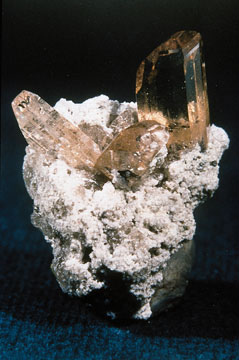


Of course, this means almost nothing, as it can be any color, and, as we are about to see, it means less than nothing. For...

Later in the same article, we read that
The name "topaz" is derived from the Greek topazos, "to seek," which was the name of an island in the Red Sea that was difficult to find and from which a yellow stone (now believed to be a yellowish olivine) was mined in ancient times. In the Middle Ages the name topaz was used to refer to any yellow gemstone, but now the name is only properly applied to the silicate described above.

According to Rebbenu Bachya, the word "Leshem" in the verse Exodus 28:19 means "Topaz" and was the stone on the Ephod representing the tribe of Dan.

In general, someone has added a Rabbenu Bachya identification on many of these minerals. But no mention of a midrash rabba identification. Perhaps something for me to do when I go through all of these.

Anyhow, see that people now identify ancient topaz as a yellowish olivine. Olivine is so named because it has a greenish, olive-like color. So what is this olivine of which the article speaks? Let us see the Wikipedia aricle on Olivine:
The mineral olivine is a magnesium iron silicate with the formula (Mg,Fe)2SiO4 in which the ratio of magnesium and iron varies between the two endmembers of the series: forsterite (Mg-rich) and fayalite (Fe-rich). It gives its name to the group of minerals with a related structure (the olivine group) which includes monticellite and kirschsteinite. Olivine occurs in both mafic and ultramafic igneous rocks, and as a primary mineral in certain metamorphic rocks. It is one of the most common minerals on Earth, and has also been identified on the Moon.
Alas, the article, while it has a picture, does not have one of yellow olivine. And it could be in theory any of these minerals with the related structure.

However, it gets better. From the same article:
Transparent olivine is sometimes used as a gemstone, often called peridot, the French word for olivine. It is also called chrysolite from the Greek words for gold and stone.
So let us look up this transparent olivine, called peridot, in Wikipedia. Because we seem to have found an excellent match. Because peridot, if we eliminate the liquid r, is pidot, perhaps piṭeḏah - פִּטְדָה. Of course, the modern etymology only traces this back to Old French, but perhaps it goes back father than that.

Indeed, it is not transparent, but a yellowish color. In the Wikipedia article on peridot, a type of transparent yellow olivine, we read:
The chemical composition of peridot is (Mg, Fe)2SiO4. Peridot is one of the few gemstones that come in only one color. The depth of green depends on how much iron is contained in the crystal structure, and varies from yellow-green to olive to brownish green. Peridot is also often referred to as "poor man's emerald". Olivine is a very abundant mineral, but gem quality peridot is rather rare. Peridot crystals have been collected from iron-nickel meteorites.
From the same article, we see it was a gemstone used by the Egyptians.
Peridot has been found in Egyptian jewellery from the early second millennium BCE and was mined from the volcanic island of Zebirget, or St. Johns Island, in the Red Sea.
It makes sense that the olivine that was used as a gemstone would be the one in the chosen.

Presumably Chazal, besides quite possibly having a tradition on the matter, knew that what contemporary Greeks were calling topaz was called in other languages something akin to peridot, similar to piteda. Alternatively, this was a tradition that this was piṭeḏah, and the French witness confirms the tradition.

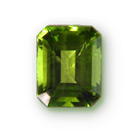
Here are pictures of peridot.
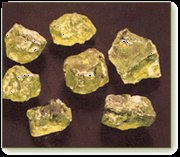


So it is a transparent yellow green, with the green content defined by how much iron is in the crystal structure.

Overall, the JPS's translation of topaz (and Jastrow's same identification) is perhaps misleading, since in modern terminology it identifies aluminum or fluorine silicate, rather than the ancient topaz which seems (if Wikipedia is to be trusted) as being olivine, and particularly peridot, which is a magnesium iron silicate.

Once again, I am an amateur, and I am sure there have been professionals researching this, but to me, at this point, it seems that peridot is the most likely candidate for piṭeḏah.

Update: However, this all depends on when the Midrash was composed. As I note regarding the next stone (bareqet), Shemot Rabba was redacted in 11th to 12th century, though it cites much earlier sources as well. Determining the date of this particular piece of Shemot Rabba not only has impact on how much credence we grant it, but also has an impact on how we identify the stones it named. This is because various names of stones meant different things in ancient times, in the middle ages, and in modern times. If this is a rather ancient midrash, then olivine, and peridot, seem like a good identification. If this midrash was initially composed during the Middle Ages, then it is possible they meant the topaz of the Middle Ages, which, as I mentioned above, was "used to refer to any yellow gemstone." (This is a similar story to the one for bareqet, hyacinth, which in the Middle Ages referred to yellow gemstones from East India, rather than blue sapphire.)

parshat Tetzaveh: Identifying the Stones: ʾoḏem - אֹדֶם

Parshat Tetzaveh includes a description of the choshen, the Kohen's breastplate, and lists the gemstones on each row. What are these stones? Midrash Rabba (among other sources) gives a definition of each one. The problem with any translation is that, since we are not really familiar with the new term, translation just substitutes one meaningless term with another. Midrash Rabba's contemporary definitions seem to be Aramaic transliterations of Greek names, and Jastrow is helpful in giving the Greek equiavalent for each, together with a modern English definition of the Greek term. This is also not much use, if we simply leave it at this stage, since now we have a modern, scientific, English term with which we are not familiar unless we are minerologists. We have just substituted one meaningless term for another. Luckily, with wikipedia, we can actually see properties and pictures of each gem.

In this series, I wish to focus on each gem in turn, as defined in Midrash Rabba. Note that this is an amateur's attempt, and also a first draft.

Shemot 28:17-21:
יז וּמִלֵּאתָ בוֹ מִלֻּאַת אֶבֶן, אַרְבָּעָה טוּרִים אָבֶן: טוּר, אֹדֶם פִּטְדָה וּבָרֶקֶת--הַטּוּר, הָאֶחָד. 17 And thou shalt set in it settings of stones, four rows of stones: a row of carnelian, topaz, and smaragd shall be the first row;
יח וְהַטּוּר, הַשֵּׁנִי--נֹפֶךְ סַפִּיר, וְיָהֲלֹם. 18 and the second row a carbuncle, a sapphire, and an emerald;
יט וְהַטּוּר, הַשְּׁלִישִׁי--לֶשֶׁם שְׁבוֹ, וְאַחְלָמָה. 19 and the third row a jacinth, an agate, and an amethyst;
כ וְהַטּוּר, הָרְבִיעִי--תַּרְשִׁישׁ וְשֹׁהַם, וְיָשְׁפֵה; מְשֻׁבָּצִים זָהָב יִהְיוּ, בְּמִלּוּאֹתָם. 20 and the fourth row a beryl, and an onyx, and a jasper; they shall be inclosed in gold in their settings.
כא וְהָאֲבָנִים תִּהְיֶיןָ עַל-שְׁמֹת בְּנֵי-יִשְׂרָאֵל, שְׁתֵּים עֶשְׂרֵה--עַל-שְׁמֹתָם; פִּתּוּחֵי חוֹתָם, אִישׁ עַל-שְׁמוֹ, תִּהְיֶיןָ, לִשְׁנֵי עָשָׂר שָׁבֶט. 21 And the stones shall be according to the names of the children of Israel, twelve, according to their names; like the engravings of a signet, every one according to his name, they shall be for the twelve tribes.
The first stone one the first row, that of Reuven, is אֹדֶם. The JPS translation above gives carnelian. According to Wikipedia, carnelian is "is a red or reddish-brown variant of chalcedony. The word is derived from the Latin word meaning flesh, in reference to the flesh color sometimes exhibited."

Also from Wikipedia, here is a carnelian seal from the British museum.


As you can see, this seal is flesh-colored. Now, as stated, this is a red/reddish brown variant of chalcadony. What is that? According to Wikipedia, Chalcadony is one of the cryptocrystalline varieties of the mineral quartz, having a waxy luster.

Here is another image of carnelian, from a site that will sell it to you for only $1.50.

That seems to be the definition, according to JPS.

What about Midrash Rabba's definition? According to parasha 29:8:
וכסדר הזה היו נתונים: ראובן שדרגנין

What is sadargenin? According to Jastrow (page 1526), this, and its variant שדרגזין, are a corruption of Greek sardonyx. This appears to be similar to, but not identical with, JPS's definition. From the same page on Wikipedia about = chalcedony, they note that various shades of chalcedony receive different names.
A clear red chalcedony is known as carnelian or sard; a green variety colored by nickel oxide is called chrysoprase. Prase is a dull green and onyx is black and white banded.
Thus, sard + onyx. Perhaps this means a combination of the two (sard and onyx). Onyx, remember, has bands of white and black. Sardonyx has red rather than black bands.

Onyx is a banded variety of chalcedony, a cryptocrystalline form of quartz. The colors of its bands are white and black.

Sardonyx is a variant, where the colored bands are sard, rather than black. Here is an image of sardonyx, from a website called Gem Hut that will sell you it for only $14.99. Useful if you want to construct your own chosen to wear on Purim, with your kohen gadol costume.


Unless of course somehow back then onyx only meant the general mineral, without the bands, in which case sardonyx perhaps meant sard, which according to different articles in wikipedia, seems to either be equal to or somewhat distinct from carnelian. From the article on sard:
The Hebrew odem (translated sardius), the first stone in the High Priest's breastplate, was a red stone, probably sard but perhaps carnelian or red jasper. Some kinds of sard closely resemble carnelian, but are usually rather harder and tougher, with a duller and more hackly fracture.
Perhaps someone should update wikipedia - while they list sard as a possible first stone in the breastplate, and mention carnelian and red jasper as well, they do not mention sardonyx, which is Midrash Rabba's definition.

Note also that sard most likely comes from the Persian word sered, which means yellowish-red, and so it (and sardonyx as well) seems a nice match for ʾoḏem - אֹדֶם, which means "red" in Hebrew.

More stones to follow in subsequent posts.

megillat Esther: Achashverosh's True Identity - A Closed Canon Approach

[spoof]
Boaz, by marrying Rut, merited to be the ancestor of the Davidic line of kings. We know from another midrash that Naomi's two daughters-in-law each merited something different for their actions. Rut 1:14:
יג הֲלָהֵן תְּשַׂבֵּרְנָה, עַד אֲשֶׁר יִגְדָּלוּ, הֲלָהֵן תֵּעָגֵנָה, לְבִלְתִּי הֱיוֹת לְאִישׁ; אַל בְּנֹתַי, כִּי-מַר-לִי מְאֹד מִכֶּם--כִּי-יָצְאָה בִי, יַד-יְהוָה. 13 would ye tarry for them till they were grown? would ye shut yourselves off for them and have no husbands? nay, my daughters; for it grieveth me much for your sakes, for the hand of the LORD is gone forth against me.'
יד וַתִּשֶּׂנָה קוֹלָן, וַתִּבְכֶּינָה עוֹד; וַתִּשַּׁק עָרְפָּה לַחֲמוֹתָהּ, וְרוּת דָּבְקָה בָּהּ. 14 And they lifted up their voice, and wept again; and Orpah kissed her mother-in-law; but Ruth cleaved unto her.
Rut merited to be the ancestress of King David, while Orpah, who kissed her mother-in-law but then left, became the ancestress of David's foe, Goliath.

What then, of Ploni Almoni, A.K.A. Tov, who passed up the chance of marrying Rut?
יג לִינִי הַלַּיְלָה, וְהָיָה בַבֹּקֶר אִם-יִגְאָלֵךְ טוֹב יִגְאָל, וְאִם-לֹא יַחְפֹּץ לְגָאֳלֵךְ וּגְאַלְתִּיךְ אָנֹכִי, חַי-יְהוָה; שִׁכְבִי, עַד-הַבֹּקֶר. 13 Tarry this night, and it shall be in the morning, that if he will perform unto thee the part of a kinsman, well; let him do the kinsman's part; but if he be not willing to do the part of a kinsman to thee, then will I do the part of a kinsman to thee, as the LORD liveth; lie down until the morning.'
It turns out that while Boaz merited to be the ancestor of the King of Israel, King David, his close relative Ploni became the King of Paras and Maday, and is known in the megillah as King Tov. Esther 1:19:
יט אִם-עַל-הַמֶּלֶךְ טוֹב, יֵצֵא דְבַר-מַלְכוּת מִלְּפָנָיו, וְיִכָּתֵב בְּדָתֵי פָרַס-וּמָדַי, וְלֹא יַעֲבוֹר: אֲשֶׁר לֹא-תָבוֹא וַשְׁתִּי, לִפְנֵי הַמֶּלֶךְ אֲחַשְׁוֵרוֹשׁ, וּמַלְכוּתָהּ יִתֵּן הַמֶּלֶךְ, לִרְעוּתָהּ הַטּוֹבָה מִמֶּנָּה. 19 If it please the king, let there go forth a royal commandment from him, and let it be written among the laws of the Persians and the Medes, that it be not altered, that Vashti come no more before king Ahasuerus, and that the king give her royal estate unto another that is better than she.
Esther 3:9:
ט אִם-עַל-הַמֶּלֶךְ טוֹב, יִכָּתֵב לְאַבְּדָם; וַעֲשֶׂרֶת אֲלָפִים כִּכַּר-כֶּסֶף, אֶשְׁקוֹל עַל-יְדֵי עֹשֵׂי הַמְּלָאכָה, לְהָבִיא, אֶל-גִּנְזֵי הַמֶּלֶךְ. 9 If it please the king, let it be written that they be destroyed; and I will pay ten thousand talents of silver into the hands of those that have the charge of the king's business, to bring it into the king's treasuries.'
Esther 5:4:
ג וַיֹּאמֶר לָהּ הַמֶּלֶךְ, מַה-לָּךְ אֶסְתֵּר הַמַּלְכָּה; וּמַה-בַּקָּשָׁתֵךְ עַד-חֲצִי הַמַּלְכוּת, וְיִנָּתֵן לָךְ. 3 Then said the king unto her: 'What wilt thou, queen Esther? for whatever thy request, even to the half of the kingdom, it shall be given thee.'
ד וַתֹּאמֶר אֶסְתֵּר, אִם-עַל-הַמֶּלֶךְ טוֹב--יָבוֹא הַמֶּלֶךְ וְהָמָן הַיּוֹם, אֶל-הַמִּשְׁתֶּה אֲשֶׁר-עָשִׂיתִי לוֹ. 4 And Esther said: 'If it seem good unto the king, let the king and Haman come this day unto the banquet that I have prepared for him.'
Esther 5:8:
ח אִם-מָצָאתִי חֵן בְּעֵינֵי הַמֶּלֶךְ, וְאִם-עַל-הַמֶּלֶךְ טוֹב, לָתֵת אֶת-שְׁאֵלָתִי, וְלַעֲשׂוֹת אֶת-בַּקָּשָׁתִי--יָבוֹא הַמֶּלֶךְ וְהָמָן, אֶל-הַמִּשְׁתֶּה אֲשֶׁר אֶעֱשֶׂה לָהֶם, וּמָחָר אֶעֱשֶׂה, כִּדְבַר הַמֶּלֶךְ. 8 if I have found favour in the sight of the king, and if it please the king to grant my petition, and to perform my request--let the king and Haman come to the banquet that I shall prepare for them, and I will do to-morrow as the king hath said.'
Esther 7:3:
ג וַתַּעַן אֶסְתֵּר הַמַּלְכָּה, וַתֹּאמַר--אִם-מָצָאתִי חֵן בְּעֵינֶיךָ הַמֶּלֶךְ, וְאִם-עַל-הַמֶּלֶךְ טוֹב: תִּנָּתֶן-לִי נַפְשִׁי בִּשְׁאֵלָתִי, וְעַמִּי בְּבַקָּשָׁתִי. 3 Then Esther the queen answered and said: 'If I have found favour in thy sight, O king, and if it please the king, let my life be given me at my petition, and my people at my request;
Esther 8:5:
ה וַתֹּאמֶר אִם-עַל-הַמֶּלֶךְ טוֹב וְאִם-מָצָאתִי חֵן לְפָנָיו, וְכָשֵׁר הַדָּבָר לִפְנֵי הַמֶּלֶךְ, וְטוֹבָה אֲנִי, בְּעֵינָיו--יִכָּתֵב לְהָשִׁיב אֶת-הַסְּפָרִים, מַחֲשֶׁבֶת הָמָן בֶּן-הַמְּדָתָא הָאֲגָגִי, אֲשֶׁר כָּתַב לְאַבֵּד אֶת-הַיְּהוּדִים, אֲשֶׁר בְּכָל-מְדִינוֹת הַמֶּלֶךְ. 5 And she said: 'If it please the king, and if I have found favour in his sight, and the thing seem right before the king, and I be pleasing in his eyes, let it be written to reverse the letters devised by Haman the son of Hammedatha the Agagite, which he wrote to destroy the Jews that are in all the king's provinces;
Esther 9:13:
יג וַתֹּאמֶר אֶסְתֵּר, אִם-עַל-הַמֶּלֶךְ טוֹב--יִנָּתֵן גַּם-מָחָר לַיְּהוּדִים אֲשֶׁר בְּשׁוּשָׁן, לַעֲשׂוֹת כְּדָת הַיּוֹם; וְאֵת עֲשֶׂרֶת בְּנֵי-הָמָן, יִתְלוּ עַל-הָעֵץ. 13 Then said Esther: 'If it please the king, let it be granted to the Jews that are in Shushan to do to-morrow also according unto this day's decree, and let Haman's ten sons be hanged upon the gallows.'
Indeed, at the end (=last pasuk of the megilla), Mordechai acts as a courtier to King Tov on behalf of his fellow Israelites. Esther 10:3:
ג כִּי מָרְדֳּכַי הַיְּהוּדִי, מִשְׁנֶה לַמֶּלֶךְ אֲחַשְׁוֵרוֹשׁ, וְגָדוֹל לַיְּהוּדִים, וְרָצוּי לְרֹב אֶחָיו--דֹּרֵשׁ טוֹב לְעַמּוֹ, וְדֹבֵר שָׁלוֹם לְכָל-זַרְעוֹ.
3 For Mordecai the Jew was next unto king Ahasuerus, and great among the Jews, and accepted of the multitude of his brethren; seeking the good of his people and speaking peace to all his seed.
This answers the difficulty I had last year - understanding why, if Haman and Achashverosh were such anti-Semites, did they instruct to give the spoils to Boaz: (Esther 3:13)
יג וְנִשְׁלוֹחַ סְפָרִים בְּיַד הָרָצִים, אֶל-כָּל-מְדִינוֹת הַמֶּלֶךְ--לְהַשְׁמִיד לַהֲרֹג וּלְאַבֵּד אֶת-כָּל-הַיְּהוּדִים מִנַּעַר וְעַד-זָקֵן טַף וְנָשִׁים בְּיוֹם אֶחָד, בִּשְׁלוֹשָׁה עָשָׂר לְחֹדֶשׁ שְׁנֵים-עָשָׂר הוּא-חֹדֶשׁ אֲדָר; וּשְׁלָלָם, לָבוֹז. 13 And letters were sent by posts into all the king's provinces, to destroy, to slay, and to cause to perish, all Jews, both young and old, little children and women, in one day, even upon the thirteenth day of the twelfth month, which is the month Adar, and to take the spoil of them for a prey.
If Boaz was King Tov's close relative, then this makes perfect sense.
[/spoof]

Thursday, March 09, 2006

posts so far for megillat Esther

A post on Dual Etymology and Esther's Name, as well as the Hidden Miracle As A Theme Present in the Megilla Itself, written as a response to a post by Naomi Chana. I have updated it significantly since then, so it is worth another read.

The Punishment For Vashti the Feminist, and a question of the extent of Haman's anti-Semitism.

to be continued this year...

parshat Tetzaveh/Ki Tisa: Rapprochement of Brothers

In next week's parsha, parashat ki ṯiśśaʾ, we read about the sin of the golden calf. Did this happen before or after the commandments in the current parasha - teṣavveh? This is a matter of dispute, with Ramban assuming the events occurred chronologically in the same order as they are described in the Torah, and others (including Rashi) assuming that in fact the command to build the Mishkan occurred after the sin of the golden calf. This is not impossible, since for many reasons the Torah departs from describing events in strict chronological order, and will instead group events and commandments by topic, theme, etc.. As I have explored elsewhere, this is even more often true when there are bridges between sections with different content. Thus, moving back and forth between narrative section and genealogical sections (what others call J and P, but which we can adopt as differences in context without adopting the theory of multiple authorship), there is often an obvious divergence from absolute chronological order, for narrative purpose. Here, as well, there is a break in the narrative, with Moshe ascending the Mountain to receive the Tablets and staying there 40 days and 40 nights (see Shemot 24:18), with lists of commandments wholly unrelated to the Tablets, and the narrative picks up again with the people reacting to Moshe taking his time on the mountain and therefore wishing to make a golden calf (see Shemot 32:1). There may well be other textual and philosophical reasons for assuming a different order, and this divergence from chronological order may indeed be the best peshat, but this seems a topic worthy of a separate post.

If we accept that the commandment to build the Mishkan occurred after the sin of the golden calf, we can read the commandment to build the Mishkan as a sort of atonement. People donated their gold for the purpose of constructing the golden calf, and now, they are directed to donate their gold towards a worthy task. Furthermore, if the Mishkan command occurs after, then this is a message that the golden calf incident was not one that entirely severed the connection between God and His People, as some have tried to put forth. Besides the fact that we see the relationship continue (and we see that God gives a second set of Tablets), the fact that immediately after the sin God instructs them to make a dwelling place for Him and He will dwell among them shows that He wishes to maintain this close relationship. This seems to be another topic worthy of exploring in greater detail.

Now, Aharon's role, and more specifically, motivation, in the construction of the golden calf is somewhat ambiguous in the text. Even a straightforward reading of the text, he certainly does not appear to be a driving force. Rather, the people gather to him and ask him to take certain actions. A closer reading of the text might reveal even more about Aharon's motivations, and the midrash indeed attempts such a closer reading, which has Aharon taking the steps he takes for the purpose of delaying the people from sinning, perhaps until Moshe descends from Mount Sinai. Why the midrash does this is another interesting question. Some obvious possible answers: (1) because it is historically true and they have this as a tradition; (2) because it engages in apologetics; (3) because there is a general trend in Midrash to take ambiguous characters, shaded in grey, and darken them and their actions in the case of evildoers and lighten them in the case of the righteous; (4) the midrash picks up on macro-level themes and reads ambiguous text in this light; (5) the midrash engages in close reading of the text, giving maximal significance to certain statements, and reads text hyper-literally, in a way that meshes well with the macro-level themes described in (4).

Now, how we may deduce Aharon's specific role and motivation is something worthy of discussion on parshat ki ṯiśśaʾ (that is, in another post). However, the midrash (or at least one midrash) will assume that Aharon was working with lofty intentions, or at least, without criminal intent. At the same time, the midrash understands that the text is ambiguous.

A great midrash in Midrash Rabba, on the current week's parsha (parasha 28:2) exploits this ambiguity (or at least, this is the way I read it -- and I am summarizing it here - so see it inside). That is, the midrash states that while Hashem knew of Aharon's positive intent (to delay the nation until Moshe arrived), Moshe did not, and so distanced himself from his brother, bearing a complaint in his heart against Aharon. Hashem then told him: "Moshe, I know Aharon's intent, that is was for good." One can make the following allegory - the pedagogue of a prince saw the prince with a shovel trying to undermine the foundation of his father's house. The pedagogue told him - do not trouble yourself, I will do it for you. The king found him and told him, "I know your true intent (to delay until found so that the palace would not be undermined - alternatively, so that the prince (=the nation) would not be implicated). By your life! I will not appoint anyone to take care of the palace except you!" Thus Hashem told Moshe that Aharon was to be the only one in charge of all the sacrifices (to Hashem) of the Israelites, as it states (Shemot 28:1):
א וְאַתָּה הַקְרֵב אֵלֶיךָ אֶת-אַהֲרֹן אָחִיךָ וְאֶת-בָּנָיו אִתּוֹ, מִתּוֹךְ בְּנֵי יִשְׂרָאֵל--לְכַהֲנוֹ-לִי: אַהֲרֹן--נָדָב וַאֲבִיהוּא אֶלְעָזָר וְאִיתָמָר, בְּנֵי אַהֲרֹן. 1 And bring thou near unto thee Aaron thy brother, and his sons with him, from among the children of Israel, that they may minister unto Me in the priest's office, even Aaron, Nadab and Abihu, Eleazar and Ithamar, Aaron's sons.
ב וְעָשִׂיתָ בִגְדֵי-קֹדֶשׁ, לְאַהֲרֹן אָחִיךָ, לְכָבוֹד, וּלְתִפְאָרֶת. 2 And thou shalt make holy garments for Aaron thy brother, for splendour and for beauty.
When did he tell him this? By the Mishkan.

// end summary of the midrash.

It should be obvious that this Midrash assumes the command to construct the Mishkan occurs after the sin of the golden calf. Let us see some other interesting aspects of the midrash.

1) As mentioned above, the midrash takes the ambiguity of Aharon's motivation, which is present in the text, and exploits it, such that Moshe does not know of Aharon's lofty intention.

2) On the macro, thematic level, it is clear that Hashem has not distanced himself from Aharon as a result of the sin of the golden calf. Thus, Aharon has either been forgiven, or Hashem understands Aharon's true intent. This is similar to the idea of Hashem's maintaining a relationship with the Israelites, dwelling in a dwelling place among them, even after the sin of the golden calf.

3) Hashem's commanding Moshe to appoint Aharon to such a position has the effect of informing the reader how to understand Aharon's ambiguous role. This translates into Hashem telling Moshe (who knows as much of Aharon's intent as any casual reader, and thus plays the role) that Aharon had lofty intentions.

4) Not only does Hashem thus vindicate Aharon, He appoints him to be in charge of His service, to bring sacrifices to Hashem for the Israelites. This is a statement that even in the (ambiguous) past, Aharon's intent was to serve Hashem, and so no one is trusted for this task more than he (the appointing over palace metaphor).

5) Finally, on the level of close, hyperliteral reading, the pasuk in an instruction to Moshe that there should be rapprochement with his brother. Thus
א וְאַתָּה הַקְרֵב אֵלֶיךָ אֶת-אַהֲרֹן אָחִיךָ וְאֶת-בָּנָיו אִתּוֹ, מִתּוֹךְ בְּנֵי יִשְׂרָאֵל--לְכַהֲנוֹ-לִי: אַהֲרֹן--נָדָב וַאֲבִיהוּא אֶלְעָזָר וְאִיתָמָר, בְּנֵי אַהֲרֹן. 1 And bring thou near unto thee Aaron thy brother, and his sons with him, from among the children of Israel, that they may minister unto Me in the priest's office, even Aaron, Nadab and Abihu, Eleazar and Ithamar, Aaron's sons.
We saw that on the macro-thematic level, the very fact of Aharon's appointment was taken as vindication. Here, within the command to appoint Aharon, we see that Moshe is commanded to bring his brother Aharon near. That means that until this point, Aharon was distant from Moshe, and this is taken as emotional distance. Integrating the close reading into the macro-theme, we see the midrash take this as an instruction that Aharon was not at fault, and so Moshe should draw Aharon near as a brother, once again.

Wednesday, March 08, 2006

parshat Tetzaveh: Yerushalayim - Pretty As A Nymph?

Midrash Rabba on parshat Tetzaveh (parasha 36:1) discusses Tehillim 48:3:

א שִׁיר מִזְמוֹר, לִבְנֵי-קֹרַח. 1 A Song; a Psalm of the sons of Korah.
ב גָּדוֹל ה וּמְהֻלָּל מְאֹד-- בְּעִיר אֱלֹקֵינוּ, הַר-קָדְשׁוֹ. 2 Great is the LORD, and highly to be praised, in the city of our God, His holy mountain,
ג יְפֵה נוֹף, מְשׂוֹשׂ כָּל-הָאָרֶץ:
הַר-צִיּוֹן, יַרְכְּתֵי צָפוֹן; קִרְיַת, מֶלֶךְ רָב.
3 Fair in situation, the joy of the whole earth; {N}
even mount Zion, the uttermost parts of the north, the city of the great King.
And on the words יְפֵה נוֹף מְשׂוֹשׂ כָּל-הָאָרֶץ, the Midrash comments מהו יפה נוף? לשון יוני קורין לכלה נמפי

That is, "how are we to understand יְפֵה נוֹף? In Greek they call a bride a nymph."

So Yerushalayim is compared to a nymph, or to a bride. How so? Maharzu explains that they were joyful in Yerushalayim like a new bride. That explanation is focused on the Hebrew, kallah.

Focusing on the Greek, nymph, I would note that this word נוֹף is connected to יְפֵה, in construct form. The pasuk would then read "beautiful as a nymph."

What is a nymph? Dictionary.com, citing American Heritage Dictionary:
nymph (nmf)
n.
  1. Greek & Roman Mythology. Any of numerous minor deities represented as beautiful maidens inhabiting and sometimes personifying features of nature such as trees, waters, and mountains.
  2. A girl, especially a beautiful one.
  3. The larval form of certain insects, such as silverfish and grasshoppers, usually resembling the adult form but smaller and lacking fully developed wings. Also called nympha.
[Middle English nimphe, from Old French, from Latin nympha, from Greek numph.]
nymphal (nmfl) adj.
So a nymph can be any girl, but especially a beautiful one, related to the beautiful maidens who were minor deities in Greek and Roman mythology.

This would reinforce the idea that the connection is to the beauty of a nymph, rather than to the joy associated with her.

Now, nymph is obviously not exactly the same as a bride, so why does the midrash say that the Greek term for a bride is nymph?

A few possible answers among many:
1) We do not know the full extent of the term nymph as it was used in the days of Chazal (by Chazal or by the Greeks), and in fact nymph can mean bride. (This is the correct answer -- see below.)
2) We do not know the full extent of the term kallah as it was used in the days of Chazal, and in fact kallah can refer to a beautiful maiden. (unlikely)
3) Chazal did not understand the true meaning of nymph (since this is afterall a Greek word), and made the connection between the two because both refer to girls.
4) There is some other word similar in form to nymph to which Chazal refer. (See Chidushei HaRashash below, which substitutes a nun for the mem. But then, see what I got from Jastrow.)

An additional possibility -- they are not stating that nymph = bride, but rather, what Chazal say (literally) is that in Greek they call a bride a nymph.

There is a dispute mentioned in Ketubot 16b-17a about how to praise a bride.
תנו רבנן כיצד מרקדין לפני הכלה בית שמאי אומרים
כלה כמות שהיא ובית הלל אומרים כלה נאה וחסודה

Thus we see that it was customary to praise the bride as being beautiful. This should be obvious even without an halachic source.

(Presumably, during other times, it might be inappropriate for men to discuss the beauty of various women, but here, this is a praise and part of the joy of the wedding.)

Thus, in this context, Greek-speaking people might well call the bride a nymph, as in a young, beautiful woman.

Another interesting point: why is there a yud at the end of נמפי? Phonologically speaking, this is necessary in Hebrew because otherwise, we would have a consanant cluster of mf at the end of a word, both with shevas (which would both be sheva nach, by the way), and the peh would get a dagesh. We would end up with nymp rather than nymph. Additionally, if we look in the Greek, that final vowel is there - numph , so we need not resort to the rules of Hebrew phonology. Note also that we do not know the vowel following the nun, since it is written chaser, so while my vowelized Midrash Rabba had a chirik chaser, it could even match the "u" in numph. This would also correspond better with the Hebrew in the pasuk - נוֹף. However, in Chiddushei HaRashash, the dibbur haMatchil is לשון יוני קורין לכלה נימפי, which would support nymph. Chidushei HaRashash also cites a variant of {in Rosh Hashana 26a} נינפי, with the chirik malei, and with a nun in place of the mem.

Also, how does נוֹף equal nymph? What about the m or n before the p? Well, both m and p are labials (from the group בומפ), pronounced with the lips, and so share a place of articulation. Especially at the end of a word, in a single consonant cluster, the mem can assimilate into the final phei, and thus the words may be pronounced quite similarly.

Do Chazal actually think this is the meaning of the pasuk, on the level of peshat? Perhaps, perhaps not. It depends upon one's particular philosophy of midrash. Perhaps words in Tanach (as in all sorts of literature) resonate with all sorts of possible connotations, and so at some level, נוֹף is meant to call to mind the Greek word.

Update: And this is why one's first stop should be Jastrow. Jastrow (pg 905) connects the word with nymph and notes the variant נינפי, and explains that the word means "bride." He gives several examples of this.
In Targum to Shir HaShirim 4:8:

ח אִתִּי מִלְּבָנוֹן כַּלָּה, אִתִּי מִלְּבָנוֹן תָּבוֹאִי; תָּשׁוּרִי מֵרֹאשׁ אֲמָנָה, מֵרֹאשׁ שְׂנִיר וְחֶרְמוֹן, מִמְּעֹנוֹת אֲרָיוֹת, מֵהַרְרֵי נְמֵרִים. 8 Come with me from Lebanon, my bride, with me from Lebanon; look from the top of Amana, from the top of Senir and Hermon, from the lions' dens, from the mountains of the leopards.
there is נימפי as a translation of כַּלָּה. (Of course, that is deriving a meaning of the translation from our interpretation of the source. Perhaps nymph as we use it is meant there in Shir haShirim as well).

Also, in Bereishit Rabba on the pasuk in Bereishit 30:8:

ז וַתַּהַר עוֹד--וַתֵּלֶד, בִּלְהָה שִׁפְחַת רָחֵל: בֵּן שֵׁנִי, לְיַעֲקֹב. 7 And Bilhah Rachel's handmaid conceived again, and bore Jacob a second son.
ח וַתֹּאמֶר רָחֵל, נַפְתּוּלֵי אֱלֹהִים נִפְתַּלְתִּי עִם-אֲחֹתִי--גַּם-יָכֹלְתִּי; וַתִּקְרָא שְׁמוֹ, נַפְתָּלִי. 8 And Rachel said: 'With mighty wrestlings have I wrestled with my sister, and have prevailed.' And she called his name Naphtali.
the Midrash explains נַפְתּוּלֵי as "I should have been a נימפי before my sister," thus a bride.

Tanchuma on Ki Tisa, in reference to a pasuk three pesukim later in Shir Hashirim

יא נֹפֶת תִּטֹּפְנָה שִׂפְתוֹתַיִךְ, כַּלָּה; דְּבַשׁ וְחָלָב תַּחַת לְשׁוֹנֵךְ, וְרֵיחַ שַׂלְמֹתַיִךְ כְּרֵיחַ לְבָנוֹן.
11 Thy lips, O my bride, drop honey--honey and milk are under thy tongue; and the smell of thy garments is like the smell of Lebanon.
refers to a כלה נופי, beautiful bride (based perhaps on the nofet rather than on the kallah).
And there is a bit there in Jastrow about קלי נינפי in several sources which is entirely Greek, χάλή νύφη, and means "the beautiful bride."

Jastrow also cites the same gemara referred to by Chidushei haRashash, in Rosh haShana 26a:
אמר ר"ש בן לקיש כשהלכתי לתחום קן נשרייא היו קורין לכלה נינפי ולתרנגול שכוי לכלה נינפי מאי קרא (תהילים מח) יפה נוף משוש כל הארץ

Thus Rabbi Shimon ben Lakish notes a dialectal variance, and connects it to this very pasuk, perhaps as a source for the usage.

Aside from the pasuk, as I noted above, the use of nymph to describe a bride may have developed from praise of the bride as a young beauty, or because women typically married when they were at the age when they would be called a nymph.

Update: Or perhaps the usage of nymph to mean kalla comes from similarity of the two words in Greek.

Dictionary.com, citing American Heritage Dictionary:
Cal·lis·to (k-lst)
n.
  1. Greek Mythology. A nymph, beloved of Zeus and hated by Hera. Hera changed her into a bear, and Zeus then placed her in the sky as the constellation Ursa Major.

[Latin, from Greek Kallist, perhaps from kallistos, superlative of kalos, beautiful.]
Thus, we have a nymph who is called kalei, or kalos. And both nymph and kalos refer to beauty. So a speaker of Greek might move nymph to mean bride, just as kallah means bride.

a

Tuesday, March 07, 2006

An Interesting Etymology: Yenta

From dictionary.com, from American Heritage Dictionary

yen·ta
n. Slang
A person, especially a woman, who is meddlesome or gossipy.


[Yiddish yente, back-formation from the woman's name Yente, alteration of Yentl, from Old Italian Gentile, from gentile, amiable, highborn, from Latin gentlis, of the same clan. See gentle.]

Update: One interesting thing I was going to comment on - many of the steps in this etymology are interesting, but the last step, the back formation, is particularly so. The L ending of Yentl was part of the word, coming from Old Italian gentile. However, it was interpreted as the diminutive, a suffix indicating familiarity. Thus, e.g. Yossele. Thus, they took away this pseudo-diminutive to generate Yente -- thus, this is a back formation.

Monday, March 06, 2006

parshat Terumah: tekhelet As Black As Kohl?

In a post last week, on the identification of tekhelet, I noted that Yefet ben Ali the Karaite states that tekhelet is black, and that Ibn Ezra rejects this in favor of Chazal who say that it is yarok (blue, in the "green" family). Then I turned to the Rambam and noted that he also identifies it as black, saying that it is wool dyed like the mixture in kochal {/kechol}, and later states that other blackening dyes are not valid. Kochal would seem to be black, from various sources in the gemara, and that, together with the mention of other dyes which make things black, suggest that he meant black and not dark blue, as some read Rambam. Further, that he says that the wool is dyed like the color mixture in kochal suggests that this is the color of the final product, not just the dye when it sits in a bottle.
Jastrow identifies kochal as stibnite, which was used even in Biblical times as a cosmetic for the eyes. From various sources we know that kochal is black.

Firstly, kohl is a modern cosmetic, an eyeliner, and the color of this seems to be black. This comes from the word kochal/kechol (and the equivalent in Arabic). (Though kohl then becomes a name for eyeliners in general, of any color.) Apparently, in Ancient Egypt:
First they tinged the eyelids green above, and below, then smeared a dark grey powder toward the eyebrows. The final procedure was to outline the eyes with black kohl, making them look larger and longer. Today, black kohl is still used by Bedouin women and the color "black kohl" is a popular eyeliner in any modern department store.
"Black kohl is also a color additive for food, not allowed in the US.

In terms of gemaras:
Chullin 88b speaks of mixing powdered coal (called שחור) and kohl. Chullin 47b} refers to a color which could be either black as kuchla {stibium} or else like ink {perhaps Indian ink}.

(Also, perhaps the expression "black as kohl." Read on.)

Thus, it truly seems that kochal is black, and it is to this black that the Rambam refers.

This brings us to an interesting question. The common expression "black as coal" -- did it originate as "black as coal" or as "black as kohl?" A search on the phrase "black as kohl" in google returns only 78 hits, many of which are simply some person who chose the name "black as kohl." Meanwhile, "black as coal" returns 127,000. Both make sense because both are black. Perhaps "black as kohl" came from a wordplay. Or, perhaps, "black as kohl" was the original, under lectio difficilior - people would chose the more familar "coal" in reinterpreting the expression.

Several of the uses of "black as kohl" occur in fiction. The second hit on google had it in contemporary Arab-American poetry.
It is summer and you are a boy
hunting birds and turning stones,
eyes as bright as the snow as it melts
from the Cedars beneath the summer sky.
Your hair is black as kohl,
your body olive brown,
your cheeks red as the rooftops of Hasroun,
red as the pomegranates your mother
in full burning youth
plucked from the cliffs of Hasroun.
Some examples based in India:
In The Death of Vishnu, used to describe hair color:
The buds would glow creamily in her tresses, black as kohl back then, and he would squeeze the petals between his fingers to release their fragrance and perfume her hair.
In this posting, used to describe night:
After some haggling and a maharajahs ransom, a rickshaw began peddling me to Bhubaneshwar, some 40 miles through a howling, screeching, black as kohl Indian night.
An example of it used to describe the sky in Colorado:
when the sky to the east is black as kohl
On the other hand, coal is certainly used to describe the color black as well. Consider the expression "jet black hair," or "jet hair." Jet is "A dense black coal that takes a high polish and is used for jewelry" and, as an adjective, is defined by the dictionary as "Black as coal."

posts so far for parshat Tetzaveh

Year 0
The Purpose of the Tzitz

Year 1
A Populist Midrash

Friday, March 03, 2006

Rabbi Ovadia Yosef and Rabbi Yochanan

Orthomom takes issue with a specific statement of R' Ovadia Yosef, that anyone who votes Shas will get a place in heaven.

Firstly, I wouldn't necessarily trust the article in YnetNews, because many, many times statements of various rabbinic figures have been taken out of context or misreported by Israeli papers, for the purpose of mocking them or for providing an amusing anecdote. These stories often find their way to "Oddly Enough" news in America, without proper context.

In this case, the context is that since Shas supports various Torah and mitzvot projects, providing support for Shas via a vote makes Shas your emissary, and thus one gets merit, and a share in the reward. He illustrated this with a story of a man let into heaven even though he though he felt he had few personal merits; he had merits because he voted for Shas and thus supported the cause of Torah and mitzvot. To cite the article:
Anyone who votes for religious Sephardic party Shas in the upcoming elections is assured of a place in heaven, the party's spiritual leader Rabbi Ovadia Yosef told about 8,000 activists at a pre-election rally in Tel Aviv Tuesday evening.

Rabbi Ovadia told the enthusiastic listeners about a man who reaches heavens and fears God's verdict. At that point, a white angel appears and tells the man he is heading to heaven for building a mikvah (Jewish ritual bath) and a synagogue. The man says he has not done any of that because he had no money, but later admits he did vote for Shas.

The angel's reply: "Exactly. And by sending emissaries who built mikvahs and synagogues and safeguarded the world of Torah, you're a party to mitvzot and your place is in heaven." Therefore, the rabbi explained, anyone who votes for Shas will end up in heaven.
The article sums up R Ovadia Yosef's position as being that whoever votes for Shas will end up in heaven. But note that the quotation mark ends at end of the previous sentence. This is the article writer's summary.

One can easily understand his remarks as being that one attains merit, and that this merit will go into the calculation when standing before God on Judgement Day, such that one might enter heaven for this, helping outweigh certain sins. Why? Because voting for Shas and thus supporting Torah projects is a meritorious act. But not that voting for Shas automatically allows one into heaven.

And even if he said it, it is possible that he overstated the case for rhetorical effect.

So let us not leap to conclusions. Rather, we should certainly give R Ovadia Yosef the benefit of the doubt, and not blindly accept sensationalist reporting whose purpose it to provide amusement at the expense of the "backward" chareidim.

Anyhow, compare with this statement by Rabbi Yochanan, which we will encounter fairly soon in Daf Yomi, and which will be posted on the Rif blog soon:
And Todus of Rome was a great man. And furthermore, he cast merchandise into the pockets of Torah scholars {=gave them opportunities for trading}.
For Rabbi Yochanan said: Whoever casts merchandise into the pockets of Torah scholars will be privileged to sit in the Heavenly Academy, for it is stated {Kohelet 7:12}:
יב כִּי בְּצֵל הַחָכְמָה, בְּצֵל הַכָּסֶף; וְיִתְרוֹן דַּעַת, הַחָכְמָה תְּחַיֶּה בְעָלֶיהָ 12 For wisdom is a defence, even as money is a defence; but the excellency of knowledge is, that wisdom preserveth the life of him that hath it.

Also, the Rif cites a related source from Ketubot:
We learn at the end of shenei dayanei edut {Ketubot 111b}: It is written {Devarim 4:4}:
ד וְאַתֶּם, הַדְּבֵקִים, בַּה', אֱלֹקֵיכֶם--חַיִּים כֻּלְּכֶם, הַיּוֹם. 4 But ye that did cleave unto the LORD your God are alive every one of you this day.
Now is it possible for a man to cleave to the Divine Presence? Was it not already stated {later in the same perek}:

כד כִּי ה' אֱלֹקֶיךָ, אֵשׁ אֹכְלָה הוּא: אֵל, קַנָּא
24 For the LORD thy God is a devouring fire, a jealous God.
rather, anyone who marries off his daughter to a Torah scholar, and anyone who gives trade to a Torah scholar, and anyone who gives benefit to a Torah scholar from his possessions, Scriptures considers it as if he has cleaved to the Divine Presence.

Thus, in classic Jewish thought, providing support for Torah is considered meritorious, and according to Rabbi Yochanan, assures one a place in the Heavenly Academy. This certainly seems of similar nature to Rabbi Ovadia Yosef's statement.

But I would think that many of the people who would attack R Yosef for this statement, had they lived in the days of the first generation of Amoraim, would also attack Rabbi Yochanan for his statement.

Update: Thanks to Hirhurim and Yeranen Yaakov for the links!

Thursday, March 02, 2006

parshat Terumah: The Identification of tekhelet

Ibn Ezra has an interesting comment on Shemot 25:4:

ד וּתְכֵלֶת וְאַרְגָּמָן וְתוֹלַעַת שָׁנִי, וְשֵׁשׁ וְעִזִּים. 4 and blue, and purple, and scarlet, and fine linen, and goats' hair;
אמר יפת שהוא כדמות שחרות. כי הוא תכלית כל הצבעים. והכל ישובו אליו והוא לא ישוב במעשה אדם לעולם. ואנו נסמוך על רז"ל שהוא ירוק והוא צמר
He cites Yefet, who claims that tekhelet is a type of shachor (black) and gives an derivation for this (please correct me in the comments, since I do not feel entirely comfortable with this translation):
All the other colors end in it, and eventually come to it, but black cannot ever become another color by human action.

Thus, it is perfectly described by the כלה, end, that lies at the root of the word tekhelet.
After citing Yefet, Ibn Ezra writes that we rely upon our Rabbis, of blessed memory, who says that it is yarok (blue being in the "green" family).

This is an interesting comment by Yefet. He comes to an identification of color by (philisophically) reasoning what color is best described by the root. At the heart of this seems to lie an approach to linguistics that natural language is sytematic and regular, such that the meaning of any word can be derived from an analysis of its root. Yet often natural language is not systematic in this way - as words come from other languages, or change in meaning over time as people use it in different ways, etc.

In this instance, it seems particularly ill-advised to derive meaning from such an analysis. Even if the root does mean "end," how do we know that the derivation should be made in this particular manner. I could give similar rationalizations for an identification with red (an association with blood and thus death) or white (absence of dye or color). The explanation seems scientific but it is not. Furthermore, we have a tradition from Chazal. Yefet is a Karaite, so he does not put stock in Chazal, but in this case, it is entirely reasonable to accept the Masorah on this. After all, Chazal saw tekhelet. Even as tekhelet was not in use in the days of the Rishonim, it was in use in the days of Chazal. And it was not just Pharisees who used it, but other groups and nations as well. They are giving testimony of a well-known color in their days. Discarding this testimony in favor of a speculative derivation based on the apparent root makes no sense.

Indeed, we have recently found corroborating evidence to the blueness of tekhelet, at least in the time of Chazal, in the form of tzitzit dyed with fake tekhelet - kala ilan - around the Bar Kochba caves. (And it is the same color, and of similar chemical composition, to murex tekhelet.)

As I noted above, Yefet is Yefet ben Ali, a 10th century Karaite who Ibn Ezra often cites. Thus we can expect him to differ from Chazal in respect to this identification, or at least it is not truly suprising. I would like to see Yefet inside, so if anyone knows of an online text or has access to it, I'd appreciate any help.

What is interesting is that Rambam also identifies tekhelet as black! In Mishneh Torah, in Hilchot Tzitzit 2:1, we read:

א תכלת האמורה בתורה בכל מקום, היא הצמר הצבוע כפתוך שבכוחל; וזו היא דמות הרקיע, הנראית לעין בטוהרו של רקיע. והתכלת האמורה בציצית, צריך שתהא צביעתה צביעה ידועה, שעומדת ביופייה, ולא תשתנה. וכל שלא נצבע באותה הצביעה, פסול לציצית: אף על פי שהוא כעין הרקיע, כגון שצבעו באיסטיס או בשאר המשחירין--הרי זה פסול לציצית. ורחל בת עז, צמרה פסול לציצית.

Thus, he identifies it as a particular shade of black, and notes that other black dyes are not fit for tzitzit.
Tekhelet, he claims, is wool dyed like the mixture in a kochal - stibium. kochal was used as a powder for painting eyelids, and Chazal refer to the blackness of kochal, saying in Chullin 47b that something is as black as kochal.

This certainly reads like Rambam is saying that tekhelet is black. And that Chazal's statement that it is comparable to the sky is that it is comparable to the night (rather than day) sky. Yet apparently (see this post on Maven Yavin by lamedzayin and his response to my comment there),
The Beis Yosef reads the Rambam that way, but most people assume he means a darkish blue and just that the ink itself is black, not the final dyed product.
I find this reading difficult. kochal seems to be black. Now, Jastrow translates kochal as stibium, and according to Webster's, stibium is either the chemical name for antimony (which is whitish blue, and not black), or in archaic usage, stibium is stibnite, the natural sulfide of antimony, which is a mineral which is steel-gray to dull-gray. Follow the link to see a picture. The latter seems more likely. And as the wikipedia article on antimony states, it is stibnite, and not antimony, which known as Biblical times and was used as a medicine and a cosmetic. So it stands to reason that kochal is exactly this - stibnite (Sb2S3).

As I said, kochal seems to be black, not darkish blue, and the Rambam explicitly states that the wool is dyed black, so it is difficult to see how one can say it is the ink and not the dyed product which looks like kochal. I won't rule out alternate readings but I would need some compelling proof before accepting one of these alternate readings.

Presumably, what influenced these alternate readings is the difficulty the contradiction between the Rambam's words and the various statements of Chazal that suggest that it is yarok. Thus, there are attempts at harmonization.

However, now that we see that there were people contemporary to Rambam (Karaites) who held that it was black and not blue, and those who recognized that this was a dispute with Chazal's identification, we should expect for Rambam to be extremely clear if he talks of it as black. He should say that it is the dye, not the wool, that is black, or should mention yarok somewhere.

No, what seems to be happening is that Rambam is actually adopting the modern (for his day) "scientific" and philosophical identification of tekhelet and rereading Chazal (in terms of the midrash about being similar to the rakia) so that they agree with this modern definition. And since this is a definition with no basis except a shaky Karaitic linguistic argument, we should pay it no heed in terms of considering this Rambam to be an impediment to recognizing genuine tekhelet - the murex stuff.

Update: On the other hand, Rambam does not identify this as the color of kochal, but rather at the pitukh which is in kochal. Now, pitukh is a mixture, an 'eruv or meziga. Now, we know that powedered coal was mixed with stibium (see Chullin 88b), so that, together with references to "other blackening agents," strongly suggests black. Perhaps, though, one might say that it refers to the "tarnish" on stibnite. According to wikipedia, the color of stibnite:
Steel gray to dull gray. Black iridiscent tarnish may be present.
So once again we would have black.

parshat Terumah: The Identification of 'izzim

Parshat Terumah begins {Shemot 25:1-8}:

א וַיְדַבֵּר ה, אֶל-מֹשֶׁה לֵּאמֹר. 1 And the LORD spoke unto Moses, saying:
ב דַּבֵּר אֶל-בְּנֵי יִשְׂרָאֵל, וְיִקְחוּ-לִי תְּרוּמָה: מֵאֵת כָּל-אִישׁ אֲשֶׁר יִדְּבֶנּוּ לִבּוֹ, תִּקְחוּ אֶת-תְּרוּמָתִי. 2 'Speak unto the children of Israel, that they take for Me an offering; of every man whose heart maketh him willing ye shall take My offering.
ג וְזֹאת, הַתְּרוּמָה, אֲשֶׁר תִּקְחוּ, מֵאִתָּם: זָהָב וָכֶסֶף, וּנְחֹשֶׁת. 3 And this is the offering which ye shall take of them: gold, and silver, and brass;
ד וּתְכֵלֶת וְאַרְגָּמָן וְתוֹלַעַת שָׁנִי, וְשֵׁשׁ וְעִזִּים. 4 and blue, and purple, and scarlet, and fine linen, and goats' hair;
ה וְעֹרֹת אֵילִם מְאָדָּמִים וְעֹרֹת תְּחָשִׁים, וַעֲצֵי שִׁטִּים. 5 and rams' skins dyed red, and sealskins, and acacia-wood;
ו שֶׁמֶן, לַמָּאֹר; בְּשָׂמִים לְשֶׁמֶן הַמִּשְׁחָה, וְלִקְטֹרֶת הַסַּמִּים. 6 oil for the light, spices for the anointing oil, and for the sweet incense;
ז אַבְנֵי-שֹׁהַם, וְאַבְנֵי מִלֻּאִים, לָאֵפֹד, וְלַחֹשֶׁן. 7 onyx stones, and stones to be set, for the ephod, and for the breastplate.
ח וְעָשׂוּ לִי, מִקְדָּשׁ; וְשָׁכַנְתִּי, בְּתוֹכָם. 8 And let them make Me a sanctuary, that I may dwell among them.
The JPS translation identifies עִזִּים as "goats' hair." Similarly, Onkelos and Tg. Yonatan say וּמַעְזֵי. Onkelos' translation of the full pasuk: וְתַכְלָא וְאַרְגְּוָנָא וּצְבַע זְהוֹרִי, וּבוּץ וּמַעְזֵי. And so translater Rashi and Ibn Ezrea. Yet literally, it seems to mean goats. So why not say that one of the donations was goats? Or perhaps goat skins?

The answer is that peshat is not the hyper-literal reading (for that is usually derash), but rather the simplest meaning that fits in context, and here, the context makes clear the meaning of עִזִּים.

How can עִזִּים mean goats' hair on the level of peshat? This seems to be an example of synecdoche, in which the whole stands in for the part (example: "the law" used to refer to a police officer). This is a usual feature of natural language, so we should not insist that עִזִּים refer to whole goats.

Why should it not mean goat skins? The answer is context. Consider each pasuk:

ג וְזֹאת, הַתְּרוּמָה, אֲשֶׁר תִּקְחוּ, מֵאִתָּם: זָהָב וָכֶסֶף, וּנְחֹשֶׁת. 3 And this is the offering which ye shall take of them: gold, and silver, and brass;
Thus, pasuk 3 speaks of metals.
ד וּתְכֵלֶת וְאַרְגָּמָן וְתוֹלַעַת שָׁנִי, וְשֵׁשׁ וְעִזִּים. 4 and blue, and purple, and scarlet, and fine linen, and goats' hair;
Pasuk 4 seems to speak of dyes, or as many understand it, dyed cloth. Thus tekhelet is wool which is dyed blue, and similarly for argaman and tola'at shani. shesh refers to fine linen, or white linen (see e.g. Jastrow). Thus, וְעִזִּים should refer to a cloth-like substance that that could be dyed. It is unlikely that it refers to whole goats, which we should expect to be listed among sacrifices, or among cows and sheep.
ה וְעֹרֹת אֵילִם מְאָדָּמִים וְעֹרֹת תְּחָשִׁים, וַעֲצֵי שִׁטִּים. 5 and rams' skins dyed red, and sealskins, and acacia-wood;
Here in pasuk 5 we have animals skins and wood. Could עִזִּים in pasuk 4 also be goat skins? Perhaps, but we should then expect it in pasuk 5. Furthermore, when animal skins are meant, the word עֹרֹת is overt, as in the case of rams and techashim.

Thus, goats' hair makes the most sense in context.

Another possibility, which might or might not necessitate a revocalization: עז, 'az, in the context of colors, can mean bright or intense (again, see Jastrow). Given that all the other elements in the pasuk are colors, or dyes or cloths of various colors, perhaps וְעִזִּים in the pasuk means other sundry bright and intense dyes and dyed cloth.

Tuesday, February 28, 2006

I've Not Posted Much Lately

As usual, I've been busy, but recently I've been even busier that usual. I started teaching a class at Lander College and another at Queens. I've been teaching myself PHP, and have been working on a machine transliteration problem (perhaps more on this in some later post). I'm also taking a lingustics course at CUNY.

In addition to the many other papers I owe for Revel, I owe a paper for Shir HaShirim. I'm in the middle of reworking the Shir haShirim Frustrated Lovers post from a while back.

I hope to increase blogging as I get acclimated.

parshat Terumah: The Mishkan Reflecting A Changed Relationship With Hashem

Two midrashim in Midrash Rabba really resonated with me this week. The first was a twist on the popular rereading of Torah Tziva Lanu Moshe, from Devarim 33:4:
ד תּוֹרָה צִוָּה-לָנוּ, מֹשֶׁה: מוֹרָשָׁה, קְהִלַּת יַעֲקֹב. 4 Moses commanded us a law, an inheritance of the congregation of Jacob.
(While on the topic of this pasuk, I should mention that Meir likes the song and known how to fill in the words "Moshe" and "Yaakov" at the appropriate points.)

The famous midrash is "read not מוֹרָשָׁה but rather מְאֹרָסָה -- betrothed." This teaches that the Torah is an arusa to Israel, as it states in Hoshea 2:21:
כא וְאֵרַשְׂתִּיךְ לִי, לְעוֹלָם; וְאֵרַשְׂתִּיךְ לִי בְּצֶדֶק וּבְמִשְׁפָּט, וּבְחֶסֶד וּבְרַחֲמִים. 21 And I will betroth thee unto Me for ever; yea, I will betroth thee unto Me in righteousness, and in justice, and in lovingkindness, and in compassion.
we see in many places the God-Israel relationship described as that of lovers, or a betrothed couple, or a married couple.

The twist in this specific midrash is the role the mishkan plays in this. The God-Israel relationship, before the giving of the Torah, was one of a betrothed couple. In such an instance, when the chatan wishes to visit the kallah, he must visit her in her father's house. Thus, in Shemot 19:3:
ג וּמֹשֶׁה עָלָה, אֶל-הָאֱלֹהִים; וַיִּקְרָא אֵלָיו יְהוָה, מִן-הָהָר לֵאמֹר, כֹּה תֹאמַר לְבֵית יַעֲקֹב, וְתַגֵּיד לִבְנֵי יִשְׂרָאֵל. 3 And Moses went up unto God, and the LORD called unto him out of the mountain, saying: 'Thus shalt thou say to the house of Jacob, and tell the children of Israel:
But matan Torah was nisuin, so now the couple is married. The chatan no longer needs to enter his father-in-law's house to visit his beloved. Rather, she lived with him. Thus, after matan Torah, we see in the beginning of parshat Terumah {Shemot 25:8}:
ח וְעָשׂוּ לִי, מִקְדָּשׁ; וְשָׁכַנְתִּי, בְּתוֹכָם. 8 And let them make Me a sanctuary, that I may dwell among them.
Thus, the Mishkan reflect the changed, deeper, nature of the relationship between God and Israel.

I don't have anything to add to the content of this midrash. It speaks for itself.

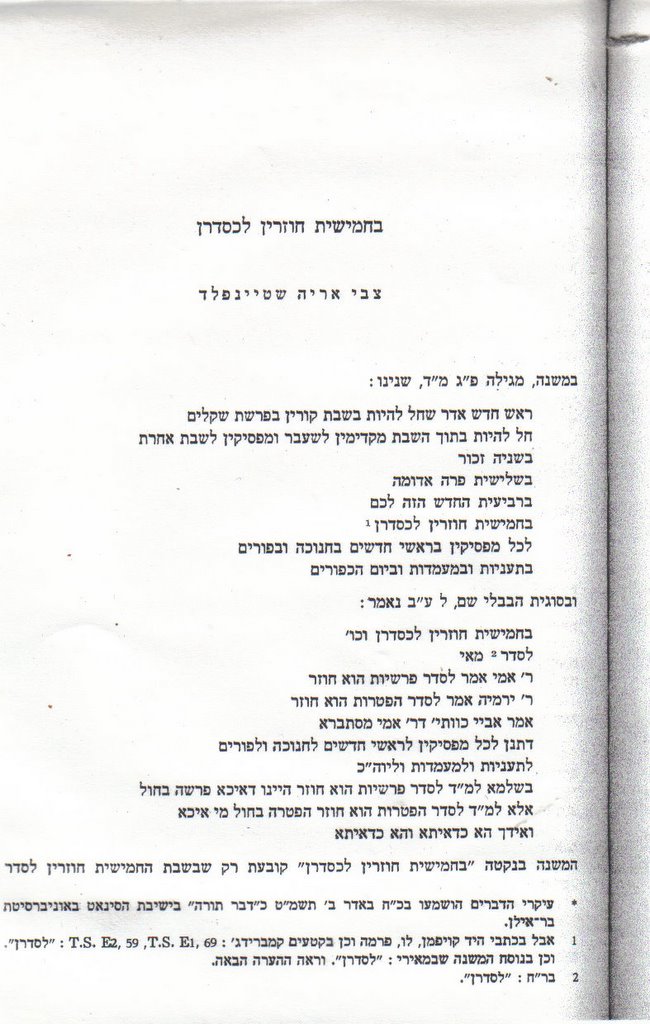
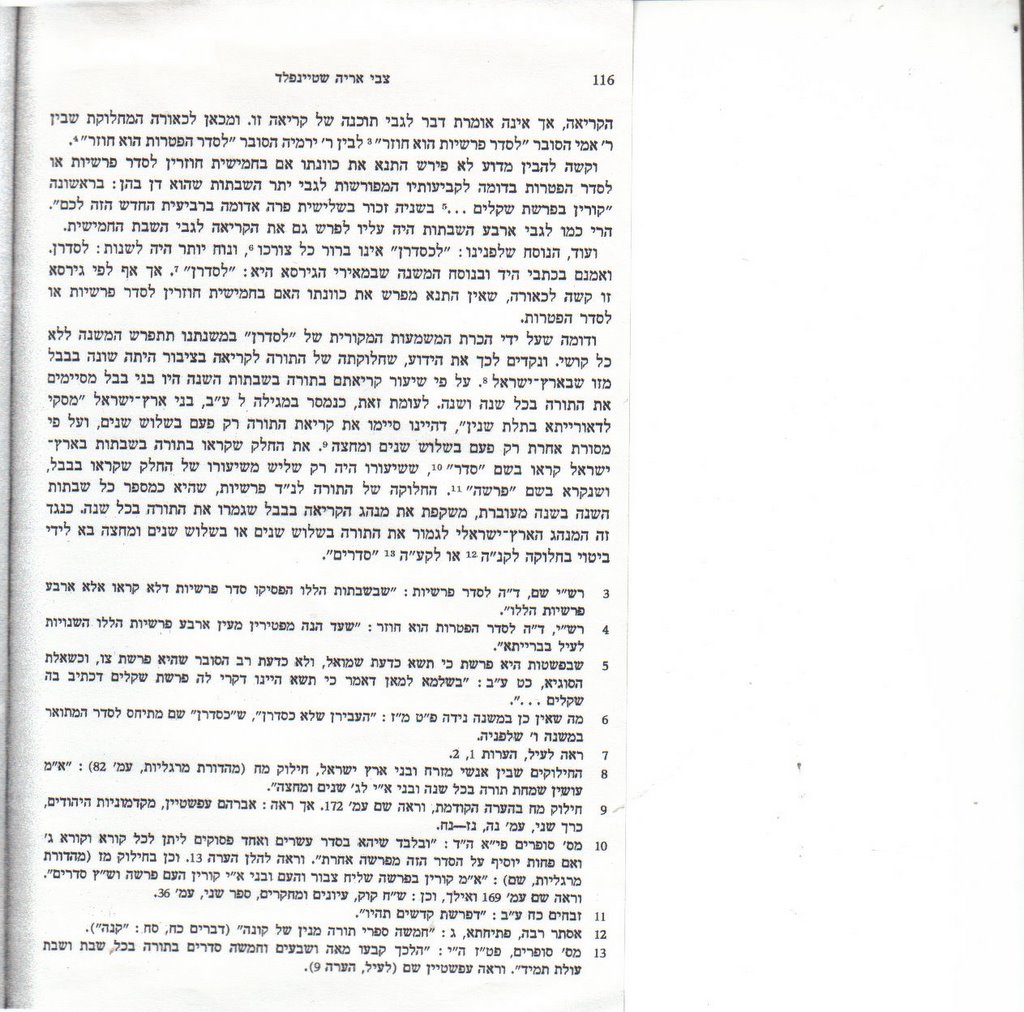
Sidra vs. Parsha - The Article

I discovered Dr. Steinfeld's article I mentioned (about sidra vs. parasha). It was sitting on a shelf, in a stack of other articles. Here are scans. Click on an image to zoom in.


Sunday, February 19, 2006

Posts so far for parshat Mishpatim

Year 1 (2004)
  1. HaAm = Ziknei HaAm as synecdoche
  2. Ayin Tachat Ayin as metaphor
  3. From parshat Behar-Bechukotai, a discussion of serving LeOlam/until Yovel for the perpetual servant mentioned in the beginning of Mishpatim.
  4. from parshat Ki Teitzei, Eshet Yefat To`ar As Progressive Feminist Legislation, where in the course of discussion, I compare it to Amah Ivriya, the Hebrew maidservant, mentioned in the beginning of Mishpatim.
Year 2 (2005)
  1. Twice Betrayed: A Case Study in Multivalence - part 1
  2. Implementing Biblical Law in Florida
to be continued...

Saturday, February 18, 2006

Must read article about the Danish cartoons

by the guy who published the cartoons. "Why I Published Those Cartoons." It is a must read, from start to finish (and it spans two web pages), regardless of your particular take on the the cartoons.

One point, among many, of note:
One cartoon -- depicting the prophet with a bomb in his turban -- has drawn the harshest criticism. Angry voices claim the cartoon is saying that the prophet is a terrorist or that every Muslim is a terrorist. I read it differently: Some individuals have taken the religion of Islam hostage by committing terrorist acts in the name of the prophet. They are the ones who have given the religion a bad name. The cartoon also plays into the fairy tale about Aladdin and the orange that fell into his turban and made his fortune. This suggests that the bomb comes from the outside world and is not an inherent characteristic of the prophet.
Read it here, in the Washington Post.

LinkWithin

Blog Widget by LinkWithin